By Rodger Morrow, Editor & Publisher, Beaver County Business
Listen to a podcast discussion about this article.
Beaver County has always had an audience problem.
Not a shortage of people to fill the seats, mind you, but a tendency to sit there with arms folded, waiting for the show to prove it’s worth the nickel. That skeptical streak didn’t stop us from building theaters anyway. By the turn of the 20th century, nearly every town with a mill had a marquee—and if you squinted hard enough through the smoke, you could almost imagine you were on Broadway. A very small Broadway, with more soot and fewer chorus girls.
Pittsburgh’s Ripple Effect
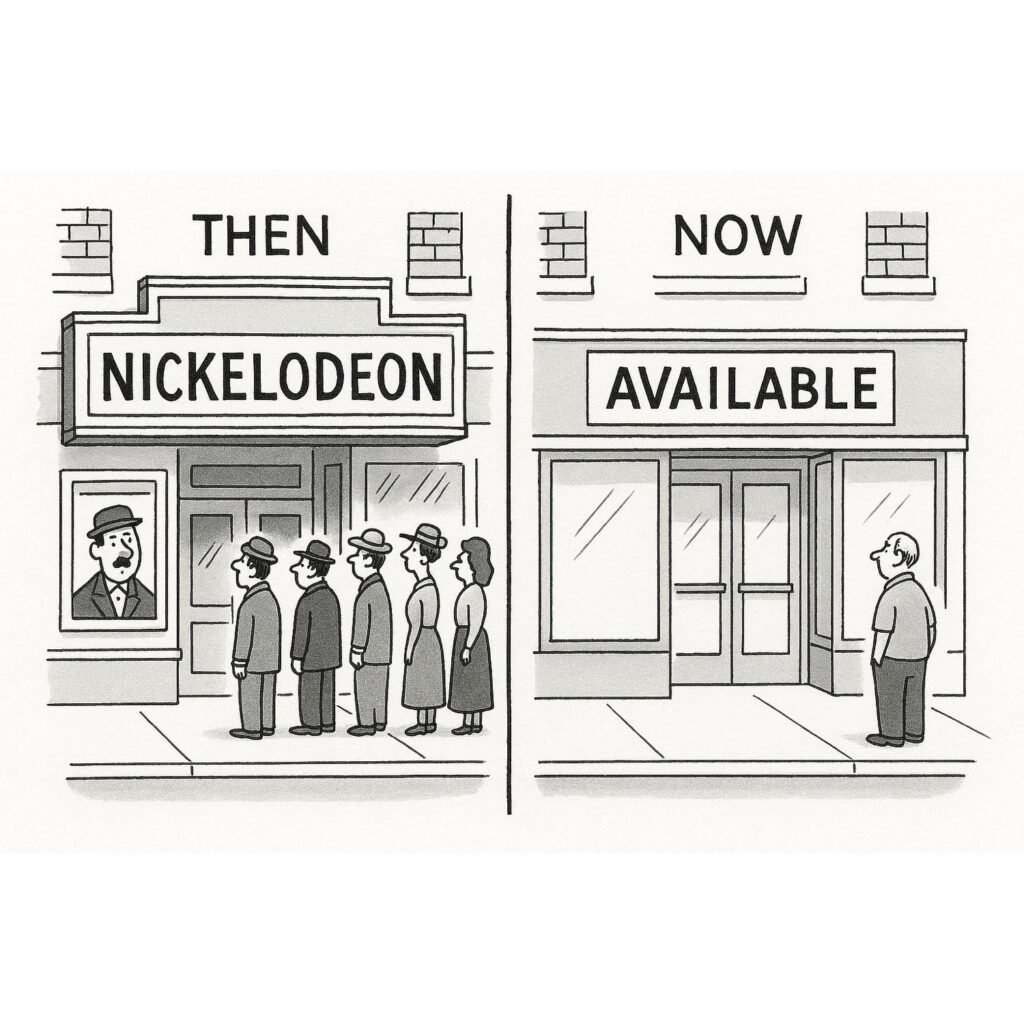
The first venue to call itself a “Vitascope Hall” actually opened in New Orleans in July 1896—an early experiment in charging customers to watch moving pictures. But Pittsburgh made its own mark when the world’s first Nickelodeon opened on Smithfield Street in 1905. From there, the idea drifted down the river. Beaver Falls, Aliquippa, Ambridge, Rochester— soon each had its own nickelodeon. By the 1920s, the Strand in Rochester and the Granada in Beaver Falls were beckoning locals with velvet seats, chandeliers, and promises of Hollywood glamour. The closest thing we had to red carpet was whatever the street sweepers hadn’t gotten to yet.
Steel, Glass, and Popcorn
While no Beaver County factory can claim to have invented the movie camera, our mills and shops helped the pictures roll. Steel for projector housings, glass for lenses, wiring from Westinghouse—all the industrial odds and ends that kept the reels spinning and the bulbs from burning out too quickly. In this way, Beaver County played the role of supporting actor: never top billing, but always dependable when the leading man needed his cues.
Stagehands, Projectionists, and Millworkers
Theaters don’t run themselves, despite what Hollywood montages suggest. Many a Beaver County resident earned extra cash as a projectionist or stagehand, often commuting to Pittsburgh for training before bringing the know-how back home. Millworkers could put in a shift pouring steel, then dash downtown to watch Charlie Chaplin take a pratfall that looked suspiciously like their own. Movies were one of the first things that allowed everyone—from Ambridge’s bridge builders to Beaver’s professionals—to laugh at the same gag the same week. That’s what you call cultural unity, even if you had to brush coal dust off your lapels before entering the theater.
Palaces and Peg Legs
The county’s theaters were nothing if not versatile. The Sixth Avenue Theater in Beaver Falls managed to host everything from skating sessions to six-day bicycle races before settling down into a respectable movie house. It was also home to the annual “Peg Leg Ball,” a social highlight that proves you didn’t need two good legs to dance, only good humor and maybe a pint. By the mid-20th century, the more ornate houses like Aliquippa’s State Theater were screening Hollywood hits beneath chandeliers that could have paid for a shift foreman’s annual wages.
Fade to Black (and Back Again)
Television, suburban flight, and the slow unwinding of the steel mills dimmed many of those marquees by the 1960s and ’70s. The Savoy and Lyceum in Beaver Falls went dark; the Strand in Rochester became a memory; even Aliquippa’s grand State Theater fell silent. Yet the urge to perform is stubborn. Community groups like R-ACT in Rochester and the Bobcat Players in Beaver Falls still mount productions, and Lincoln Park Performing Arts Center in Midland gives local teenagers the chance to belt out Broadway show tunes without ever leaving the valley.
Coming Attractions: Beaver County on Camera
Just when you thought we’d only been fading into archival projects, Hollywood remembered that Beaver County still exists. A Man Called Otto (2022)—the Tom Hanks remake of A Man Called Ove—filmed scenes in Ambridge, including at Stangl’s Bakery. I Am Number Four (2010) managed to drop aliens into Homewood and Buttermilk Falls. Out of the Furnace (2013) gave Raccoon Creek State Park and a Koppel mill their gritty close-ups. And while there are reports that One for the Money (2012) may have used Ambridge locations, the details are hazy enough that even the camera operators might plead the Fifth. None of these productions will be mistaken for Gone with the Wind, but they do prove that Beaver County hasn’t entirely exited stage left.
Curtain Call
So no, Beaver County wasn’t Hollywood on the Ohio. We didn’t invent the movies, and Cecil B. DeMille never came calling. But we did our part: we built the theaters, supplied the parts, trained the projectionists, and most importantly, showed up. And now, camera crews turn their lenses on us—if only briefly, and often quietly—because no matter how small the role, Beaver County still knows how to be seen. And if the floor was a little sticky with spilled pop and the projector occasionally jammed? Well, that was part of the charm. In Beaver County, even the silver screen comes with a touch of rust.
Recent Films Shot in Beaver County
- One for the Money (2012) – Possibly filmed in Ambridge; location details unconfirmed
- A Man Called Otto (2022) – Ambridge (Stangl’s Bakery)
- Out of the Furnace (2013) – Raccoon Creek State Park; Koppel mill scene
- I Am Number Four (2010) – Homewood; Buttermilk Falls (Monaca)