By Rodger Morrow, Editor & Publisher
Beaver County Business
Listen to a podcast discussion about this article.
Beaver Falls in 1889
Beaver Falls in 1889 was not a town for the delicate. The river grumbled, the mills smoked, and shirts on the line came back dirtier than when they were hung. It was here, on College Hill next to Geneva’s “walls old and hoary,” that Thomas Midgley Jr. was born. His father tinkered with tires, his grandfather with saws, and young Tom seemed destined to fiddle with the machinery of modern life.
The family decamped to Columbus, Ohio, in 1903 but Beaver Falls clung to him like mill soot. Geneva’s halls of scripture and Greek, alas, were not for young Tom; by 1911 he was off to Cornell, collecting a mechanical engineering degree and a bride, Carrie Reynolds.
The Knock Heard ’Round the Engine
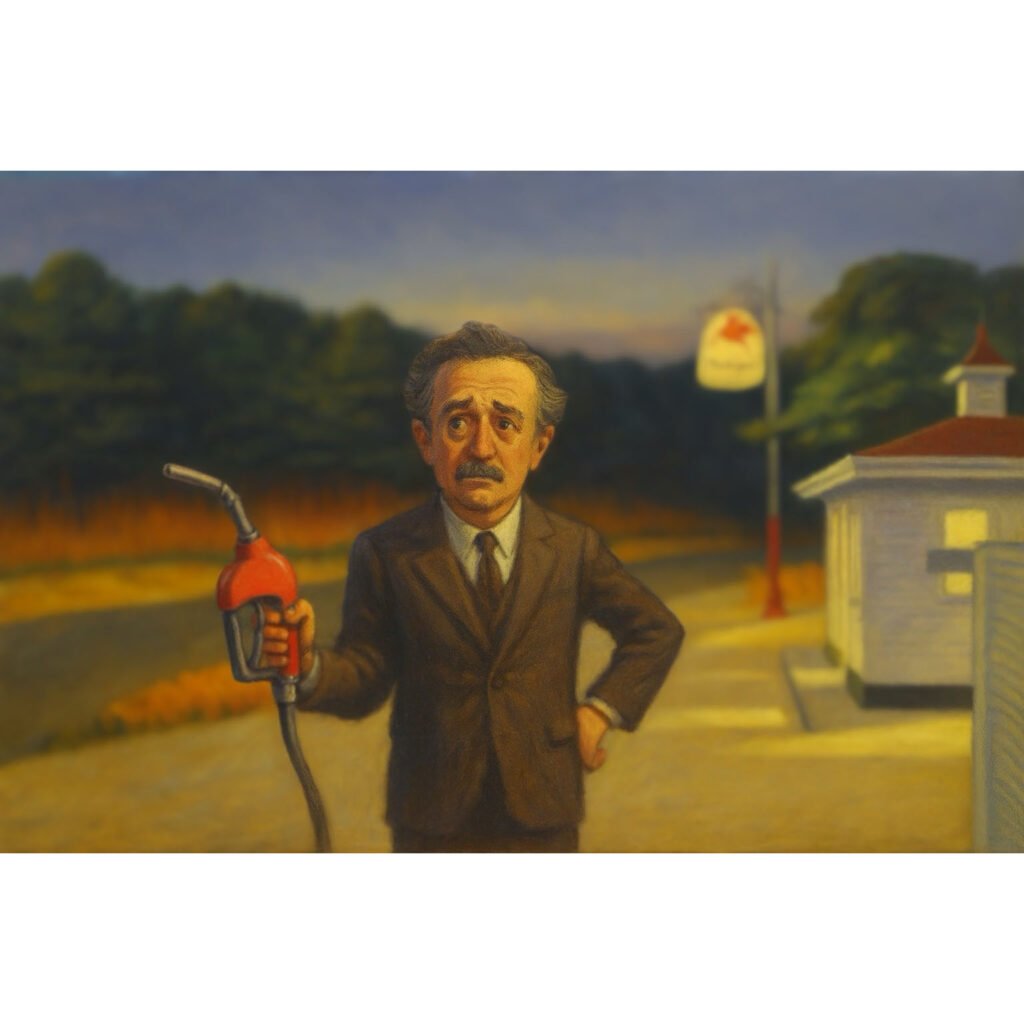
At General Motors in Dayton, under Charles Kettering, Midgley set about silencing the infernal “knock” of early car engines. He tried iodine. He tried hope. Neither worked. Then in 1921, tetraethyllead did. The engines purred, America cheered, and the Ethyl Gasoline Corporation was born. The American Chemical Society handed him the Nichols Medal in 1923, though he accepted while recovering from lead poisoning. Back in Beaver Falls, locals might have chuckled: the hometown boy solved the rattle but poisoned himself doing it.
Cooling the Kitchen
Not content, Midgley and Albert Leon Henne produced Freon, the miracle gas that made refrigerators safe, replacing deadly ammonia. It made modern kitchens possible and won Midgley a string of medals—the Perkin, the Priestley, the Willard Gibbs. By the 1940s, he was president of the American Chemical Society, a member of the National Academy of Sciences, and the proud owner of more than a hundred patents. Geneva’s scholars parsing scripture must have wondered how the Beaver Falls kid had gone so far astray—and so high.
Trouble in the Air
Every invention has its shadow. Leaded gasoline fogged the air and left a trail of brain damage. Freon, once the cool savior, turned out to nibble away at the ozone. By the time the Montreal Protocol banned CFCs in 1987, Midgley was long gone, but his legacy was under cross-examination. One historian called him “the single organism to have most affected the atmosphere.” Beaver Falls had given the world both the cure and the disease.
A Fatal Contraption
Polio struck Midgley in 1940, leaving him crippled but still inventive. He built a system of pulleys to move himself around. On November 2, 1944, the ropes entangled him, ending his life in an accident the coroner labeled suicide. Fate’s final joke: undone not by rivals, but by his own device.
The Beaver Falls Lesson
So here’s to Thomas Midgley Jr.—not Geneva’s preacher but Beaver Falls’ mechanic-in-chief. He gave us smooth engines and safe refrigerators, but also clouds of lead and holes in the sky. His story, like the river that runs through his hometown, is both proud and cautionary: Genius can light the world—or choke it—depending on how you handle it.
Midgley’s Life: A Roadmap
- 1889 – Born in Beaver Falls, Pennsylvania
- 1911 – Graduates from Cornell University; marries Carrie Reynolds
- 1921 – Discovers tetraethyllead, the anti-knock additive
- 1923 – Awarded the Nichols Medal; suffers lead poisoning
- 1924 – Ethyl Gasoline Corporation founded
- 1930 – Develops Freon with Albert Leon Henne
- 1937 – Wins Perkin Medal
- 1941 – Wins Priestley Medal
- 1942 – Wins Willard Gibbs Medal
- 1940s – Serves as president of the American Chemical Society; elected to National Academy of Sciences
- 1940 – Stricken with polio
- 1944 – Dies in Ohio at age 55, entangled in pulley system