By Rodger Morrow, Beaver County Business Editor & Publisher
Listen to a podcast discussion about this article.
The Legacy of Alfred D. Chandler Jr.
When Alfred D. Chandler Jr. died in 2007, it wasn’t front-page news. Business historians rarely get obituaries in The Wall Street Journal. But Chandler’s influence still hangs over every quarterly earnings call and every merger announcement that drops at 4:59 p.m. on a Friday.
Chandler was the man who gave American business its grand unifying theory. He argued that, in the industrial age, the “visible hand” of professional managers replaced the “invisible hand” of Adam Smith’s market. Once technology—railroads, telegraphs, telephones—made it possible to coordinate production and distribution over vast distances, the old model of independent merchants buying and selling in open competition gave way to something much larger, colder, and far more efficient: the managerial enterprise.
In Chandler’s telling, the railroads came first, the great trusts followed, and before long the nation was being run by men who didn’t own the companies they managed. Scale demanded hierarchy. The economy of small shopkeepers and tinkers yielded to one of departments, divisions, and vice presidents with pensions.

Beaver County as Case Study
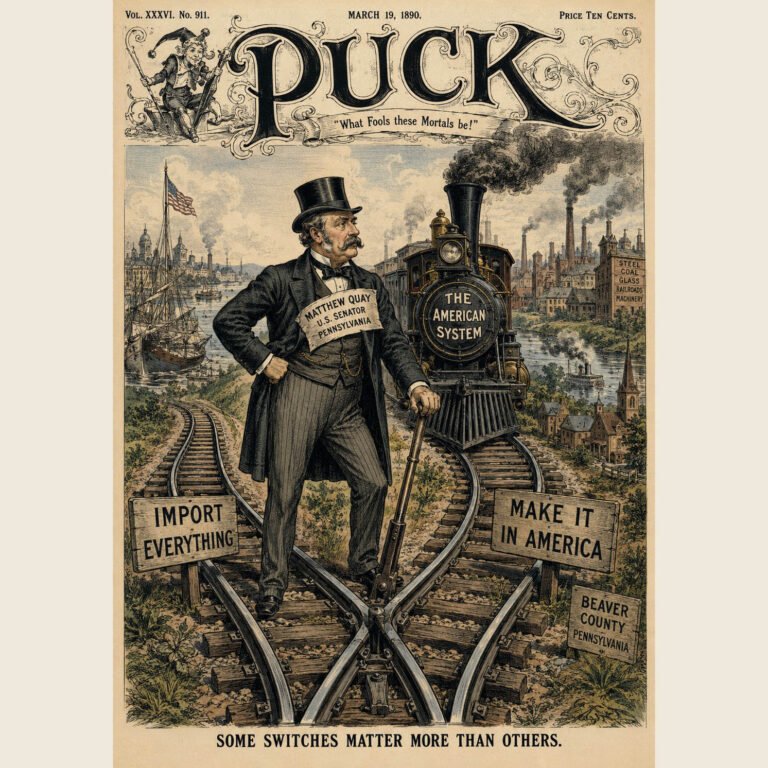
If you want to see Chandler’s theory in brick and smoke, look no further than Beaver County. Here, Jones & Laughlin built one of the largest fully integrated steel complexes in the world—a seven-mile industrial organism stretching along the Ohio River between Aliquippa and Monaca. Constructed between 1905 and 1909, the Aliquippa Works became a self-contained empire of furnaces, rail yards, power stations, and neighborhoods. Every ton of ore, every ingot, every railroad car was part of a tightly choreographed system. Chandler would have smiled.
This was “the visible hand” in action: not a metaphor but a literal one—the strong hand of the foreman, the dispatcher, the engineer. The plant was its own universe—schools, stores, even a hospital—designed to produce not just steel but stability. Efficiency through organization. Profit through planning.
Later, when J&L merged into LTV and eventually disappeared into the footnotes of global steel, another local name rose to prominence: Michael Baker Jr., civil engineer, entrepreneur, and visionary in a bow tie. He didn’t start in a skyscraper or a factory but in Room 122 of the old Penn-Beaver Hotel in Rochester, a modest suite that doubled as his first office. From that room, he began surveying roads when most of Beaver County was still gravel. By mid-century, his firm was designing the Parkway East, then airports, then entire infrastructure systems from the Trans-Alaska Pipeline to highways in Saudi Arabia.
If J&L represented the industrial “visible hand,” Baker embodied its managerial offspring—the knowledge firm that could export Beaver County expertise to the world. Chandler would have seen in him the natural progression from factory floor to planning floor: same discipline, less soot.
From Steel to Silicon and Back Again
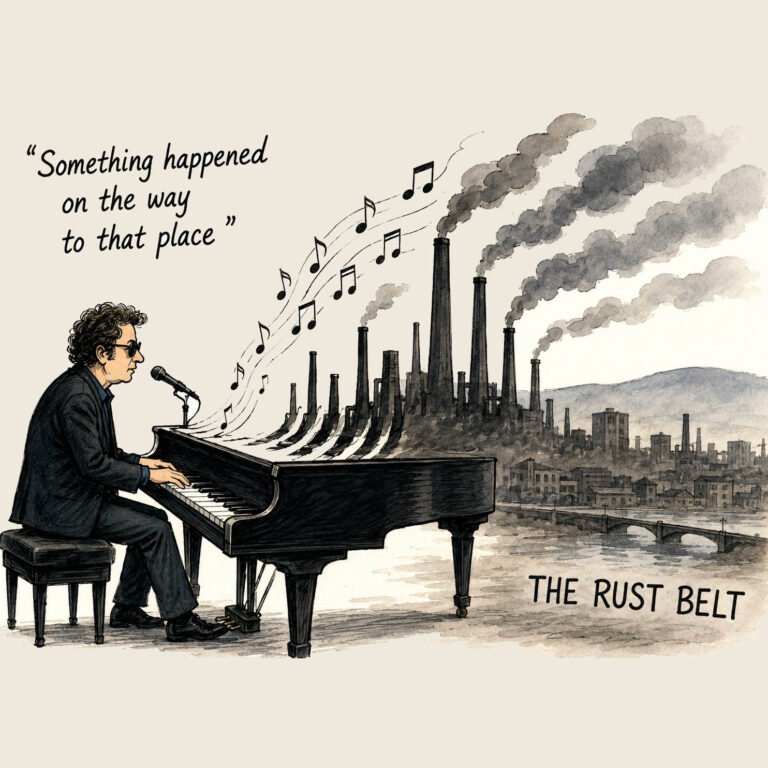
Then came deindustrialization, a word that never quite captures the sound of silence when a mill stops running. By the 1980s, the visible hand had let go, and the invisible one wasn’t catching us. Chandler’s model of the big integrated enterprise had reached its limit. The very structures that had once made American business so powerful—huge bureaucracies, multilevel management, lifetime employment—were now its burden.
But technology abhors a vacuum, and capitalism, like nature, never stays empty for long. The digital revolution promised something new—or at least, new packaging. No more managers! No more middlemen! Just frictionless markets where anyone could sell anything to anyone at the speed of light.
Then just two years after Chandler’s death, Chris Anderson, chronicler of Wired-era optimism, dropped his book Free: The Future of a Radical Price. His thesis was simple: in the digital realm, the marginal cost of producing one more unit—one more download, one more copy, one more “like”—is effectively zero. Give the product away, and make money on the add-ons: the ads, the data, the “premium experience.”
If Chandler’s world ran on the logic of coordination, Anderson’s ran on the logic of abundance. In the old economy, the bottleneck was production; in the new one, it was attention. The manager’s job was no longer to plan the flow of goods but to keep the user scrolling.
The New Consolidation
Yet here’s the punch line: Anderson’s “free” economy ended up looking a lot like Chandler’s old one—only with better branding. The platforms that were supposed to empower the individual became, inevitably, consolidated. Google owns search. Meta owns social. Amazon owns retail. Apple owns the device in your pocket.
The invisible algorithm has replaced the visible hand, but the grip is the same. Instead of railroads, we have data centers; instead of Standard Oil, we have standardized code. The captains of industry are now captains of infrastructure—digital infrastructure, but infrastructure all the same.
And here, again, Beaver County finds itself in the middle of the story. Mawson Infrastructure, for instance, operates its large-scale Bitcoin mining facility in Midland, on the site of the former ATI Allegheny Ludlum Steel Plant—not far from where molten steel once poured night and day. The power once used to roll stainless now mints digital currency. Chandler would recognize the efficiency, even if he couldn’t quite make sense of the product.
And while Chandler’s model of integrated management has changed hands over time, its legacy persists. Tuscarora Plastics, the once-independent manufacturer that specialized in protective molded packaging, was acquired by Swedish firm SCA (Svenska Cellulosa Aktiebolaget) in 2001 for $284 million. Its story illustrates Chandler’s point in reverse: scale and integration still rule the day, only now under international ownership. The company may have changed flags, but its trajectory—from local innovation to global acquisition—proves that the managerial logic he described remains in force.
The Local Lesson
The temptation, in this age of global platforms, is to think small towns like ours no longer matter—that the center of gravity has shifted to the cloud. But every cloud has a data center, and data centers need power, cooling, and land. Beaver County happens to have all three. Our industrial geography—the very thing that doomed us when the mills closed—may yet save us in the digital age.
We are learning to think like Chandler’s managers again: organize, integrate, anticipate. But we are also learning to think like Anderson’s hackers: experiment, iterate, distribute. The tension between those two instincts—order and chaos, hierarchy and freedom—is what gives local enterprise its energy.
The old steelworker who retrains to maintain robotics systems at a plastics plant isn’t betraying the past; he’s continuing it. The electrical engineer designing modular cooling systems for crypto-mining operations in Midland is part of the same lineage that once built power stations for J&L. The county’s DNA—make it work, make it last, make it local—hasn’t changed.
Freedom and Its Price
Chandler’s title, The Visible Hand, was half admiration, half warning. When coordination replaces competition, efficiency comes at the cost of independence. Once you’ve built a system big enough to run the world, you can’t easily walk away from it. Anderson’s digital disciples discovered the same paradox: when everything is “free,” control flows to whoever owns the platform.
For small businesses—and for small counties—the moral is clear. You don’t have to be big, but you do have to be yours. An enterprise that depends entirely on someone else’s algorithm isn’t a business; it’s a tenant. Local ownership may look quaint in the age of cloud computing, but it’s the only real hedge against becoming data dust.
That’s why Beaver County Business exists—to remind ourselves that the local story is still the American story, and that “scaling up” doesn’t mean selling out. We are heirs to both Chandler’s discipline and Anderson’s disruption. The trick is knowing when to manage and when to improvise.
A Modest Proposal for the Future
So perhaps the next chapter in Beaver County’s economic history will blend the two traditions: Chandler’s organization with Anderson’s openness. Imagine a cooperative data center where local manufacturers, schools, and startups share computing resources—owned by the community, powered by our own grid, and governed with the same practical intelligence that once ran the mills.
That would be a twenty-first-century version of the “visible hand”: visible because it’s local, because we can see who’s running it, and because we can still shake that hand across a Main Street table.
Beaver County’s genius has always been its ability to adapt without losing itself. From steel to pipelines to plastics to Bitcoin, we keep finding new ways to turn raw material—iron, oil, electricity, information—into value. Chandler would call it managerial evolution. I’d call it survival with a sense of humor.
The digital age is no different from the industrial one in its most basic rule: the future belongs to those who organize it. But if we’ve learned anything from history, it’s that we can build systems without surrendering our souls.
The next “visible hand” doesn’t have to belong to a faceless corporation or an algorithm humming in a server farm. It can belong to us—to the people still living and working in the places where America learned how to make things.
The future may be free, but freedom never is.