By Rodger Morrow, Editor & Publisher, Beaver County Business
Listen to a podcast discussion about this article.
Hugh A. Brackenridge, writing in 1913 with the calm assurance of a man who still trusted the horse to stop at the end of the street, declared the newspaper “the most persistent of teachers, the most intimate of companions.” In those days, the most dangerous thing a paper did was smear ink on your thumbs. Its algorithm—though no one called it that—was a cigar-chewing editor who believed the citizenry could digest the day’s events without the aid of a personality test.
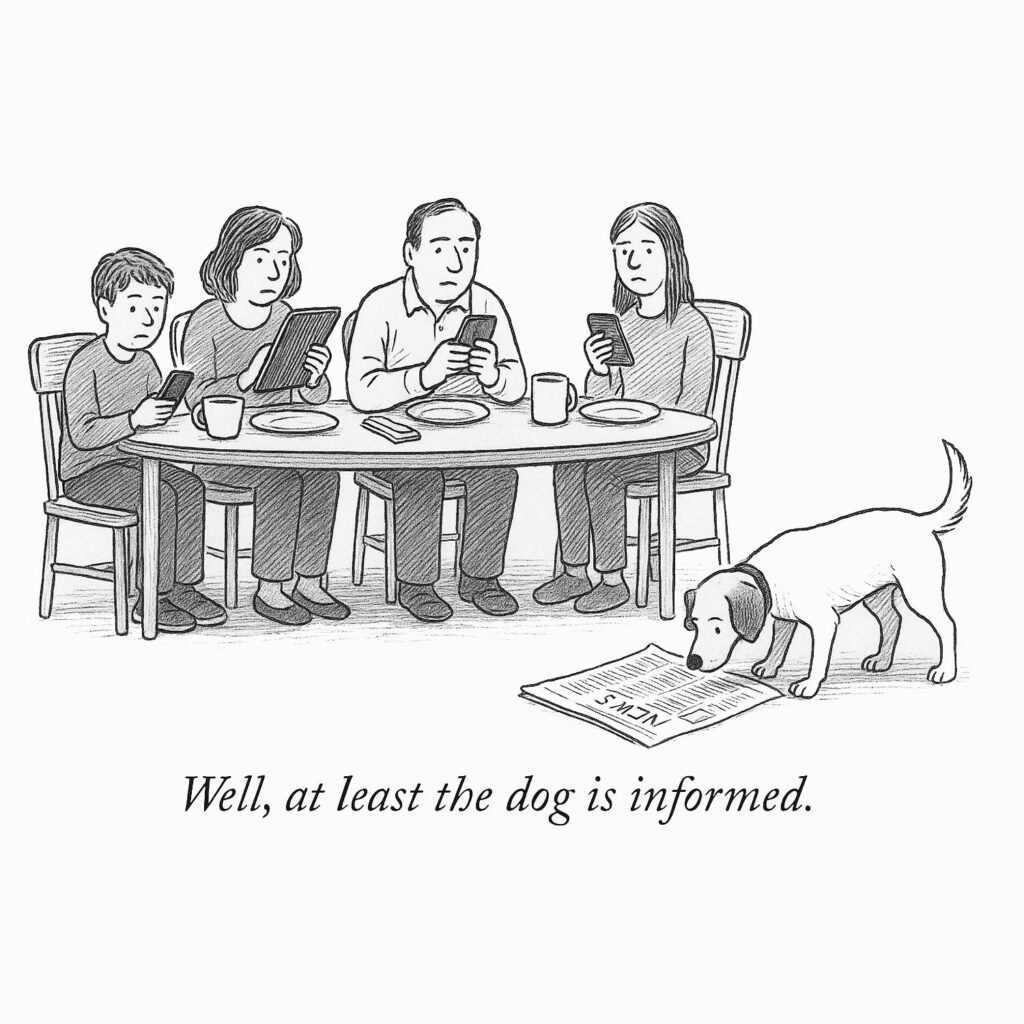
Today, our “news diet” is shaped not by editors but by digital conjurers who, after a brief consultation with our browsing history, decide the precise emotional cocktail most likely to keep us scrolling. These algorithmic sous-chefs specialize in serving us what we already wanted to taste. The result is a vast media buffet in which we gorge ourselves on confirmation, go back for seconds, and waddle away convinced that the world is exactly the shape we imagined.
The old Brackenridge generation would not recognize this arrangement. Back then, a newspaper did not ask what you wanted; it told you what mattered. It plopped a shared slab of civic conversation on the national kitchen table and invited everyone—steelworker, shopkeeper, banker, schoolteacher—to chew on it together. It wasn’t always pretty, but it was common ground, and democracy, being a notoriously fragile houseplant, needs the occasional open window of common ground to survive.
Local newspapers were the purest form of this common ground. They covered the zoning battles, the floods, the high-school triumphs, the scandals, and the price of tomatoes—none of which mattered to the rest of the world but mattered very much to the people who happened to be living in Beaver County. A community reading the same stories becomes a community capable of arguing, deliberating, and—miracle of miracles—arriving at something resembling consensus.
Try getting consensus from an algorithm today. It can barely decide whether you’re more likely to click on a picture of a lost dog or a conspiracy theory about the lost dog.
Which brings us back to newspapers, or at least their sensible digital descendants. The time has come to restore what Brackenridge celebrated: the newspaper as the daily textbook of democracy, the great leveling force that insists we all start at the same paragraph. Not a series of bespoke feeds whispering sweet nothings into our ideological ears, but a civic commons where we stand shoulder to shoulder and ask, “What’s happening in our town—and what does it mean for us?”
Beaver County does not need another infinite scroll of tailored outrage. It needs a shared front page. We all need a place where Republicans and Democrats, steelworkers and software engineers, grandparents and Gen Z can see the same facts, even if we promptly disagree about what to do with them.
Brackenridge was right: “No other agency touches so many minds so constantly, so intimately, and so cheaply.” One hundred twenty years later, the technology has changed, but the democratic job description has not. We still need news that levels us—news that teaches without tailoring, informs without flattering, and invites us all, however begrudgingly, into the same conversation.
In short, we still need newspapers. Or, if ink is too much trouble, their honest digital heirs. Because if democracy is a group project—and it is—someone has to make sure we’re all reading from the same assignment sheet.