By Rodger Morrow, Editor & Publisher, Beaver County Business
Listen to a podcast discussion about this article.
Washington Irving was the sort of man who could sit down on a bitter December night, look out a frosted window at a world already beginning to hurry itself into the future, and decide that what it really needed was an essay about mistletoe, wassail bowls, and the moral value of lingering.
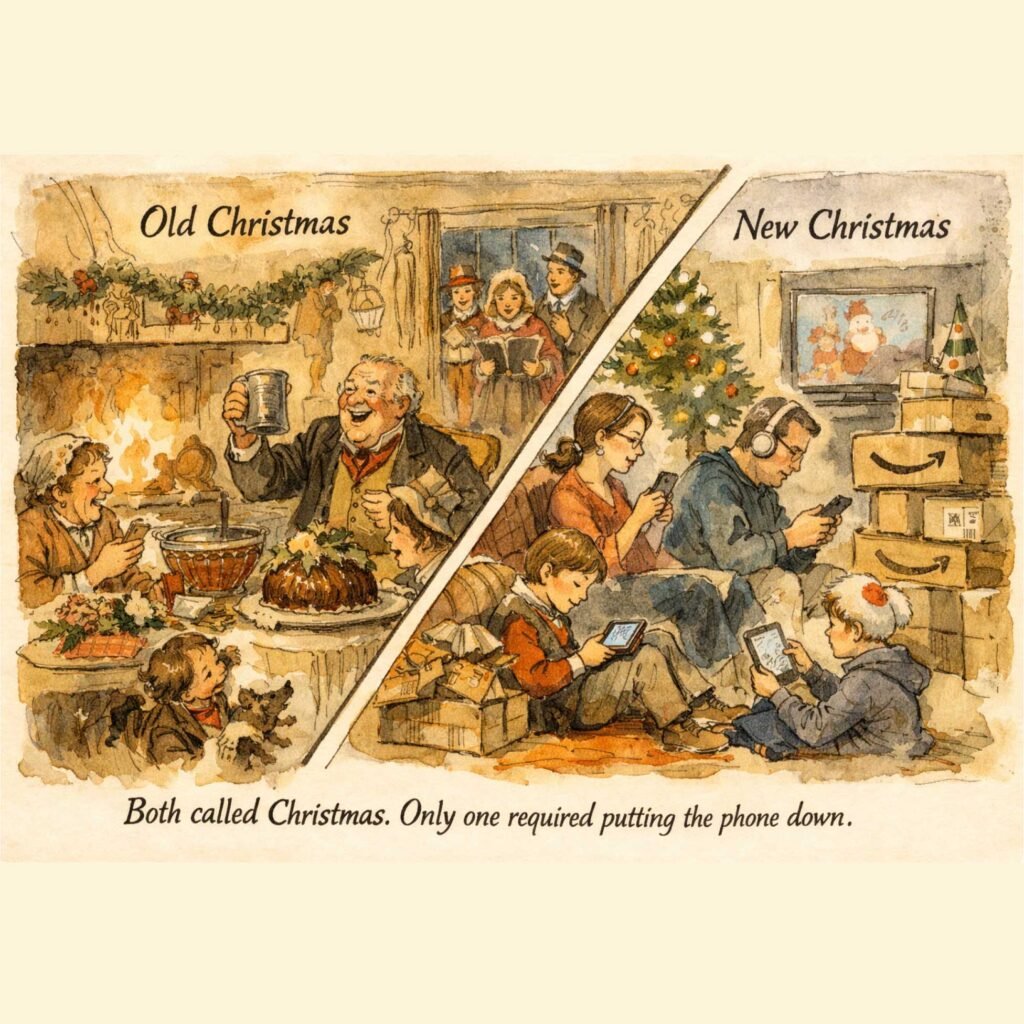
Not lingering in the modern sense — scrolling, doom-scrolling, or standing in line — but lingering by a fire, with a story, and perhaps one more glass of something warm that no one felt obliged to justify.
Irving’s Christmas sketches — the essays often gathered under the heading Old Christmas in The Sketch Book — do not read like instructions for throwing a holiday party. They read like an act of cultural salvage. Irving was not inventing Christmas so much as rescuing it, gently, from the forces of efficiency and improvement that were already busy sanding down its rough edges.
Through the genial eyes of his narrator, Geoffrey Crayon, Irving wanders into an old English country house at Christmastime and finds there a society temporarily at rest. Servants and gentry share the same season if not the same table. The fire burns high. The games are mildly ridiculous. The food arrives in quantities suggesting no one is watching the clock.
What Irving offers is not nostalgia in the cheap sense but something sturdier. He is documenting how customs work: how they bind people together, how they teach behavior without lectures, and how they allow a society to rehearse kindness once a year so it might remember it the rest of the time.
It is worth noting that Irving himself never ventured much beyond Pennsylvania’s eastern hills. He got no farther west than Honesdale, where he admired the scenery and sensibly stopped short of Pittsburgh’s future smoke and ambition. But geography mattered less to Irving than temperament.
One suspects that had he pressed on a few more decades and arrived in places like Beaver County, he would have recognized the same instinct at work: families gathering despite the cold, neighbors showing up uninvited but expected, and the year’s hard labor briefly set aside in favor of food, stories, and a fire that stayed lit longer than strictly necessary.
Irving worried — politely, almost apologetically — that such traditions were already slipping away in his own time. He blamed “modern refinement,” which sounds less like an accusation than a sigh.
Old Christmas endures not because we wish to recreate its menus or revive its party games, but because Irving understood something enduringly human: civilization is not built only in markets and institutions, but around tables, fires, and shared pauses in the year.