By Rodger Morrow, Editor & Publisher, Beaver County Business
Listen to a podcast discussion about this article.
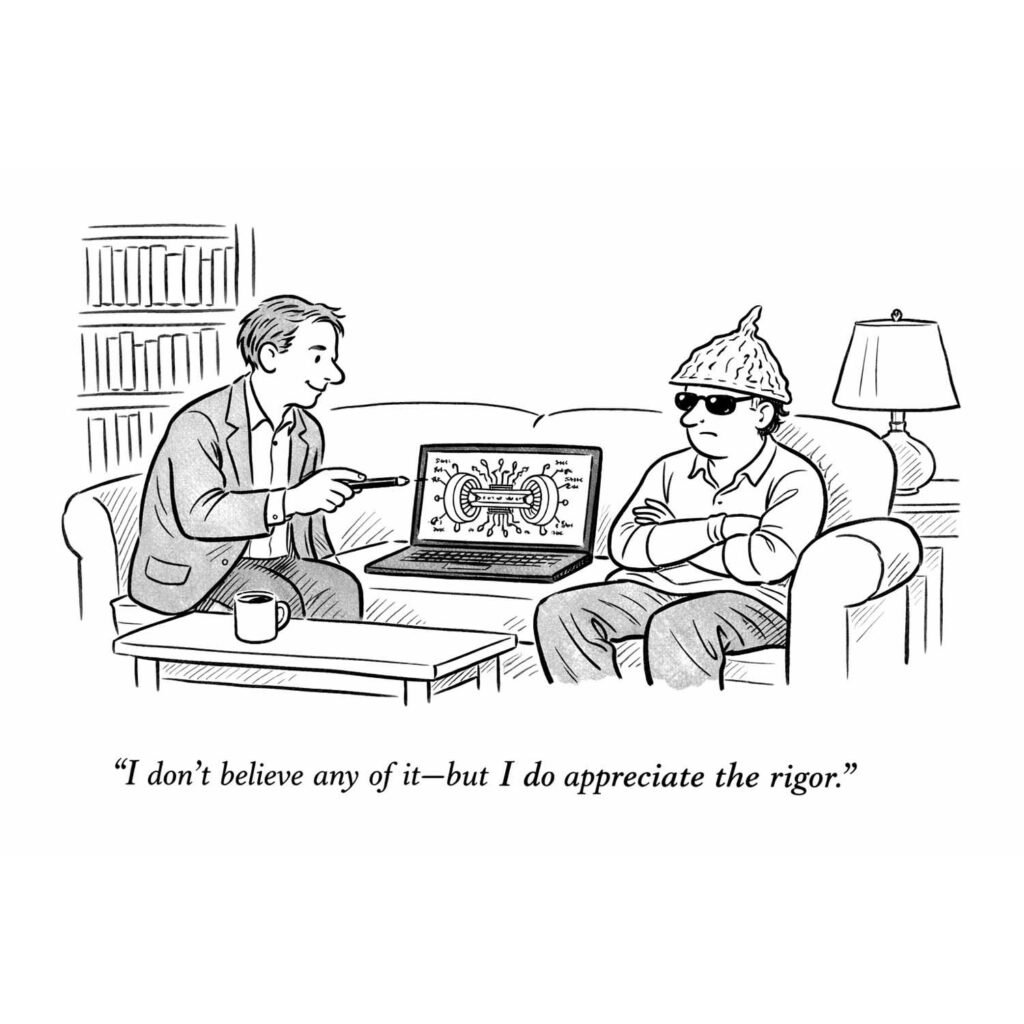
If you wanted to design a story guaranteed to make the internet lose its collective mind, you could hardly do better than this: an MIT fusion scientist is murdered under odd circumstances; a media company associated with Donald Trump announces a multibillion-dollar deal with a nuclear fusion startup days earlier; Nikola Tesla’s name gets dragged in; and somewhere, inevitably, a grainy PDF about “free energy” appears like a ghost at a séance.
Stir vigorously, post recklessly, and voilà: Fusion Wars, suppressed science, energy cartels, and a conspiracy smoothie so thick you could stand a spoon in it.
The victim was Nuno F. G. Loureiro, director of MIT’s Plasma Science and Fusion Center, a world-class theoretical physicist whose work focused on the deeply unglamorous but absolutely essential plumbing of fusion energy: magnetic reconnection, plasma turbulence, and instabilities that can turn billion-dollar reactors into very expensive paperweights.
The reality, alas, is far less cinematic than the rumor mill would have you believe.
First, a Brief (and Mercifully Clear) Explanation of Fusion
Nuclear fusion is the process that powers the Sun. Light atomic nuclei—usually isotopes of hydrogen—slam together at extreme temperatures and pressures, fuse into heavier nuclei, and release enormous amounts of energy. It is the opposite of nuclear fission, which splits heavy atoms and powers today’s nuclear plants.
The most promising Earth-based reaction uses deuterium and tritium:
²H + ³H → ⁴He + n + 17.6 MeV
That missing mass becomes energy via Einstein’s E = mc². Elegant. Beautiful. Simple on paper. Nightmarishly difficult in practice.
Why? Because atomic nuclei are positively charged and repel each other. To get them to fuse, scientists must heat fuel to more than 100 million degrees Celsius—hotter than the Sun’s core—creating plasma, a superheated soup that desperately wants to escape.
To confine that plasma, researchers rely on either powerful magnetic fields in tokamaks and stellarators, or laser-driven implosions in inertial confinement experiments. None of this is secret. None of it is mystical. All of it is hard.
What Loureiro Actually Worked On—and Why It Mattered
Loureiro was not guarding a classified breakthrough or a rogue reactor in a locked basement at MIT. His work was theoretical and foundational—exactly the kind of research that quietly moves fusion forward.
His most influential contributions involved magnetic reconnection, a process where magnetic field lines break and reconnect, releasing energy explosively. This phenomenon occurs in solar flares, Earth’s magnetosphere, and fusion devices, where it can trigger disruptions that abruptly shut down reactors.
Early in his career, Loureiro helped solve a 50-year-old puzzle: why reconnection happens so fast in plasmas that, according to classical theory, should behave sluggishly. His answer—plasmoid instabilities—has since become standard plasma physics.
This work earned him the American Physical Society’s Thomas H. Stix Award and later the Presidential Early Career Award for Scientists and Engineers. It was published, peer-reviewed, and openly discussed. There is no credible evidence linking his murder to his research.
Enter Trump Media, TAE, and the Coincidence Machine
Days before Loureiro’s death, Trump Media & Technology Group announced a merger with TAE Technologies, a long-standing California fusion startup. Headlines quickly reduced this to “Trump buys fusion,” a phrase doing far more work than accuracy would recommend.
The deal, valued at more than $6 billion, would make TAE one of the first publicly traded fusion companies. TAE is pursuing aneutronic proton-boron fusion using a field-reversed configuration—a promising but technically demanding approach requiring temperatures far higher than conventional fusion designs.
TAE has been around since 1998, raised over $1.3 billion from mainstream investors, and built multiple experimental reactors. This is hot fusion, not cold fusion, not zero-point energy, and not a garage-built miracle.
And Then, Inevitably, Nikola Tesla
No modern conspiracy cycle is complete without Nikola Tesla, patron saint of misunderstood geniuses and internet folklore.
Tesla envisioned wireless power transmission and spoke poetically about energy being “everywhere present.” He did not invent a machine that produced infinite energy from nothing. His Wardenclyffe Tower failed for the very mundane reasons of physics, economics, and withdrawn funding.
After Tesla’s death in 1943, U.S. authorities briefly seized his papers amid wartime rumors of a particle-beam “death ray.” They asked MIT electrical engineer John G. Trump—Donald Trump’s uncle—to review them.
His conclusion was devastatingly dull: Tesla’s later ideas were speculative and lacked workable engineering. No superweapons. No suppressed energy source. One rumored “death ray” box contained an old resistance meter.
Why Beaver County Should Know Better
Fusion is complicated. Plasma physics defies intuition. Tesla’s life invites mythmaking. Add a violent crime and a Trump-adjacent headline, and the internet predictably loses its grip.
But Beaver Countians should view this with a jaundiced eye. This county helped give the world its first experiment in nuclear power. We understand that energy revolutions are incremental, imperfect, and built by serious people doing unglamorous work over decades.
Fusion will change the world someday. It will not arrive via assassination, suppression, or secret papers in a trunk. It will arrive through open research, brutal engineering, and patient iteration.
The murder of Nuno Loureiro was a tragedy. Turning it into mythology does neither him nor science any favors. Around here, we know better than to confuse coincidence with causation—or mystery with truth.