By Seamus Morrow, Hooman Interest Editor
Listen to a podcast discussion about this article.
Allow me to begin with a confession. I am a large dog. A dignified dog. A Landseer Newfoundland of considerable presence, appetite, and philosophical depth. I am not, however, a walking ATM.
Yet lately, every time my hooman and I cross the threshold of a modern veterinary clinic, I can feel his wallet tense up like a frightened squirrel. Somewhere between the lobby’s reclaimed wood accents and the laminated poster warning about “silent dental disease,” the bill begins clearing its throat.
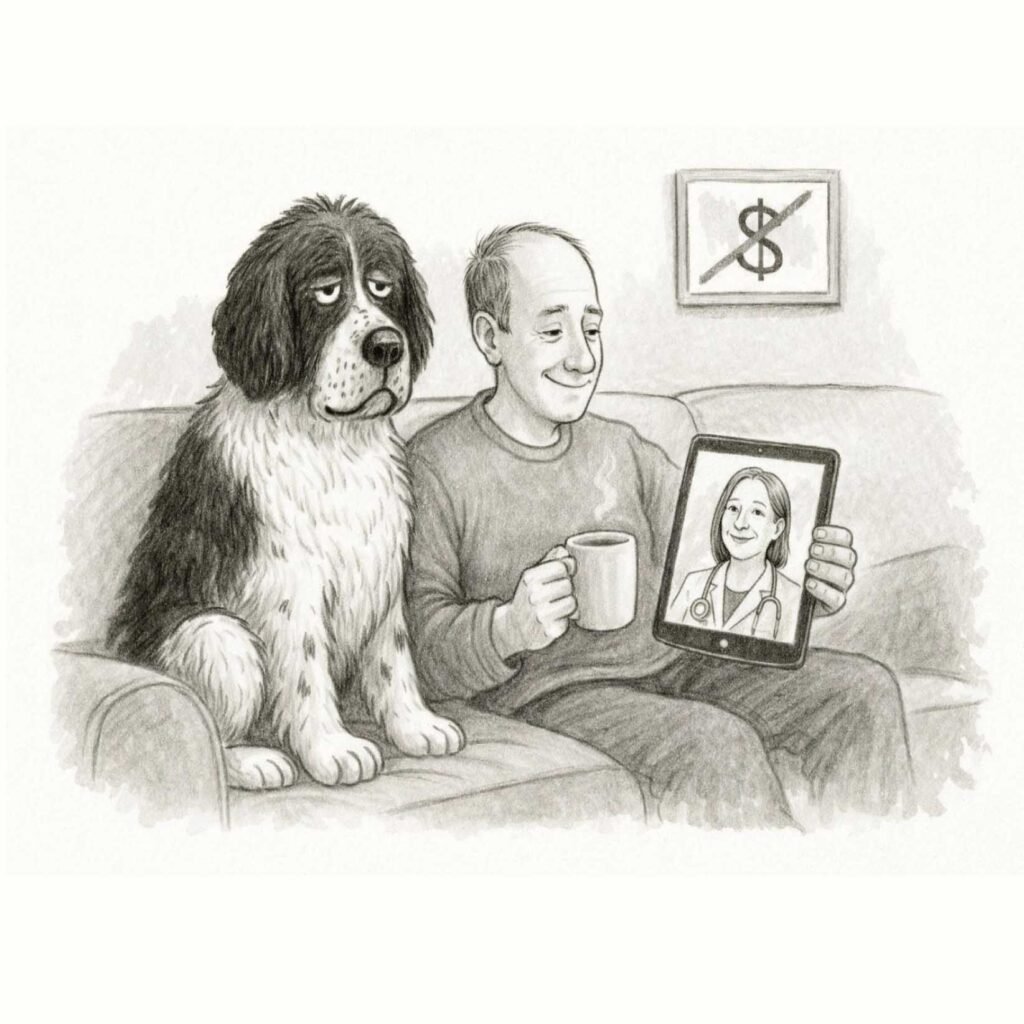
Which brings us to the good news.
After last week’s column—“The Bad News About Vet Care Your Hooman Won’t Tell You”—several readers asked whether there is any hope for hoomans who love their pets but would also like to retire before the age of 112.
There is. It’s called telemedicine. And unlike the chew toy shaped like a lobster that cost $18 and lasted four minutes, it actually works.
What Went Wrong (A Brief Sniff)
In a recent interview, Joe Spector—the founder of Dutch, a pet telehealth company—described what he calls a private-equity veterinary scam. His claim, in short: Wall Street discovered pets.
Private equity firms have been buying up independent veterinary clinics at a brisk trot. By Spector’s estimate, somewhere between one-third and one-half of all U.S. veterinary practices are now owned by corporate chains. The result has been prices rising at roughly twice the rate of inflation, alongside new pressure on veterinarians to “produce.”
As a dog, I can tell you this word has no comforting meaning.
“Production” often looks like upselling anxious hoomans on expensive procedures—sometimes necessary, sometimes merely aspirational—using phrases like, “If you really loved him…” This is emotional blackmail of the highest order. Even I find it distasteful, and I eat things off the sidewalk.
Meanwhile, there is a genuine veterinarian shortage—roughly one veterinarian for every 3,000 pets. According to Spector, accreditation bottlenecks and lobbying efforts keep the supply artificially tight, helping maintain higher prices. Add pressure from professional associations and state boards, and you end up with a system that is oddly allergic to innovation.
Including telemedicine.
Enter Telemedicine (Tail Wagging Commences)
Here is the part where I sit up straighter.
Veterinary telemedicine allows hoomans to consult licensed veterinarians by video or chat for non-emergency issues: itchy skin, allergies, anxiety, diet questions, medication refills, post-procedure check-ins, or the timeless mystery of “Why is he licking that?”
No driving. No waiting room full of nervous cats plotting my demise. And—most importantly—no $400 bill to be told I am, once again, “a big healthy boy.”
Telemedicine does not replace in-person care. If I am struck by a truck or eat a sock (hypothetically), I still require a physical veterinarian. But for a very large share of routine concerns, telehealth is faster, cheaper, and saner.
Which is precisely why it is opposed.
In roughly twenty states, meaningful veterinary telemedicine remains restricted or outright illegal unless a prior in-person veterinarian-client relationship exists. Critics claim allowing digital consultations will endanger animals. I find this implausible, given that dogs cannot operate Zoom without assistance.
Legal challenges are ongoing, including cases that may hinge on veterinarians’ freedom of speech. In the meantime, grassroots efforts such as savepuppies.com encourage hoomans to contact legislators and ask for laws that reflect modern reality.
I support this effort. Puppies are delightful and should be saved.
Practical Options (A Shopping List, Not A Scam)
For hoomans wondering where to begin, several reputable veterinary telemedicine platforms already operate nationwide. Availability, prescribing authority, and pricing vary by state, but common options include Dutch, Vetster, Airvet, Chewy’s Connect with a Vet, FirstVet, Pawp, and others.
Think of these services not as replacements for your local veterinarian, but as pressure-release valves for a system that has grown too expensive, too consolidated, and too fond of scented candles in exam rooms.
A Final Thought From A Large Dog
Hoomans love us. We know this. We see it in the treats, the walks, and the ridiculous voices you use when no other adults are present.
Telemedicine does not cheapen that love. It protects it—from unnecessary costs, from guilt-based sales tactics, and from a system that has forgotten the difference between care and commerce.
Now, if you will excuse me, I need to lie down somewhere dignified and contemplate a world in which veterinary visits no longer require a second mortgage.