By Rodger Morrow, Editor & Publisher, Beaver County Business
Listen to a podcast discussion about this article.
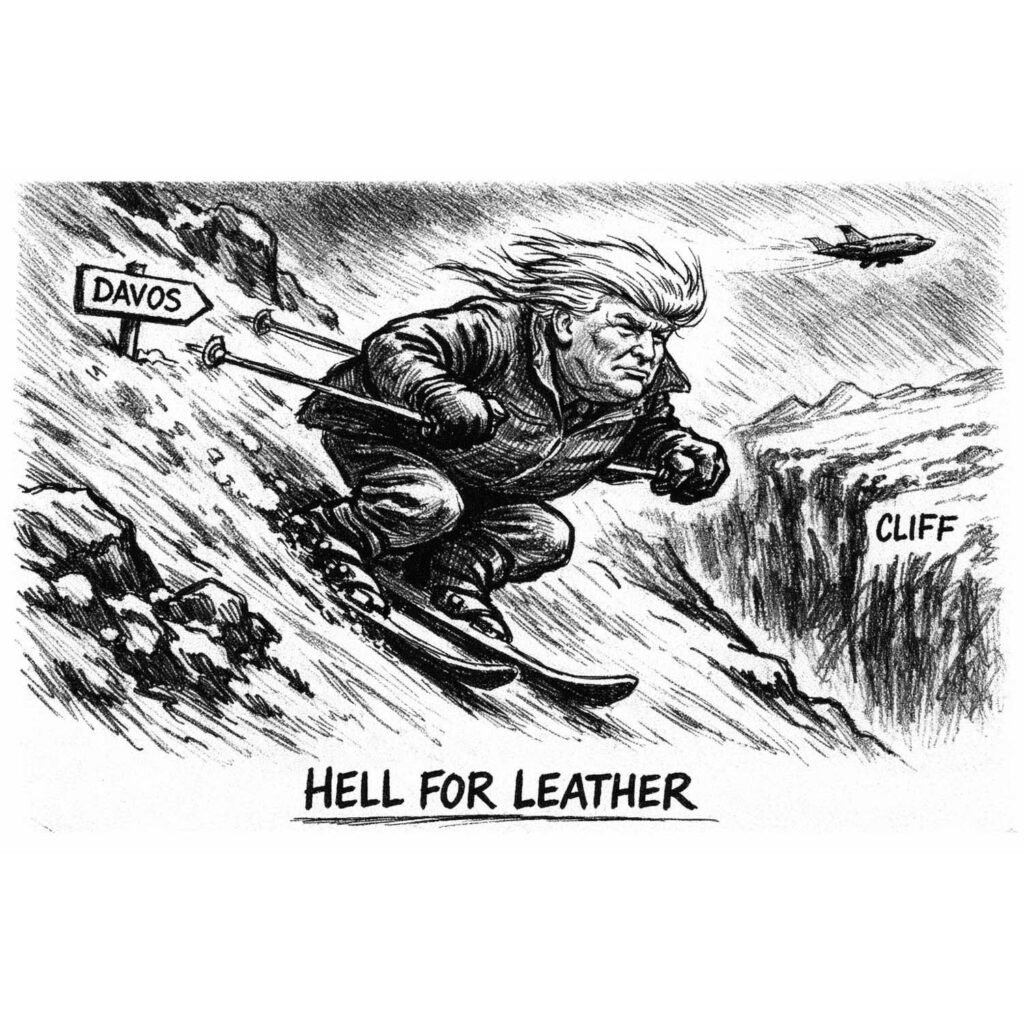
Every January, a small Swiss ski village named Davos becomes the most important place on earth—at least in the minds of the people flying there on private jets to explain why the rest of us need to tighten our belts, eat fewer hamburgers, and learn to be happy in smaller apartments.
The annual meeting of the World Economic Forum is sometimes described as a conference. This is inaccurate. Davos is more accurately the HOA from hell: a gathering of the rich and attractive, for the rich and attractive, where the rich and attractive admire one another over expensive food, rare wines, and—according to persistent rumors—well-paid companionship arranged with Swiss discretion and impeccable invoicing.
It is Aspen with better accents. Seven Springs with more PowerPoints.
The unspoken rule of Davos has always been simple: everyone agrees loudly, nobody decides anything, and the bill—economic, cultural, and moral—is sent elsewhere. Preferably to Ohio, western Pennsylvania, or any other place where people still make things instead of slide decks.
This year, however, something went wrong.
America showed up.
When the Theoretical Met the Tired
The trouble began when Donald Trump took the stage. Davos is accustomed to Americans arriving with apologies, nuance, and soothing reassurances about “shared values.” Trump brought none of that. What he brought instead was leverage.
His message, stripped of diplomatic upholstery, was straightforward:
America is finished subsidizing bad trade deals. Sovereignty matters more than global consensus. Greenland is strategic—and negotiable. And lectures, however elegant, lose to power applied deliberately.
He looked tired. Not weak—just worn, the way people look when they have spent years pushing against institutional molasses. One couldn’t help hoping he’s okay. But tired or not, he reset the room. Davos stopped being theoretical and started being transactional, which is not its comfort zone.
The crowd did not applaud so much as absorb impact.
The Fed Guy Who Said “Relax”
Then came Scott Bessent, the American “Fed guy” in European shorthand, though titles matter less than tone. He informed the assembled grandees that markets were not panicking, U.S. debt was manageable, and Europe—how to put this politely—might consider taking a breath.
They were expecting reassurance. They received dismissal.
Nothing unsettles a Davos audience faster than the suggestion that America is not anxious. The entire ecosystem depends on American anxiety. It lubricates consensus. It justifies process. It keeps the panels humming. When an American official shrugs and says, in effect, “We’re fine,” the fondue curdles.
Heresy in the Temple of Free Trade
Trade discussions were handled by Jamieson Greer, the US Trade Representative, who committed the cardinal sin of pointing out history. Tariffs, he explained, are not radical innovations. They are old tools. Free trade, as practiced over the last several decades, hollowed out the American middle class. Balance matters more than ideology.
This is not a popular sermon in Davos, where globalism is less an economic theory than a sacrament. To suggest that it failed structurally—not accidentally—is to question the moral architecture of the room. It is like asking uncomfortable questions during communion.
The response was polite displeasure, which in Davos is the equivalent of fainting couches and smelling salts.
Energy, Reality, and the Closed Door
Energy conversations, we are told, became tense behind closed doors when Secretary of Energy Chris Wright reminded attendees that energy security precedes climate theater, that oil and gas still matter, and that supply beats slogans every time.
No official transcript emerged, which only made the message louder. Davos prefers its energy discussions abstract, carbon-priced, and safely decoupled from physical reality. The suggestion that the lights must stay on—even when the wind doesn’t blow—introduced an awkward silence usually reserved for technical malfunctions.
When the Booing Started
The moment the meeting tipped from discomfort into outright distress came courtesy of Secretary of Commerce Howard Lutnick, who reportedly dispensed with niceties altogether.
Europe’s energy policy, he suggested, is delusional. Coal works when renewables don’t. America is not apologizing for winning.
There were jeers. There were walkouts. Christine Lagarde, president of the European Central Bank, reportedly left early, which in Davos is a dramatic flourish usually reserved for malfunctioning translation headsets.
Was it harsh? Yes. Was it intentional? Absolutely.
Sometimes clarity requires friction, and Davos has been friction-free for decades.
The Familiar European Refrain
European leaders responded as they always do. French President Emmanuel Macron warned darkly about American “coercion,” adopted the familiar moral-authority posture, and delivered what might charitably be described as the same speech he has been giving since the Obama administration.
It was polished. It was earnest. It was boring.
Ursula von der Leyen, the European Commission president, then unveiled Globalism Lite: a rebranded vision of trade blocs, regional partnerships, and Latin American outreach. Same system. New label. America not invited.
Globalism, it turns out, is not dead. It has just changed fonts.
The Canadian Sideshow
Canadian Prime Minister Mark Carney played his accustomed role, offering globalist chit-chat while being quietly warned by Trump to watch his tone. Proxy criticism, even from allies, was no longer being indulged. This, too, unsettled the room. Davos runs on polite indirection.
America arrived speaking plainly.
Why This Felt Like a Smackdown
Europe was not offended because Americans were rude. Europe was offended because Americans stopped pretending.
Davos depends on polished language, managed outcomes, and consensus without accountability. America showed up with leverage, direction, and consequences. That is a different operating system.
And here’s the part that really stung: after all the outrage, after the editorials and the walkouts, deals still happened. Including Greenland. Yes—Trump and Greenland came to an agreement.
Intent.
Planning.
Action.
Delivery.
Results.
It is an unfamiliar sequence in Davos.
From the outside—from Beaver County, from Seven Springs, from anywhere people still shovel their own driveways—this whole episode looked less like a diplomatic crisis and more like a thaw. The world’s most self-important ski resort finally encountered reality, and reality, as it turns out, does not wait its turn politely for the chairlift.
It just moves, hell for leather, downhill.