By Beaver County Business Staff
Listen to a podcast discussion about this article.
On Tuesday, February 17 at 7 p.m., the waiting room at the Beaver Station hosted something it had not seen in quite some time: a former vice president assembling boats for a possibly unauthorized continental reorganization.
Technically, it hosted Beaver Area Heritage Foundation’s latest speaker series installment. But spiritually, it hosted what Rodger Morrow, editor and publisher of Beaver County Business, cheerfully titled “The Great Bridgewater Conspiracy.”
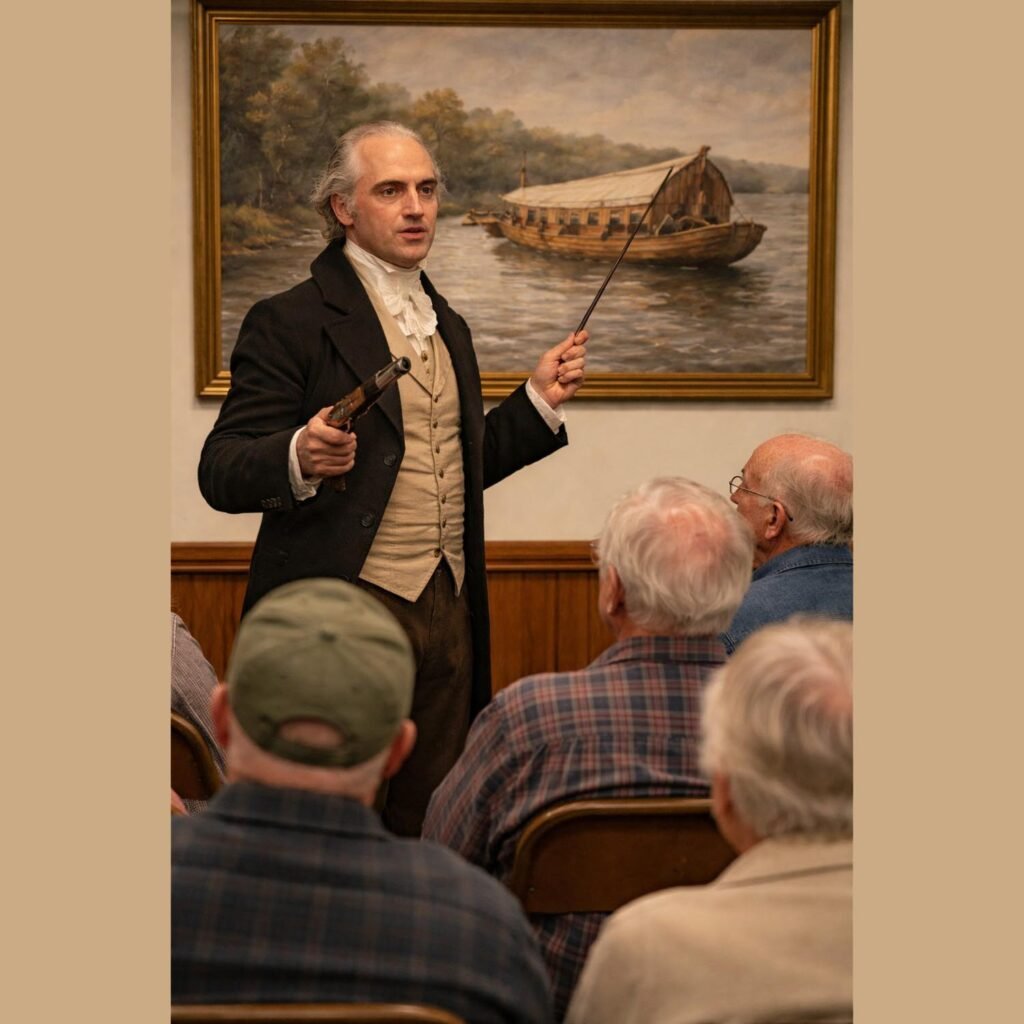
Morrow, adopting his patented “substitute teacher who found the faculty lounge coffee” tone, opened his remarks by thanking his “fellow conspiracy theorists” who braved the February chill rather than stay comfortably home with Olympic bobsleds and leftover Godiva chocolates.
From there, he pivoted—gently, mischievously—into the unsettling proposition that Western Pennsylvania had pioneered political melodrama long before cable news learned to shout.
The evening’s central character was, of course, Aaron Burr—former vice president, duelist, and the only man to resolve a professional disagreement with Alexander Hamilton by firearm. (Unless, Morrow noted, one counted Lyndon Johnson, “but that’s another conspiracy theory.”)
While Broadway’s Hamilton left Burr brooding attractively before firing a pistol, Morrow reminded listeners that two years after Weehawken, Burr had done something far less choreographed and considerably more local: he had inspected keelboats along Bradys Run in what was then Sharon—now Bridgewater.
Not fishing boats. Not pleasure craft. Conspiracy boats.
In Morrow’s telling, early America had been “a republic in soft focus”—the Constitution barely dry, the Louisiana Purchase fresh, Spain still clutching Mexico, Britain hovering in Canada. The West had not yet become myth; it had been wet plaster. Into this malleable republic stepped Burr, newly politically radioactive and searching for relevance.
Historians, Morrow explained, had long debated Burr’s true aim. Was he planning to invade Spanish Mexico? Detach western territories? Crown himself emperor of something sketched hastily on parchment? “The honest answer,” Morrow said, “was that we didn’t know. The less honest answer was that everyone thought they did. Which was how panic began.”
And panic did begin.
Burr had required three items for continental ambition: men, munitions, and boats. Beaver County—then Sharon—supplied the third. At Amasa Brown’s yard along Bradys Run, sturdy covered keelboats were constructed for a flotilla intended to assemble at Blennerhassett Island (then Virginia, now West Virginia, and still close enough to Ohio to inspire family-picnic border disputes).
The imagery, Morrow emphasized, had been less cinematic than clerical. Conspiracies in real time had looked like lumber receipts, barrel measurements, and rope negotiations. They had looked, in short, like procurement.
From Blennerhassett, the flotilla would have drifted down the Ohio, gathered recruits, and continued toward the Mississippi—toward destiny, or indictment.
Enter President Thomas Jefferson.
When Jefferson learned that his former vice president might be assembling a western expedition of ambiguous legality, he had not treated it as entrepreneurial river tourism. Having recently endured the Whiskey Rebellion, Jefferson saw in Burr’s activity the specter of secession.
The result, as Morrow carefully outlined, had been legislative muscle memory. In 1807, amid the Burr alarm, Congress passed what became known as the Insurrection Act of 1807, clarifying presidential authority to deploy federal troops domestically to suppress rebellion or enforce federal law.
In plain English: if someone floated a private army down the Ohio River, the president now had clearer constitutional authority to respond.
The law had since been invoked during the Civil War, Reconstruction, and desegregation crises—its roots tracing directly back to keelboats built within earshot of the Beaver River.
“That wasn’t just local color,” Morrow observed. “That was constitutional muscle memory.”
The expedition, of course, had dissolved. General James Wilkinson—U.S. Army commander and inconveniently a paid Spanish agent—alerted Jefferson. Militias mobilized. Boats were seized. Recruits scattered. The sugar cube dissolved in coffee.
Burr was arrested and transported to Richmond for what Morrow described as the “Trial of the Century,” presided over by Chief Justice John Marshall.
Jefferson had been convinced of guilt. Publicly convinced. Privately convinced. Enthusiastically convinced. Which, as Morrow dryly noted, had not been ideal for due process.
The Constitution defined treason narrowly: levying war against the United States or adhering to its enemies, proven by two witnesses to the same overt act. Not rumors. Not ambition. Not suspicious boat shopping.
Marshall insisted on proof of an actual act of war. The government’s case wobbled. Evidence proved thin. The jury acquitted Burr.
Legally innocent. Politically radioactive.
The epilogue carried its own Shakespearean timing. Burr’s beloved daughter, Theodosia, vanished at sea. He married Eliza Jumel, only to be divorced—with Ms. Jumel represented by Alexander Hamilton’s son—on September 14, 1836. Burr died that same day. “Even Broadway couldn’t have improved on the timing,” Morrow said.
So why revisit this riverine melodrama?
Because the Burr Conspiracy had tested the young republic. It clarified the meaning of treason. It strengthened executive authority. It forced the nation to distinguish suspicion from proof.
And here in Beaver County?
“We built the boats,” Morrow concluded. “Not as revolutionaries. Not as loyalists. As practical Americans responding to a customer.”
In an era when “insurrection” and “executive power” have reentered headlines with unsettling frequency, the story of keelboats on Bradys Run feels less antique and more instructive.
Constitutional evolution, it turns out, sometimes begins with a lumber order.
The train station audience responded with warm laughter and thoughtful quiet—an appropriate blend for a night when history proved that the Ohio River once carried more than commerce.
It carried constitutional consequence.
And on that note, Morrow closed as promised:
“Thank you for your attention to this matter.”
1 thought on “Live On Stage: The Great Bridgewater Conspiracy”
Rodger, I thoroughly enjoyed your presentation this week at the standing-room-only Beaver Station! I appreciate your sense of humor and, surprisingly, your use of AI on this platform.
Your content on this platform is informative, educational, and entertaining. I’m looking forward to reading more articles and listening to your podcasts.