By Beaver County Business Staff
Listen to a podcast discussion about this article.
There’s a particular stillness that settles over a city when its newspaper begins filling out its own obituary paperwork.
Not the loud, theatrical sort of ending—no presses crashing to a halt while editors wave the final edition like the last helicopter out of Saigon. Instead, the process tends to unfold the way bureaucracies prefer: with forms.
In this case, the form is a WARN notice filed with the Commonwealth of Pennsylvania, which is the official way large employers inform the state that a sizeable number of people will soon be looking for work. According to that filing, 171 employees of the Pittsburgh Post-Gazette will be affected when the paper closes in early May.
The closure date listed is May 3, 2026, confirming what the paper’s owner, Toledo-based Block Communications Inc., announced earlier this year: after more than two centuries of publishing in one form or another, the region’s largest newspaper of record intends to cease operations.
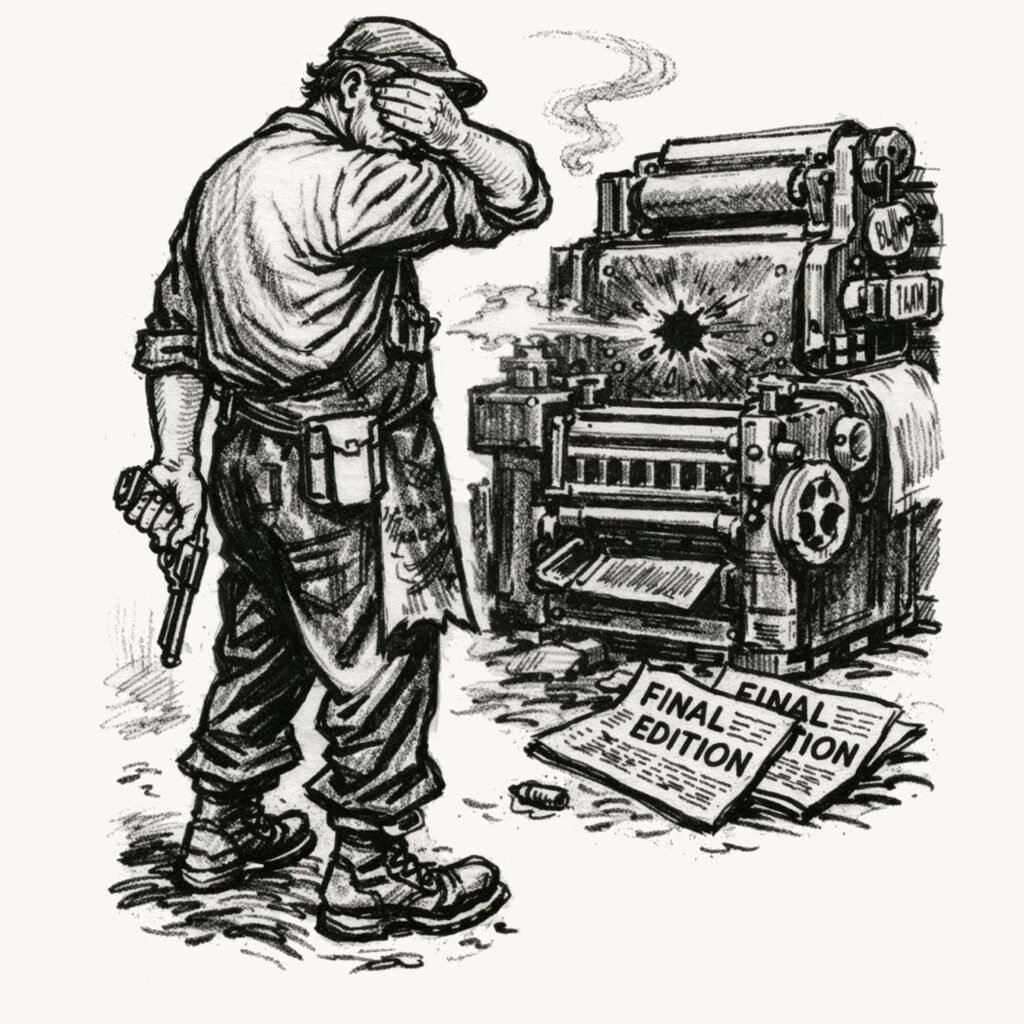
For readers across western Pennsylvania—including those here in Beaver County—the announcement carries the peculiar feeling of watching a large and familiar piece of civic furniture quietly disappear from the living room.
The Post-Gazette, after all, has been part of Pittsburgh’s daily landscape longer than the steel industry itself. It predates the Civil War, the telephone, the automobile, and most of the bridges crossing the Ohio River. At various moments in its life it has chronicled everything from Andrew Carnegie’s industrial rise to Roberto Clemente’s line drives to the long twilight of the region’s steel mills.
But history, as the newspaper business has been learning for the better part of twenty years, does not automatically translate into solvency.
Block Communications has said the paper lost approximately $350 million over the past two decades, a figure large enough to make even the most sentimental publisher reach for a calculator. The company’s decision to close the paper came the same day the U.S. Supreme Court declined to hear an appeal in a long-running legal dispute between the company and the paper’s striking newsroom employees.
That ruling effectively ended a labor battle that had dragged on for nearly three years, following a decision by the U.S. Third Circuit Court of Appeals last November. The strike, which began in 2022, became one of the longest and most contentious labor disputes in modern newspaper history.
In the end, neither side appears to have emerged particularly victorious—unless one counts the lawyers, who traditionally do well in such circumstances.
Meanwhile, the physical signs of the paper’s retreat have been appearing around Pittsburgh with the quiet inevitability of autumn leaves.
The Post-Gazette recently vacated its North Shore offices, where the building once bore the familiar PG sign facing the Allegheny River. That space, according to the Pittsburgh Steelers, has now been taken over by the football team.
It’s a tidy metaphor for the modern media landscape: journalism moving out while sports moves in.
The WARN notice lists the paper’s address as 300 Corliss Street in the Sheridan neighborhood, a reminder that over the past decade the Post-Gazette has migrated through several offices as the industry steadily contracted.
Yet even as the paperwork advances toward May, the story may not be entirely finished.
Speculation continues to swirl about whether a buyer or alternative ownership group might step forward to preserve some version of the two-centuries-old institution. Nothing has been confirmed, and anyone who has spent time around the newspaper business knows rumors of rescue tend to multiply precisely when the oxygen supply runs low.
Still, the possibility lingers—partly because Pittsburgh has always considered the Post-Gazette something more than just a business enterprise.
It has been, at various times, a chronicler, a scold, a booster, a watchdog, and occasionally a perfectly serviceable fish wrapper. But above all it has been a civic habit. Generations of western Pennsylvanians grew up with the mild morning ritual of unfolding its pages over coffee.
That habit has been fading for years, of course. Readers migrated to phones, advertisers migrated to algorithms, and the once-mighty metropolitan newspaper began shrinking like a wool sweater left too long in a hot dryer.
Across the country, dozens of large-city dailies have already disappeared or become shadows of their former selves. Pittsburgh now appears poised to join that list.
For smaller publications—like those scattered across Beaver County and the surrounding region—the moment carries a certain bittersweet irony.
For decades, local papers lived in the shadow of the big metro daily downriver. Now the giant is the one filing WARN notices while smaller outlets attempt to keep the lights on with a combination of stubbornness, caffeine, and subscription reminders.
Whether the Post-Gazette ultimately closes in May or finds an unexpected second act, one thing seems clear: the age of the metropolitan newspaper as we once knew it is drawing to a close.
And like most historical transitions, it’s happening not with a thunderclap—but with paperwork.