Listen to a podcast discussion about this article.
Ambridge is what happens when people set out to build heaven on earth and end up fabricating steel instead.
This is not a criticism. It may, in fact, be the most practical outcome available to the human race.
If you stand on Merchant Street on a mild afternoon, with the traffic behaving itself and the storefronts doing their best, you can almost convince yourself the town has always been this way—compact, walkable, faintly dignified, and just a little bit stubborn about it. But that would be to ignore the two very different dreams that built the place, both of which arrived with conviction and left behind architecture.
The First Dream: Perfection
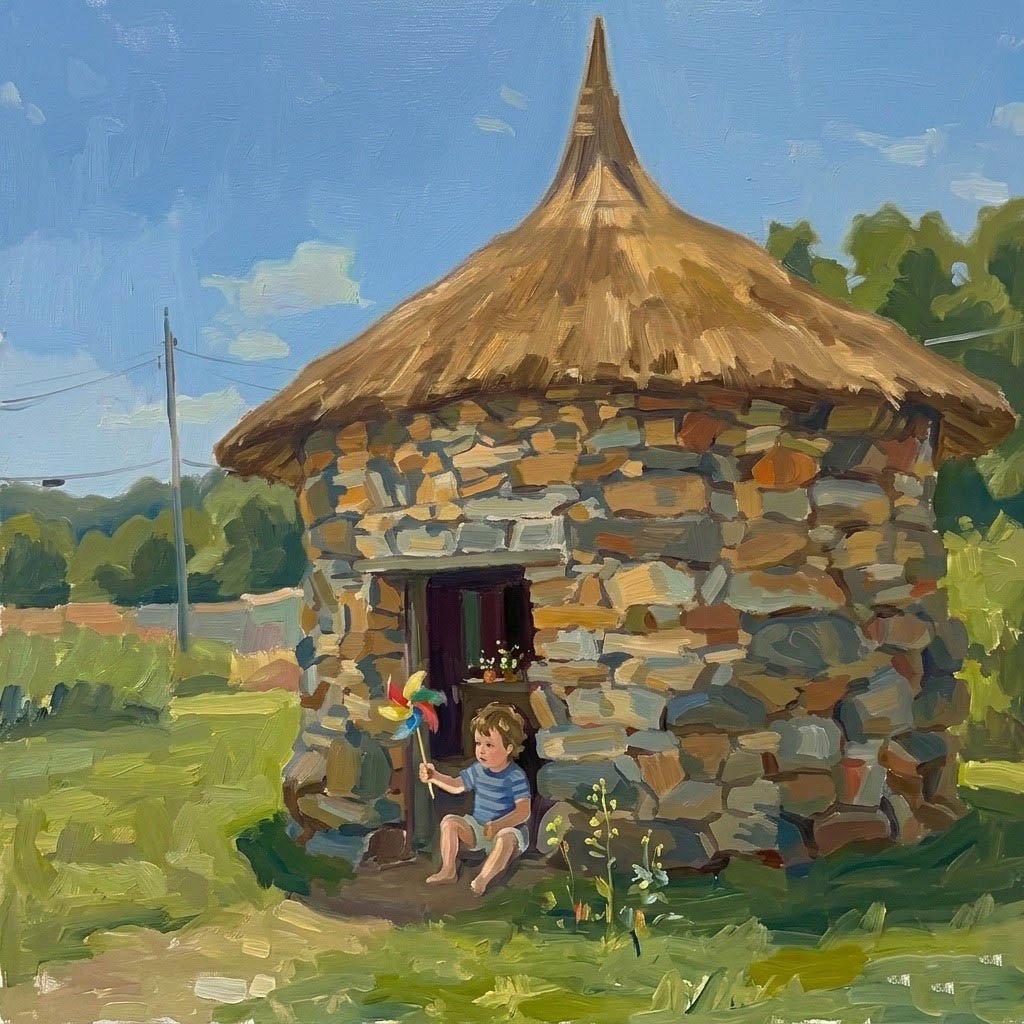
Long before there was an Ambridge, there was a group of German pietists who believed, with admirable seriousness, that the world could be improved through discipline, industry, and a certain amount of theological confidence.
They were the Harmony Society, led by George Rapp, and in the early 19th century they established a community along the Ohio River that they called Economy. It was meant to be a place apart—orderly, self-sufficient, and, if not exactly heavenly, then at least well on its way.
Today, their legacy survives as Old Economy Village, a collection of buildings and gardens that suggest a people who believed strongly in straight lines, careful planning, and the moral benefits of keeping things in their proper place.
They practiced communal living, celibacy, and economic cooperation. They prospered, which is always inconvenient for critics of utopian schemes. But like many such experiments, their success contained the seeds of its own conclusion. By the late 19th century, the Society had declined, its grand experiment reduced to a historical footnote and a very well-maintained set of brick structures.
Nature, it seems, has its own zoning regulations.
The Second Dream: Steel
If the Harmonists sought perfection, the men who came next sought production.
In 1905, the American Bridge Company—at the time a subsidiary of U.S. Steel—arrived with a different vision. They would build a town designed not for spiritual refinement but for industrial efficiency. They called it Ambridge, a tidy contraction of “American Bridge,” which has the virtue of sounding both practical and faintly optimistic.
The company laid out streets, built housing, and erected a massive fabrication plant along the river. Here, steel was shaped into the skeletons of bridges, buildings, and infrastructure that would define the American landscape in the 20th century.
If you’ve ever driven across a river and felt reasonably confident you would reach the other side, there’s a decent chance something from Ambridge had a hand in it.
A Town That Worked
For decades, Ambridge worked in the same sense that a well-designed machine works.
The plant employed thousands. The town filled with immigrants—Italians, Slovaks, Croatians, and others—who brought with them languages, cuisines, and a willingness to do difficult things for steady pay. Churches rose accordingly, each with its own architectural personality and theological emphasis, creating a skyline that doubled as a census report.
Merchant Street became the commercial spine of the community, lined with shops that sold what people needed and, occasionally, what they wanted. There were barbers who knew your name, grocers who extended credit, and restaurants that understood the importance of portion size.
It was not utopia. It was better. It was sustainable.
The Familiar Decline
Then came the late 20th century, which has not been kind to towns built around heavy industry.
Global competition, technological change, and corporate consolidation did their quiet work. The American Bridge plant, once the town’s economic engine, reduced operations and eventually ceased to be the force it had been.
Jobs disappeared. Population followed. Storefronts that had once been lively grew contemplative.
Ambridge did not collapse in a dramatic fashion. It simply…thinned out. Like a once-busy restaurant after the lunch rush, it retained the furniture but lost the noise.
What Survives—and Why
And yet, Ambridge has an advantage that many towns would envy: it was built well.
The street grid still makes sense. The buildings, many of them constructed with a degree of care that would alarm modern developers, remain standing and usable. The scale is human. You can walk from one end of Merchant Street to the other without requiring provisions.
In recent years, this has begun to matter again.
Small businesses—coffee shops, boutiques, service providers—have found their way into the available spaces. Artists and entrepreneurs, priced out of more fashionable ZIP codes, have discovered that Ambridge offers something increasingly rare: affordability combined with character.
It turns out that exposed brick and high ceilings are more charming when they come without a six-figure mortgage.
A Different Kind of Growth
The town’s revival, if that’s the word, is not the sort that produces headlines about transformative investment or billion-dollar projects. There is no single ribbon-cutting that explains Ambridge.
Instead, there is accumulation.
One business opens, then another. A building is renovated. A street looks a little better than it did the year before. The process lacks drama but gains credibility over time.
There is also proximity. Ambridge sits within reasonable commuting distance of Pittsburgh, Cranberry, and the growing energy and logistics corridor along the Ohio River. It offers access without pretense—a place to live that doesn’t require a second mortgage or a personality transplant.
The Unexpected Continuity
What makes Ambridge particularly interesting is not just that it has survived, but that it has done so by quietly blending its past with its present.
The Harmonists’ emphasis on order and craftsmanship still echoes in the built environment. The industrial era’s focus on work and practicality lingers in the town’s sensibility. And the current wave of small-scale entrepreneurship adds a layer of adaptability that neither of the earlier visions quite anticipated.
It’s not utopia. It’s not a company town.
It’s something in between, which may be the most realistic arrangement available.
Why It Matters
For Beaver County Business, Ambridge offers a useful case study in what happens after the grand plans fade.
Not every community will land a data center or a major industrial investment. Not every town will reinvent itself in a single, dramatic gesture. Some will do it the slower way—through incremental change, local initiative, and the stubborn refusal to become irrelevant.
Ambridge suggests that this approach, while less glamorous, may be more durable.
It also raises a quiet question for the rest of the county: in an era of large-scale energy projects and billion-dollar announcements, is there still room for places that grow one storefront at a time?
The Practical Outcome
If the Harmonists returned today, they might be disappointed to find that their vision of perfection has given way to coffee shops and small businesses. Then again, they might recognize something familiar in the order of the streets and the persistence of the place.
If the executives of American Bridge came back, they might look in vain for the plant that justified their investment. But they would likely approve of the continued usefulness of the town they laid out.
Ambridge did not achieve heaven.
It did something arguably more impressive.
It endured.