Listen to a podcast discussion about this article.
Beaver County has seen big numbers before.
We’ve hosted industries that spoke in the language of millions, then billions, and occasionally in tones that suggested the arithmetic might never end. Steel did it. Energy did it. And now, in the latest turn of the economic kaleidoscope, data centers are doing it—with a kind of quiet confidence that suggests they don’t intend to make much noise while they do.
The number currently making the rounds is $10 billion.
That’s the scale of the proposed investment tied to Aligned Data Centers and its plans for a massive campus in and around Shippingport. It’s the sort of figure that causes local officials to sit up straighter, developers to return phone calls more promptly, and columnists to reach for metaphors involving small countries.
But there’s a question that tends to get lost somewhere between the press release and the artist’s rendering:
Who actually gets rich?
It’s not a rude question. It’s a practical one.
Because “investment” is one of those words that sounds like money raining down on everyone equally, when in fact it tends to arrive in very specific places, linger there, and then leave by routes that aren’t always obvious from the ground.
Start with construction.
A $10 billion project will employ a great many people to build it—engineers, electricians, pipefitters, laborers, and the assorted specialists required to turn a field into something that hums. That’s real money, paid in real time, often to workers who live within driving distance.
It’s also temporary.
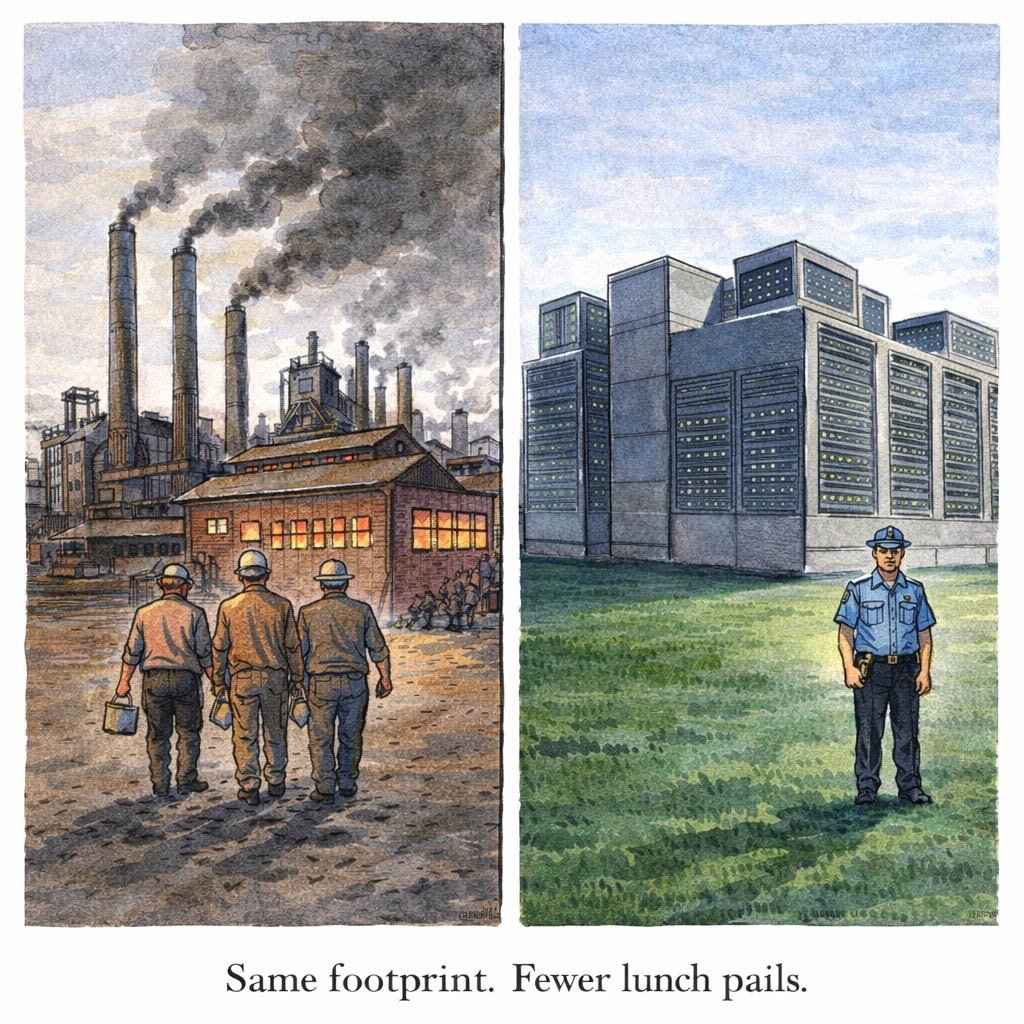
Construction jobs, by their nature, end when construction ends. The paychecks stop. The crews move on to the next large ambition somewhere else. What remains is the structure—and a much smaller group of people needed to operate it.
Which brings us to operations.
Data centers, for all their scale, aren’t major employers in the traditional sense. They’re designed to be efficient, which is a polite way of saying they don’t need many people to do what they do. A facility that costs billions to build may employ only a few dozen or a few hundred workers once it’s up and running.
Those are good jobs—technical, stable, well-compensated. But they’re not numerous enough to transform a county’s employment picture on their own.
So if the jobs don’t account for the bulk of the “wealth,” where does it go?
Follow the ownership.
The Flow of Wealth
The companies behind these projects—whether it’s Aligned Data Centers or the technology giants they serve—are not headquartered in Beaver County. Their investors are spread across the country and, in many cases, the globe. The profits generated by these facilities, substantial as they may be, tend to flow back to those owners.
That’s not unusual. It’s how modern capital works. But it does mean that the wealth created by a local project doesn’t necessarily stay local.
Then there are the incentives.
Large developments often come with tax abatements, infrastructure support, and other inducements designed to make the numbers work. These aren’t giveaways so much as negotiations—public officials trading near-term revenue for the promise of long-term gain.
The theory is straightforward: attract the investment, broaden the tax base over time, and let the rising tide do what rising tides are supposed to do.
The reality is a bit more complicated.
In the early years of a project, tax revenues may be lower than the headline numbers suggest, precisely because of those incentives. Over time, as abatements phase out and the full assessed value comes into play, the public return improves.
But that’s a long game. And it requires patience, discipline, and a certain tolerance for explaining to constituents why a $10 billion project doesn’t immediately translate into $10 billion worth of local benefit.
There are, of course, secondary effects.
Local businesses may see increased demand—from construction crews, from visiting engineers, from the steady if smaller workforce that remains. Land values may rise. Infrastructure improvements made for the project may benefit others.
These are real gains. They’re just harder to measure, and they tend to arrive unevenly.
One business thrives. Another notices little difference. A landlord does well. A retailer wonders where everyone went.
Economic development, it turns out, is not a uniform experience.
Which brings us back to that original question: who actually gets rich?
The unsatisfying but honest answer is: a number of different people, in different ways, at different times.
Construction workers earn strong wages—for a while. Landowners who sell or lease property can do very well. Companies that build and operate the facilities stand to make substantial returns over the long term. Local governments, eventually, may see increased tax revenues—if the project performs as advertised and the policy choices hold.
And the broader community?
It benefits, but not always in ways that feel immediate or dramatic.
There’s a tendency, in places like Beaver County, to look for a single project that will restore something we remember—a sense of shared prosperity, visible and undeniable. The steel mills once did that. You could see the jobs. You could hear them. You could feel them in the rhythm of daily life.
Data centers don’t work that way.
They’re quieter. More abstract. They generate value that moves at the speed of light and often settles somewhere else.
That doesn’t make them bad investments. It just makes them different.
Which means the real challenge for Beaver County isn’t simply to attract projects like this. It’s to negotiate them wisely—to understand where the value is created, how it flows, and what levers exist to ensure that a meaningful share of it stays close to home.
That requires clear eyes and fewer illusions.
Because $10 billion is an impressive number. But it’s not a guarantee. It’s a starting point for a conversation—one that should include not just what gets built, but who benefits when it does.
In the end, the question isn’t whether Beaver County should welcome this kind of investment.
It’s whether we’re prepared to make the most of it.
And that’s a question worth at least $10 billion.