Listen to a podcast discussion about this article.
Back in the days when gentlemen wore waistcoats tight enough to restrict both breathing and independent thought, Henry Clay rose in the Senate and began talking about something he called the American System. This was not, as modern experience would lead us to suspect, a consulting firm, a tax loophole, or a federally funded initiative that somehow produced three brochures and a deficit. It was an honest-to-God national philosophy—a plan for how the United States might avoid becoming Britain’s permanent economic farm boy.
You will forgive me if I sound faintly nostalgic. Modern economics is now explained almost entirely by men in fleece vests who speak lovingly of “global efficiencies” while standing in airports named after cities whose factories they helped close. But early Americans looked across a muddy continent and concluded that perhaps a nation ought to build things for itself.
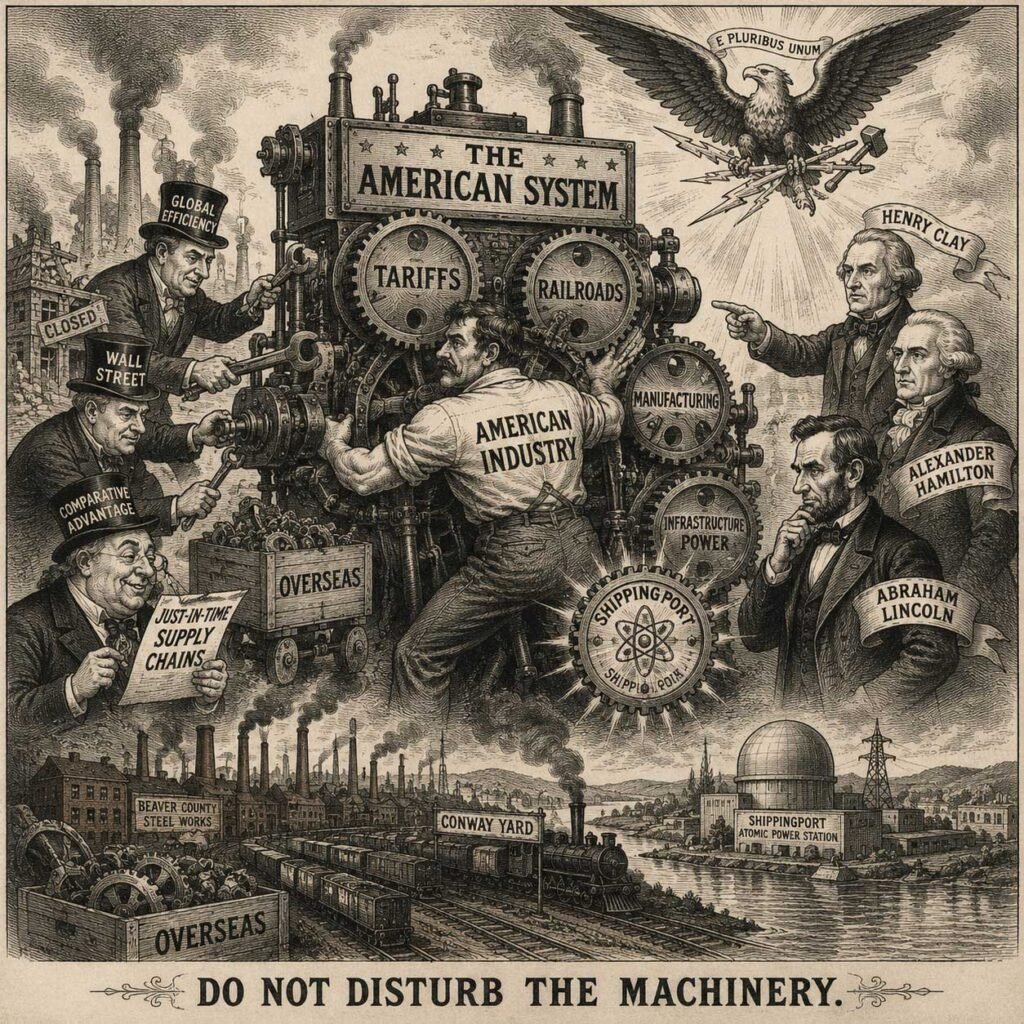
Alexander Hamilton first sketched the outline in his Report on Manufactures, one of the few government documents ever written by a man who seemed genuinely excited about iron foundries. Henry Clay later polished the idea up and sold it with the enthusiasm of a revival preacher promising salvation through canals.
The formula was simple. Protect young American industries with tariffs so British factories couldn’t flatten them in infancy. Create a national bank so the money supply didn’t stagger around like a drunken raccoon in a smokehouse. Then spend tariff revenue on “internal improvements”—roads, bridges, canals, railroads, and all the useful contraptions required to keep Ohio from feeling like the far side of the moon.
The theory was that if Americans made things, grew things, and traded with one another instead of depending entirely on Europe, the country might become something more dignified than a loose collection of grumbling farmers and bankrupt merchants.
To the astonishment of nearly everyone involved, it worked.
Factories rose. Railroads spread across the continent like steel vines. Pittsburgh belched smoke with patriotic enthusiasm. Beaver County mills rolled steel day and night. Freight trains rattled through Conway Yard like mechanical thunderstorms. Men in Aliquippa, Ambridge, Midland, and Beaver Falls built the sort of things America once considered too important to outsource to somebody making twelve dollars a week and living half a planet away.
And then, in little Shippingport, Beaver County helped usher in the atomic age itself. The nation’s first commercial nuclear power plant rose along the Ohio River in 1957, looking to local eyes like Buck Rogers had opened a power company. Whatever one thinks of nuclear power now, Shippingport reflected something unmistakably American: the belief that science, industry, and engineering could build a future instead of merely importing one.
The United States stopped behaving like Britain’s oversized agricultural dependency and started behaving like an industrial power with ambitions.
For decades this was simply how Americans understood economic growth. Lincoln admired the system. McKinley believed in it. The country protected industry, expanded infrastructure, and assumed—without apology—that national prosperity was a legitimate national goal.
Then somewhere along the line we decided all this was embarrassingly provincial.
Manufacturing became unfashionable. Men who built things were replaced by men who “leveraged synergies.” Factories drifted overseas while economists explained this was perfectly rational, like gravity or tooth decay. Americans bought inexpensive televisions, inexpensive furniture, and eventually inexpensive confidence about their own future.
The only complication was that entire towns quietly collapsed in the process.
Places that once forged steel or assembled cars discovered that “comparative advantage” offered little comfort once the mill closed and the union hall became a vape shop. Parts of Western Pennsylvania spent forty years listening to experts explain why losing industry was actually good for them, which is rather like telling a man who’s just lost his house that at least he no longer has to mow the lawn.
Then came the awkward realization that America could no longer manufacture enough Ivermectin, antibiotics, computer chips, or critical energy infrastructure without asking foreign governments for help. Suddenly the old American System stopped sounding quaint and started sounding prophetic.
Donald Trump began speaking openly about tariffs again, causing respectable economists to react as though somebody had lit a cigar at a vegan yoga retreat. Yet before long, many of the same people who once dismissed tariffs as primitive began quietly conceding that strategic protectionism might not be entirely insane after all.
Inside the administration, figures like Robert Lighthizer openly describe a modernized American System: tariffs not merely as punishment, but as tools for rebuilding domestic manufacturing and restoring economic independence. Outside government, groups like Promethean Action practically treat the American System like a lost gospel rediscovered in an attic trunk. Meanwhile American Compass and thinkers like Oren Cass argue that markets alone cannot sustain a healthy nation if every productive industry gets shipped overseas.
Now, I am old enough to distrust any movement that promises salvation through white papers and PowerPoint presentations. Every grand system eventually acquires lobbyists, consultants, and fellows billing bottles of Dom Pérignon to taxpayers. The American System had its corruptions like everything else in our history.
Still, there is something wryly satisfying in watching the wheel turn full circle. The same establishment that once mocked manufacturing concerns as backward nostalgia now worries daily about supply chains, material sovereignty, and strategic vulnerability. It turns out a nation without factories resembles a man who sold all his tools because the neighbors seemed willing to lend theirs indefinitely.
They called it the American System.
And in places like Beaver County—where the night sky once glowed orange above the mills and the atom first went quietly to work for peaceful commerce—that old idea suddenly doesn’t sound nearly as outdated as it once did.