Listen to a podcast discussion about this article.
Business used to be something you talked about while slicing a Titleist into the trees at your country club. A fellow in plaid trousers would mutter something about steel orders between putts, another would nod gravely over a highball, and by the eighteenth hole, somebody had agreed to buy three truckloads of pipe fittings from Aliquippa and expense the martinis.
Increasingly, however, the country club itself is the business.
And business is suddenly healthier than the guy in the pro shop trying to sell you a $600 driver “engineered by aerospace technology.”
For years, country clubs occupied that peculiar American category known as “endangered luxury.” They were expensive to maintain, difficult to modernize, and increasingly out of fashion with younger Americans who preferred breweries, pickleball, and posting photographs of tacos on Instagram. Some clubs closed altogether. Others limped along like retired steel executives surviving on cholesterol medication, fading memories of the Nixon administration, and stories about the year they nearly beat Arnold Palmer at Latrobe.
Then came the pandemic.
While the rest of America was bleaching groceries and conducting office meetings from spare bedrooms in sweatpants, golf quietly staged one of the great comebacks in modern recreational history. A socially distanced stroll across manicured grass suddenly looked less like elitism and more like preventative medicine.
Americans took up golf in droves. Millennials—the same generation once accused of killing napkins, department stores, chain restaurants, and possibly Western Civilization itself—started joining clubs.
Country clubs, smelling opportunity the way a Labrador smells unattended steak, reinvented themselves overnight.
According to an analysis of IRS filings by The Business Journals, nonprofit country clubs saw unrelated business income rise 63 percent between 2019 and 2023. Translation: clubs are making money from a lot more than dues and old men arguing about bunker etiquette.
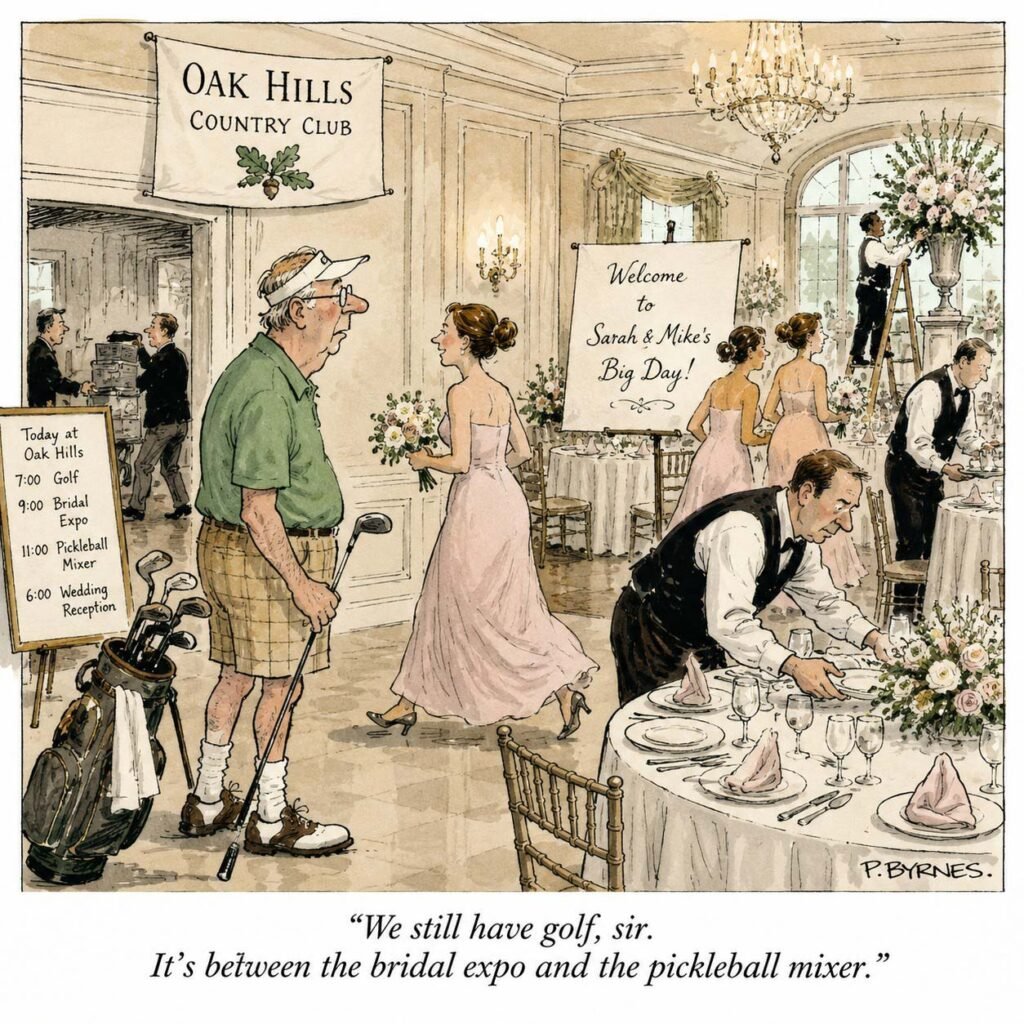
Weddings. Corporate retreats. Public dining. Concerts. Charity outings. Vacation golf packages. Some clubs now resemble luxury summer camps for adults with orthopedic shoes and brokerage accounts.
In Arkansas, Diamante Country Club now markets golf vacations to nonmembers. In Florida, Kensington Golf & Country Club renovated itself into a sprawling wedding-and-event operation capable of hosting 330 guests at a time. Somewhere, a fellow who once joined simply to avoid the public golf course is now wandering through a bridal expo looking for the locker room.
One almost expects country clubs to introduce escape rooms and artisanal goat yoga by Labor Day.
Even investment income has exploded. Median investment earnings among clubs studied jumped from barely more than two thousand dollars in 2019 to nearly nineteen thousand by 2023. More than two-thirds of clubs are now operating profitably, which may explain why the crab cakes suddenly contain actual crab again.
The golf boom itself is remarkable. Americans played more than 500 million rounds last year, according to the National Golf Foundation. That exceeds even the famous Tiger Woods era, despite there being fewer golf courses than there were twenty years ago.
Around Beaver County, you can feel the shift.
Seven Oaks Country Club has evolved into something far beyond the old stereotype of cigar smoke, wilted shrimp cocktail, and men named Skip discussing municipal bonds. The club calendar now resembles the activity schedule aboard a Caribbean cruise ship: couples golf, ladies’ nights, junior camps, wine clubs, cigar clubs, pickleball, live music, poolside dining, and themed events elaborate enough to require their own subcommittee.
The old country club revolved around golf. The new country club revolves around making sure nobody has any reason to leave the property before sunset.
Seven Oaks has invested in patios, upgraded dining, refreshed courts, and family programming. Membership pitches increasingly emphasize lifestyle over exclusivity. The modern sales pitch is essentially this: where else can exhausted parents hand the kids a tennis racket, order cocktails, and complain about property taxes without ever moving the SUV?
Elsewhere around the county, clubs are adapting in similar ways.
Beaver Valley Golf Club continues to trade on panoramic Beaver River views and its long history while wisely discovering that “historic” sounds considerably better than “the carpeting remembers Eisenhower.”
Connoquenessing Country Club leans heavily into dining and events, understanding that many people attending country club weddings could not identify a seven iron if threatened with one.
The Club at Shadow Lakes has embraced a semi-public model that would once have caused traditional club boards to faint directly into the clam chowder. Public golf. Public dining. Flexible memberships. Country club amenities without the intimidating atmosphere of inherited wealth and silent judgment.
Meanwhile, Deer Trails Country Club offers something increasingly rare in modern America: silence. Scenic hills, relaxed golf, and several uninterrupted hours without hearing the phrase “circle back.”
Of course, prosperity has its complications. IRS filings suggest many clubs remain surprisingly casual about governance. Fewer than half report formal document-retention policies, and only about half maintain conflict-of-interest rules. Apparently, some boards still believe accountability means Earl promising not to let his cousin pave the parking lot again after the unfortunate asphalt incident of 2017.
Still, the larger trend is unmistakable. The country club survived the pandemic by becoming something broader: part golf course, part restaurant, part wedding venue, part wellness center, and part suburban village square for people weary of conducting their entire social lives through telephones.
Which helps explain why the parking lots are full again, the waitlists are growing, and Beaver County’s fairways are humming with activity that has remarkably little to do with lowering one’s handicap.