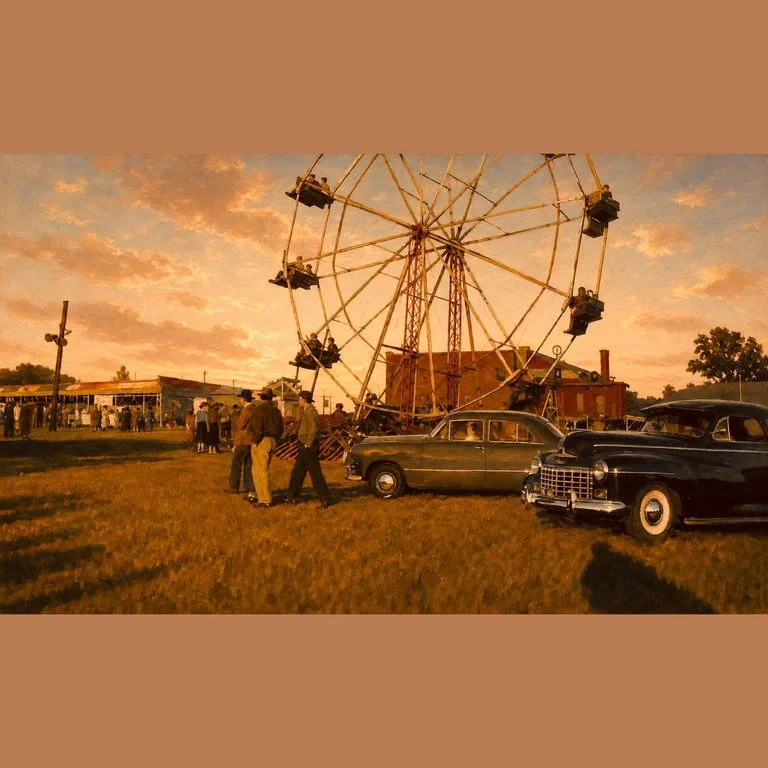
The Last Gasp of the RibbonCutters: Western Pennsylvania Edition

Rodger Morrow Avatar

Listen to a podcast discussion about this article.

One of the small consolations of growing older in Western Pennsylvania is discovering that certain institutions never truly die. They simply continue holding luncheons about “stakeholder engagement” until the lights are finally shut off by a regional authority.

The local chamber of commerce belongs proudly in this category.

These organizations were born in a gentler America, back when businessmen wore hats downtown, smoked through dinner, and conducted economic development with a handshake, two bourbons, and a nephew who “knew a guy at Babcock & Wilcox.” In those days, if you wanted customers, vendors, or influence, you joined the chamber. It was part civic fraternity, part sales directory, and part excuse to eat rubber chicken on a weekday afternoon.

Today, however, the chamber of commerce often resembles a Rotary Club trying to understand cryptocurrency.

Take the Beaver County Chamber of Commerce and its flagship Leadership Beaver County program, a nine-month educational pilgrimage involving monthly full-day Thursday sessions from 8 a.m. to 3 p.m. For $1,500, plus a $25 application fee—and chamber membership, naturally—you can spend nearly a year studying “Purposeful Leadership,” “Project Leadership,” “Equity Leadership & Cultural Competency,” nonprofit organizations, and an “Everything DiSC® Assessment,” which sounds less like business training than something administered before parole hearings.

One imagines some poor young software entrepreneur sitting there with his phone vibrating every thirty seconds from actual customers, wondering when the curriculum gets around to subjects like “How To Beat Competitors” or “How To Ship A Product Before Somebody In Singapore Copies It.”

But no. First comes a workshop on synergies.

This is not commerce. This is finishing school for future luncheon speakers.

Meanwhile, over at the Pittsburgh North Regional Chamber—which merged several chambers together back in 2010 in one of those consolidations usually described as “positioning for future growth”—the emphasis is on expanded social media outreach, networking mixers, business visibility, targeted advertising, and community engagement forums.

All perfectly respectable.

All sounding faintly like a PowerPoint presentation discovered frozen in amber sometime around the second Obama administration.

The modern chamber still promises credibility, visibility, advocacy, and professional development, which is rather like a video rental store promising an exciting VHS expansion strategy. One suspects Elon Musk would find the average chamber mixer about as useful as a fax machine at SpaceX.

Imagine trying to explain a ribbon-cutting ceremony to Palmer Luckey.

“Yes, Palmer, we gather beside a new sandwich shop while three elected officials hold ceremonial scissors large enough to neuter livestock. Then we applaud.”

The poor man would assume we had lost a war.

And yet chambers persist because they still perform one function very well: they allow people who enjoy meetings to continue having meetings with one another.

There is, after all, an entire species of American professional whose natural habitat involves banquet rooms with pitchers of iced tea and a keynote speaker discussing “regional partnerships.” These are good people. Civic people. Earnest people. They genuinely believe the future of economic development lies one breakout session away.

But the actual economy has wandered off without them.

Modern business moves at digital velocity. A twenty-five-year-old founder in Baden can recruit employees in Texas, raise capital from California, manufacture in Taiwan, and market worldwide without ever attending a breakfast mixer at Seven Oaks Country Club. Algorithms now perform much of the networking chambers once monopolized. LinkedIn replaced the business card. X replaced half the cocktail-hour chatter. Discord servers replaced committees. A clever kid with Wi-Fi and insomnia can build a customer base larger than many chamber memberships before the luncheon soup arrives.

And this has created a terrible existential problem for chambers everywhere: nobody is entirely sure what they’re for anymore.

Once upon a time, chambers connected businesses to customers and vendors. Today Google does that before breakfast. Chambers once provided advocacy, but increasingly the largest companies simply hire lobbying firms directly while smaller companies complain into the void on Facebook.

So the chamber world has adapted the way old department stores adapted to Amazon: by adding events.

Leadership programs. Awards dinners. State of the County breakfasts. Women in Business luncheons. Energy summits. Healthcare forums. Golf outings. Workforce initiatives. AI conferences featuring PowerPoint slides assembled by a consultant named Trevor.

The chamber slowly transforms into a hybrid species: part event planner, part civic booster, part government-adjacent networking ministry.

And to be fair, some of this work is useful. Communities do need civic glue. Somebody has to organize forums, host discussions, and convince local officials not to accidentally zone half the county into a parking lot. The people involved are often hardworking and sincere.

But sincerity alone does not guarantee relevance.

The deeper problem is philosophical. Chambers still operate on the assumption that business success comes through relationship management, committee participation, and institutional respectability. That was once true. It is far less true now.

Today success rewards speed, obsession, technical edge, and direct customer connection. The modern economy favors builders who move quickly enough to make committees physically uncomfortable. By the time a chamber task force approves a strategic framework for innovation initiatives, some twenty-two-year-old in a hoodie has already launched three apps and sold one of them to Microsoft.

The chamber model was designed for the age of railroads, banks, insurers, and manufacturers with local headquarters and permanent civic identities. But modern capital is nomadic. Talent is mobile. Commerce is digital. The old structure increasingly feels like a travel agency after Expedia.

And still the ribbon-cuttings continue.

Every few weeks somewhere in Western Pennsylvania, a line of smiling dignitaries assembles outside a vape shop, dental office, or sandwich franchise holding novelty scissors the size of hedge trimmers while photographers document the triumph of “economic development.”

Everybody beams heroically.

The chamber president says a few words about partnership.

The county commissioner praises growth.

Somebody mentions workforce development.

Then everyone goes inside for cookies.

Meanwhile, somewhere else, an actual high-growth business quietly scales online without involving any of them.

One can almost hear the ghost of a long-retired chamber president murmuring proudly, “But we’ve always done it this way.”

Yes. Exactly.

And that, unfortunately, is usually how institutions announce they’ve mistaken routine for relevance.

The ribbon-cutters had a good long run. But the information age does not move at the speed of the next awards dinner. It moves at the speed of innovation, adaptation, and people willing to bypass the committee entirely.

The chambers may survive in some form—as civic clubs, networking societies, or respectable luncheon associations for people who still enjoy hearing the phrase “public-private partnership” before dessert.

But as engines of genuine commercial dynamism?

That ship has already sailed.

Probably without stopping for the ribbon-cutting.

Share This Story

Facebook
X (formerly twitter)
Reddit
LinkedIn
Threads
Email

share this story:

Facebook
X (formerly twitter)
Reddit
LinkedIn
Threads
Email

Leave a Comment

MORE FROM BEAVER COUNTY BUSINESS:

Scroll to Top

Donate?

Local stories don’t tell themselves. Your contribution helps Beaver County Business report, explain, and preserve the stories that matter most.