When Rudyard Kipling Came to Beaver

Rodger Morrow Avatar

Listen to a podcast discussion about this article.

Rudyard Kipling’s travel itinerary in 1889 included India, Hong Kong, Japan, San Francisco, Yellowstone, and Chicago. Somehow, tucked among those far-flung destinations was Beaver, Pennsylvania. It is the sort of detail that makes people pause and ask if they heard correctly: yes, the future author of The Jungle Book and one of the most famous writers in the English-speaking world really did spend time in Beaver—and he liked it enough to write about it.

Few places can honestly say Rudyard Kipling came to town and wrote about it. London can. Bombay can. And, somewhat improbably, so can Beaver, Pennsylvania.

This is one of those historical facts that sounds as though it was invented by a local chamber of commerce after a particularly optimistic lunch and two rounds of dessert. Yet it is entirely true. In the summer of 1889, a 23-year-old Rudyard Kipling—the future Nobel Prize winner and author of The Jungle Book, Kim, and If—arrived in Beaver after a journey that had already taken him across much of the globe. He had come from India, crossed Asia, sailed across the Pacific, and survived Chicago. By the time he reached Beaver, he had seen enough of the world to appreciate what made the town distinctive.

Kipling was traveling from India back to England, filing newspaper dispatches that would later become the book From Sea to Sea. Along the way he encountered San Francisco politicians, Yellowstone geysers, Mormon settlements, western railroads, and the industrial thunder of America in its Gilded Age prime. Then he arrived in Beaver as the guest of the Taylor family. Dr. Riley T. Taylor, president of Beaver College, welcomed the young writer with the sort of hospitality that Beaver County has long specialized in: feed the visitor well, introduce him to everyone in town, and make certain he leaves with enough pie to remember you forever.

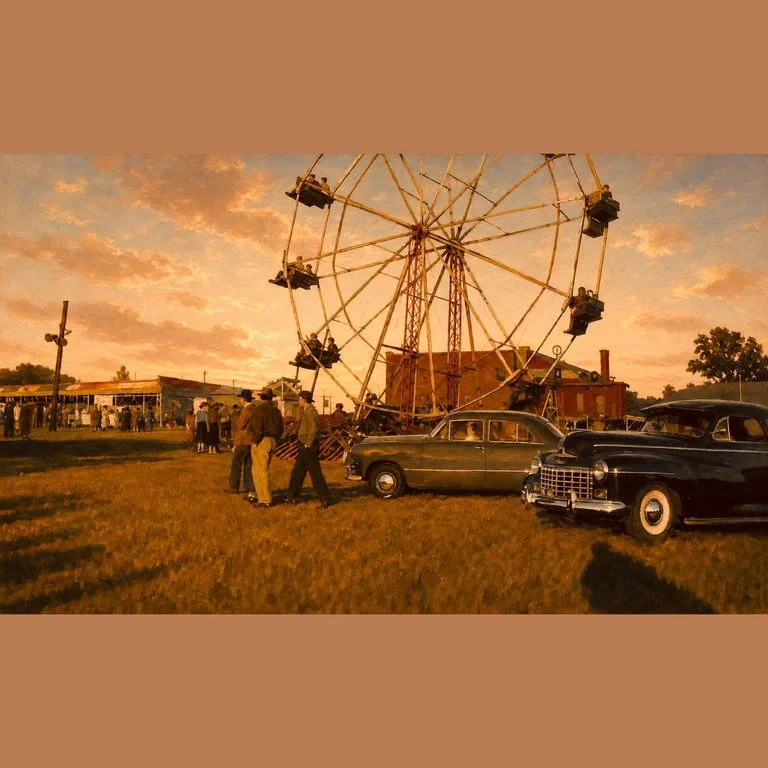
Kipling stayed in rooms associated with Beaver College, across from the Taylor home—today the site of the Fort McIntosh Club. He came because of his friendship with Professor Alec Hill and Hill’s wife, Edmonia Taylor Hill, whom he had known in India. Writing later under the fictional name “Musquash on the Monongahela,” Kipling described a landscape of rolling hills, orchards heavy with apples, goldenrod blazing in the fields, cows wandering home at dusk, and villages tucked discreetly among the trees.

The image is enough to make a modern commuter weep.

Imagine hearing apples fall from a tree. Today most of us would assume somebody had dropped their phone.

Kipling’s description of Beaver reads at times like a travel brochure written by a poet recovering from a nervous breakdown. He stretched out in hammocks, listened to cowbells, admired the orderly streets and flower gardens, and noted how local communities managed their affairs with relatively little visible bureaucracy. To a young Englishman raised in the machinery of empire, that was a noteworthy contrast. To Beaver residents, it was simply Tuesday.

Of course, Kipling could never entirely suppress the slightly patronizing curiosity of an English observer encountering provincial Americans. He was fascinated by local customs, local religion, local politics, and especially local young women. The “maidens” of Musquash receive considerable attention in his account. Kipling observed them sitting on porches in white dresses awaiting the return of local young men who were apparently experts in business, baseball, oil, and commerce. One suspects the young author’s anthropological interest may have been somewhat compromised by the fact that he developed a romantic attachment to Caroline Taylor, one of Dr. Taylor’s daughters.

History records that Beaver nearly acquired Rudyard Kipling as a son-in-law. Had events unfolded differently, generations of local schoolchildren might today be forced to memorize The Beaver County Book instead of The Jungle Book.

Yet the most powerful passage in Kipling’s Beaver letter has nothing to do with romance. Only weeks earlier, the Johnstown Flood had killed more than 2,200 people in one of America’s worst disasters. Bodies had floated downriver into communities throughout western Pennsylvania. Kipling encountered a minister who had lost virtually everything—his church, his congregation, his family, and his livelihood. The man sat quietly in the sunshine, smiling faintly, his mind shattered by grief.

Kipling never forgot him.

For all his reputation as a celebrant of empire and adventure, Kipling possessed a reporter’s eye for suffering. In this broken flood survivor he found something profoundly human: a man enduring the unimaginable because there was nothing else left to do. The moment lingers in the narrative long after the descriptions of orchards and cowbells fade.

Perhaps that is why the Beaver chapter remains one of the most memorable portions of From Sea to Sea. Kipling arrived expecting a small American town. Instead he discovered a complete civilization. There were churches, newspapers, factories, courts, gardens, baseball players, schoolteachers, reformers, romantics, busybodies, and eccentrics. There was prosperity and prohibition. There was civic pride and human frailty. There was beauty, grief, and enough local gossip to keep a newspaper alive indefinitely.

In other words, there was Beaver County.

More than a century later, it is tempting to read Kipling’s account as nostalgia for a vanished world. Yet much of what impressed him remains recognizable. The hills are still rolling. The rivers still curve through the valleys. People still argue about politics, attend church suppers, watch their neighbors closely, and worry about the future. The factories have changed. The technology has changed. The baseball teams have changed.

The gossip, thankfully, remains eternal.

And so one of the world’s most famous writers spent a few weeks in Beaver and left convinced he had found something worth remembering.

Not perfection.

But a community whose character stayed with him long after he moved on.

Kipling came to Beaver as a traveler passing through. He left with an appreciation for a place shaped by its hills and orchards, its porches and river valleys, and the people who endured both joy and sorrow there. More than a century later, that may be the finest compliment Beaver County has ever received.

Share This Story

Facebook
X (formerly twitter)
Reddit
LinkedIn
Threads
Email

share this story:

Facebook
X (formerly twitter)
Reddit
LinkedIn
Threads
Email

Leave a Comment

MORE FROM BEAVER COUNTY BUSINESS:

Scroll to Top

Donate?

Local stories don’t tell themselves. Your contribution helps Beaver County Business report, explain, and preserve the stories that matter most.