By Rodger Morrow, for Beaver County Business
Listen to a podcast discussion about this article.
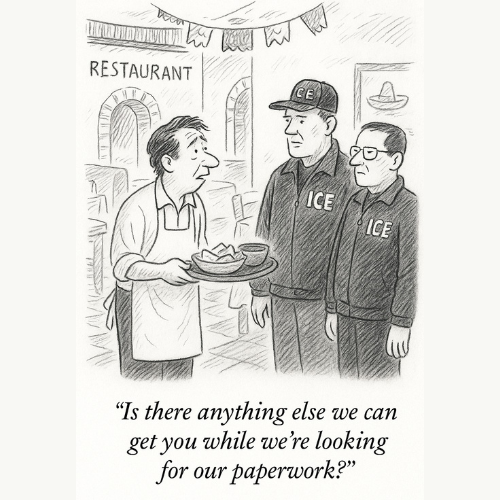
Federal agents in windbreakers don’t usually appear in the lobby for a friendly chat. Just ask the Beaver County businesses — and their neighbors in Cranberry Township — who’ve had unexpected visits from U.S. Immigration and Customs Enforcement (ICE) in recent months. These surprise appearances, sometimes accompanied by the clatter of clipboards and the flash of badges, are part of a nationwide crackdown on immigration compliance.
For employers, the message is blunt: keep your house in order, or ICE will do it for you.
Compliance Isn’t Optional
The U.S. immigration system is many things — complicated, bureaucratic, and often political — but above all, it demands paperwork. ICE typically handles immigration enforcement, but the Fraud Detection and National Security Directorate (FDNS), a branch of U.S. Citizenship and Immigration Services, also makes unannounced visits tied to H-1B and L-1 petitions. These visits are not casual drop-ins. They are designed to confirm that employers are actually living up to the promises made on immigration forms — about job duties, work sites, and salaries.
Think of it as a pop quiz for employers, except failure can bring penalties, lawsuits, and very bad headlines.
Why They Show Up
The FDNS playbook suggests they’re more likely to knock if:
- A company’s basic business information can’t be verified by standard databases.
- The employer is considered “H-1B dependent.”
- Workers are assigned off-site at other companies.
- A petition involves multiple foreign national employees.
Meanwhile, ICE has its own arsenal. The most common tool is the I-9 audit, a review of the forms every employer must keep to verify that workers — citizen or not — are legally authorized to be on payroll. Then there are the dramatic worksite enforcement actions that target specific individuals, sometimes leading to detention or deportation. These, naturally, get the headlines and the heartburn.
But don’t be fooled: the quieter FDNS visits and I-9 audits are just as dangerous if employers are sloppy.
The Playbook for Employers
So what’s a business owner in Beaver or Cranberry supposed to do besides keep the coffee hot in case ICE swings by? The Pittsburgh Business Times outlined a practical checklist worth pinning to your HR bulletin board:
- Know your rights — and your employees’ — during compliance checks.
- Review and rehearse immigration and I-9 policies regularly. Create a written response plan.
- Audit yourself — run internal I-9 audits and confirm that job duties, work sites, and salaries of H-1B and L-1 employees match petitions filed.
- Keep clean records — store I-9s and related documents safely, in order, and accessible.
- Train staff — make sure HR and supervisors know how to respond to visits, audits, or questions.
- Educate employees — staff should be able to answer basic questions about the company and its compliance practices.
- Beware scams — federal agencies won’t be contacting you on WhatsApp.
Practice Makes Professional
Perhaps the most sobering reminder is that compliance checks are almost always unannounced. That means businesses must treat preparation like fire drills: have a protocol, document it, train more than one employee to execute it, and practice until it feels routine.
The government is not impressed by panic. What it wants to see is organization, competence, and the ability to produce documentation promptly and confidently. Employers who rehearse protocols are far more likely to turn a surprise inspection into a mere inconvenience rather than a full-blown crisis.
Tailored, Not Generic
Every business is different, and immigration compliance should reflect that. A diner in Rochester with two H-1B workers won’t need the same playbook as a multinational engineering firm in Moon Township. Industry, workforce composition, and company size all shape what compliance looks like. For many, consulting counsel is not a luxury but a survival strategy.
The Bottom Line
Beaver County’s employers may pride themselves on grit, but grit won’t satisfy ICE. What will is a paper trail that proves compliance at every step. The recent enforcement actions close to home are a reminder that federal immigration rules are not abstract regulations — they are obligations with real-world consequences.
And in case anyone still thinks of compliance as optional, consider this: the government has the time, the authority, and the resolve to show up at your door unannounced. You’d better have more than donuts ready.