by Rodger Morrow for Beaver County Business
Listen to a podcast discussion about this article.
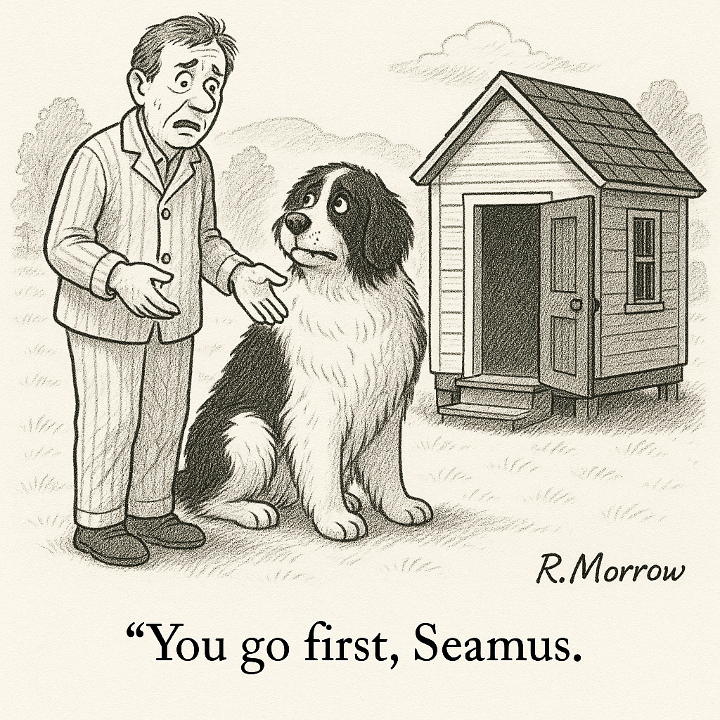
I sometimes wonder how many people actually live in those “tiny homes” we keep hearing about. Judging by Instagram, you’d think half the country has traded their mortgages for cedar-scented sheds with loft beds reachable only by Sherpa. My suspicion is that tiny homes are less a dwelling than a social-media folk tale, a sort of folk remedy for economic malaise. They promise that America hasn’t entirely given up on solving homelessness or the economy—just shrunk the square footage until the problem no longer fits inside.
The Census Bureau, not known for whimsy, says the typical new house sold last year was 2,210 square feet—roughly two tiny homes and a mudroom. Builders quietly admit the market for truly small houses is a rumor at best: only a sliver of new starts come in under 1,600 square feet, and the once-familiar sub-1,400-foot cottage has nearly vanished from the species list. Meanwhile, the “tiny homes” we see online are often park-model RVs with better lighting. The RV industry, also not famous for whimsy, counts them by the few thousand a year.
Recently, Pittsburgh City Council even tried to codify the notion of tiny homes, advancing a bill that would permit them as interim housing for people moving out of homelessness. Yet in the same breath, one of the bill’s own sponsors admitted he hoped the city would never reach a point where such housing became necessary—an almost perfect expression of the unease that hovers around the whole movement. On paper then, the “tiny house” is more anecdote than architecture.
And even if we did scatter these dollhouses across the landscape, would this be a sustainable way to live? (Forgive the word “sustainable,” which has been wrung so dry it now squeaks when you use it.) Apartment complexes are a far more efficient way to house the indigent—but we tried that. Starting in the 1950s and ’60s, cities rolled out towers of affordable housing that now serve mostly as cautionary tales. For every ribbon-cutting there followed a slow-motion collapse: maintenance neglected, elevators out, roofs leaking, corridors surrendering to crime and despair. The result was not efficiency but a kind of civic embarrassment, proof that the American Dream of front-porch life and “Howdy, neighbor” could be flattened into a bleak corridor where nobody knew your name.
So perhaps we’re only indulging a new fantasy, the Levittown of our era—mass-produced hope in miniature. The old Levittowns promised affordable prosperity, but within a few short years many of those houses were flaking, sagging, and subject to the same law of entropy that governs all human settlement: if nobody cares, it rots. The problem isn’t the footprint, it’s the stewardship.
Which leaves the larger question: has the dream itself been lost, or merely put tantalizingly out of reach by bureaucrats and politicians? Somewhere between the zoning boards that outlaw small houses and the subsidy programs that warehouse the poor in concrete towers, we’ve managed to misplace the modest, durable homes that once filled America’s towns. The fantasy persists—whether it’s called Levittown or the Tiny House Movement—but reality is larger, harder to manage, and much less Instagrammable.
By the Numbers: How Rare Are Sub-1,000-Foot Houses?
- 2,210 sq ft — Median size of a new single-family home sold in 2024
- 7% — Share of new homes built in the U.S. that are 1,400 sq ft or smaller (2022)
- 16% — New single-family starts under 1,600 sq ft (2023), despite 26% of buyers saying they wanted one
- ~1,800 sq ft — Average size of previously owned homes purchased in 2024
- 3,927 — Park-model RVs shipped in 2024 (many marketed as “tiny homes”)
- –2.8 million — Net decline in U.S. housing units under 1,000 sq ft between 1985 and 2005