By Rodger Morrow, Editor & Publisher, Beaver County Business
Listen to a podcast discussion about this article.
Beaver County, Pennsylvania. To outsiders, it’s that bend in the Ohio where the bridges groan and the old mill stacks still point accusingly at heaven. To many of us, it’s home. But let us, for the sake of imagination—and because imagination (unlike redevelopment grants) is still free—picture a future so implausibly bright that even the chamber-of-commerce brochure would avert its eyes in embarrassment: Beaver County not just surviving the Rust Belt shuffle, but becoming its epicenter.
Yes, I said it. Epicenter. Where Silicon Valley has Teslas queuing at stoplights, we’ll have barges gliding along the Ohio, rails humming, and engineers who prefer Milwaukee drills to stock options. And—if you’ll allow a moment of speculative euphoria—we’ll even master that elusive blend of kilowatts and code: Bitcoin, blockchain, and the kind of sound money our grandparents thought the Fed had misplaced somewhere around 1971.
Phase One: Ignition (2025–2035)
It starts, naturally, with tariffs. You may clutch your iPhone and mutter about Herbert Hoover, but in this daydream tariffs arrive like a summer thunderclap—loud, inconvenient, yet strangely cleansing. Foreign gadgets disappear; domestic factories stir. Mitsubishi Electric puts down roots in New Galilee; Eaton bolts in more EV chargers; Westinghouse builds modular nukes. Even Mawson Infrastructure, the digital miner in Midland, pivots from Bitcoin to AI with the ease of a man switching vices.
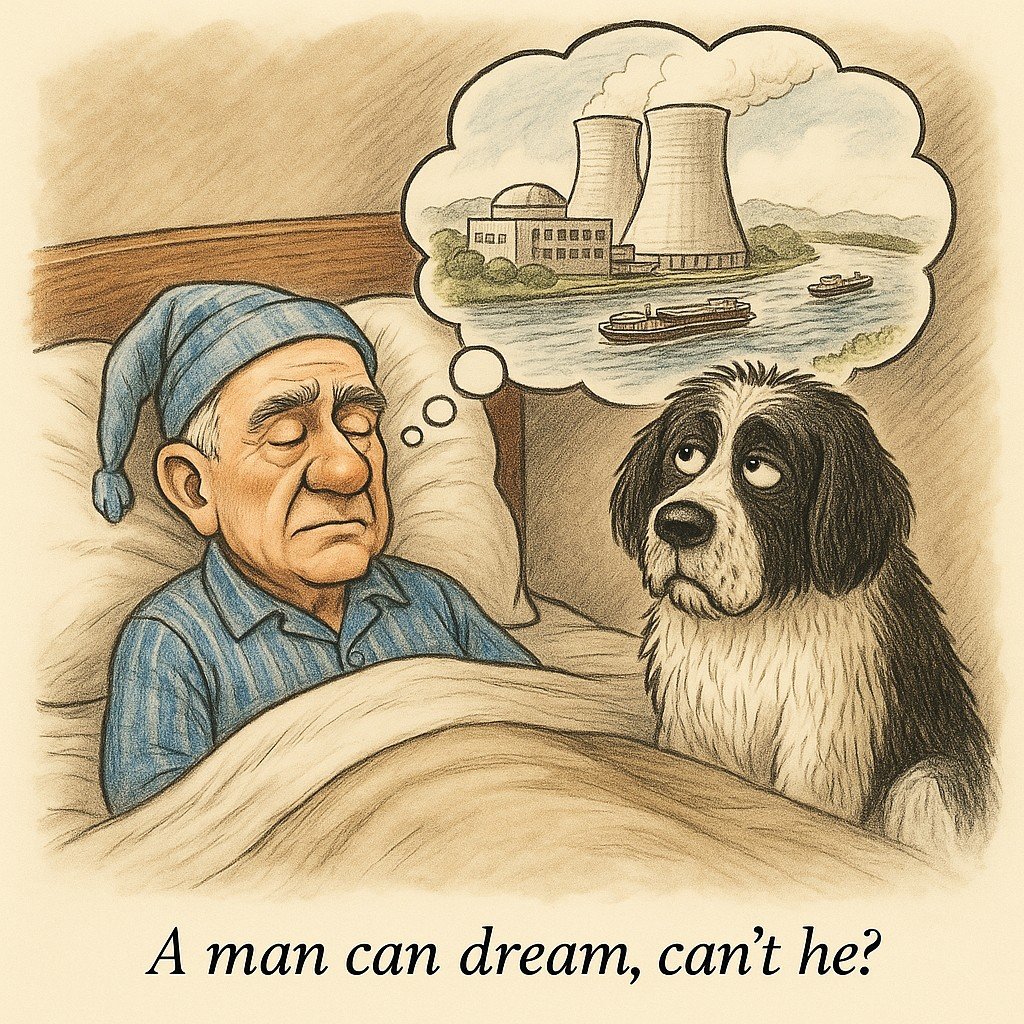
The Bruce Mansfield plant, once a coal-dust reliquary, re-emerges as a coal, natural-gas, and nuclear powerhouse with an AI data center bolted on—a three-scoop industrial sundae topped with a silicon cherry. By 2028, Beaver hums with electrons and optimism. (One can only hope the optimism proves renewable.)
Cheap energy, that elusive grail, becomes our moat. We sell power to anyone who’ll buy it, then mine digital gold with what’s left. Blockchain ledgers—bless their incorruptible hearts—record it all, ensuring that not even the most creative accountant can make off with the petty cash.
And somehow, through all this circuitry and optimism, we rediscover that old-fashioned thing called work. CCBC teaches coding to welders; Geneva turns philosophers into entrepreneurs; Penn State spins up apprenticeships that involve both laptops and calluses. By 2035, unemployment is practically theoretical, GDP has doubled, and the pothole festival is rebranded as the Infrastructure Resilience Gala.
Challenges remain, of course. Tariffs pinch, retraining grumbles, and a few environmental saints still chain themselves to compressor stations. But Beaver County people have never been shy about using both ends of a wrench.
Phase Two: Synergy (2035–2045)
With foundations poured and hope adequately caffeinated, the next decade is about cooperation. Factories talk to each other—politely, at first—via blockchain-verified contracts. Westinghouse’s carbon-neutral reactors power Mawson’s edge-computing nodes. Supply chains get so transparent that even the nosiest bureaucrat can’t find anything to regulate.
Universities blossom into miniature Silicon Valleys (mercifully without the West Coast rent). Penn State Beaver doubles in size; CCBC graduates welders who code and coders who weld. A “Grit Grant” lures Gen Z home with free tuition and the promise of a view of the Ohio instead of the Pacific.
Hyperloops snake through retired railbeds, drones monitor the river, and electric air-taxis rise from the airport. Energy exports fatten the budget. By 2045, property values triple, downtown cafés serve black coffee and industrial-grade optimism, and Beaver’s GDP tops $40 billion (in real, Bitcoin-backed dollars). Even so, we promise ourselves not to get smug—though one suspects a few new residents will try.
Phase Three: Ascendancy (2045 +)
By 2060, the fantasy goes, Beaver County quietly outpaces Silicon Valley. Per-capita income hits $250,000, GDP passes $100 billion, and our local “Beaver Tech Consortium” has replaced Stanford as the nation’s favorite producer of hoodie-clad geniuses. Factories run on AI, but the foremen still coach Little League.
The secret, if there is one, lies in that old-fashioned triangle of hard work, compounding, and sound currency. Grit breeds loyalty; loyalty breeds innovation; and innovation—anchored in sound money instead of Washington’s latest whim—finally gives this place what the mills once promised: permanence.
Still, a prudent editor can’t help wondering if this juggernaut of progress won’t make us slightly insufferable. When per-capita income reaches a quarter-million, will we still wave at each other on Third Street? Or will we hire public relations people to do it for us?
So the story ends, not with fireworks and venture-capital champagne, but with a steady industrial hum. Steel no longer clangs on the riverbank, but the music of industry remains—cleaner, quieter, verifiable on the blockchain, and perhaps just self-important enough to need a good joke now and then.
Beaver County’s future, should it arrive on schedule, will be all the things we were told America used to be: productive, grounded, and a little too sure of itself. If a visitor stands on the riverfront in 2060 and hears the whisper of AI-run factories downstream, he might call it a miracle. Around here, we’ll just call it Thursday—and quietly hope the ledger still balances.