By Ron Weddington
Staff writer, Beaver County Business
Listen to a podcast discussion about this article.
It began, as so many great Beaver County spectacles do, with somebody putting out a few cases of bottled water and figuring that would be enough.
In 2019, the New Brighton Historical Society held its first Underground Railroad walking tour. They stocked refreshments for fifty thirsty souls. Instead, buses arrived, seven hundred people poured out, and suddenly the town found itself giving history lessons on a scale not seen since the last time the Steelers won the Super Bowl.
What they came to see was not costumed reenactors or animatronic Abe Lincolns, but the real thing: houses with trap doors, cellars with secret rooms, and streets once mapped not for real estate but for escape.
The Old Safe House Circuit
In the mid-1800s, New Brighton and its neighbors perfected the art of Beaver County hospitality under cover of darkness. The Nelson House took in the first arrivals from Washington County. The Townsend family, clearly overachievers, ran a whole chain operation—Roly with his trap-door cellar, Benjamin with his handy cave, David with the grist mill, William Penn with a secret room roomy enough for ten. Think of it as a 19th century Holiday Inn Express franchise, but without the waffles.
Arthur Bullis Bradford’s Darlington estate, “Buttonwood,” provided yet another stop. And in Bridgewater, the Old Hotel gave lodging to Richard Gardner—until bounty hunters showed up and carried him off. Locals, displaying the true Beaver County knack for passing the hat, raised $600 (about $20,000 in today’s dollars) to buy him back. Try getting that kind of community support at your next school fundraiser.
Pen, Pulpit, and Platform
The Underground Railroad here wasn’t just built on trap doors and creek beds. It thrived on words. Sarah Clark Lippincott wrote so sharply about abolition that Lincoln himself called her “the little Patriot.” Frederick Douglass lectured in New Brighton in the 1860s, proving that the town could draw a crowd long before Friday night football.
“Let the religious press, the pulpit, the Sunday school, the conference meeting, the great ecclesiastical, missionary, Bible and tract associations of the land array their immense powers against slavery and slave-holding; and the whole system of crime and blood would be scattered to the winds; and that they do not do this involves them in the most awful responsibility of which the mind can conceive.” —Frederick Douglass, 1852
Enter Odette Lambert
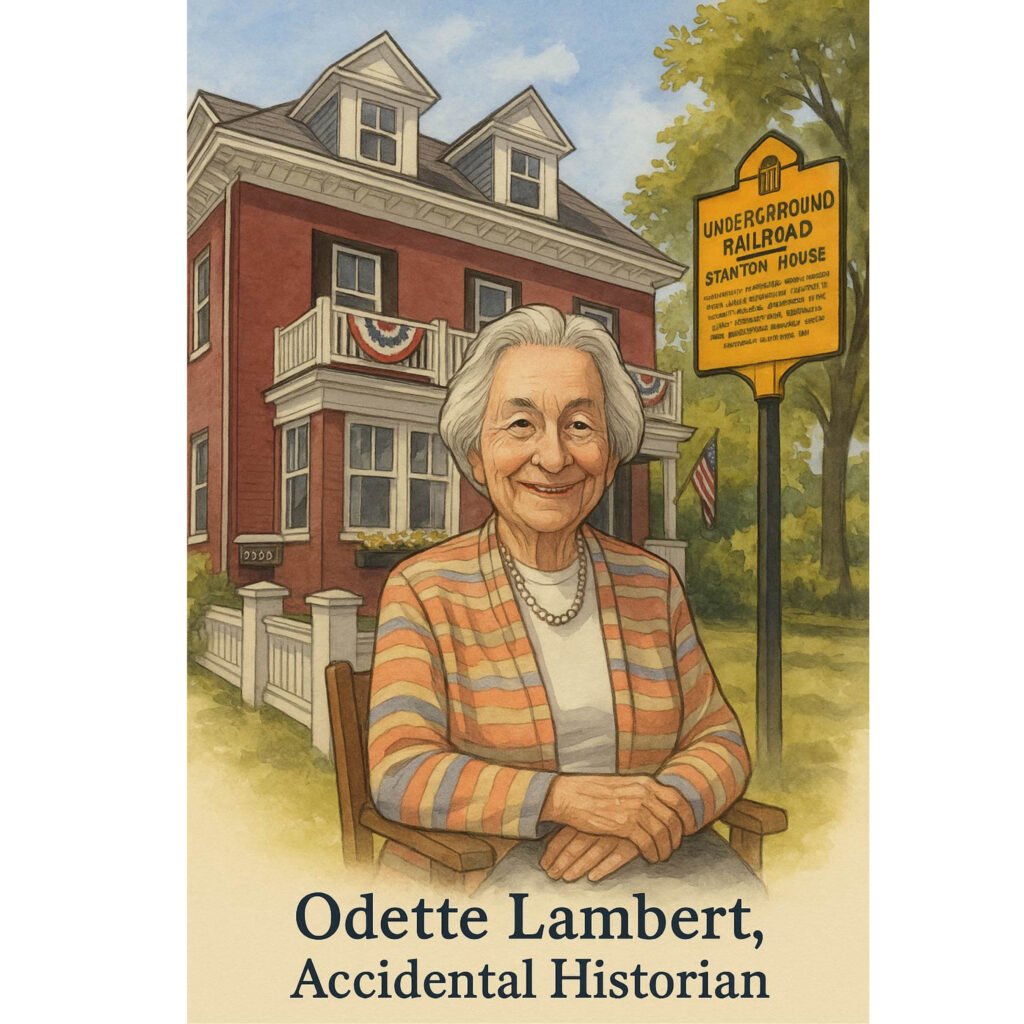
Fast-forward a century and a half. A young teacher wondered if New Brighton had something to do with the Underground Railroad. She asked her colleague, Odette Lambert, who thought it might be worth looking into. That innocent query lit a fire that still burns at age 97. Lambert became the county’s accidental archivist—burning the midnight oil, filling her spare room with books, and eventually discovering that New Brighton had more safe houses than most counties had churches.
Her findings are now the backbone of the Historical Society’s tours, which keep growing in size and spectacle. Tourists come for the history, and stay for the satisfaction of seeing a town proud enough to admit its sins, honor its heroes, and keep its stories alive.
Carrying It Forward
New Brighton is one of the few towns with seven Underground Railroad houses still standing. Walk the streets and you can almost hear the creak of cellar doors opening, the splash of fugitives slipping through the creek, the whispered directions: “This way, then north.”
Thanks to Lambert and her team, the whispers are louder than ever. They’ve become the walking tour that overflowed the bottled-water table—and, with luck, will someday fund a museum.
If You’re Going (Next Saturday)
- Date & time: Saturday, September 27, 2025, 9:00 a.m.–12:00 p.m.
- Start/Sign-in: J&J Spratt Funeral Home, 1612 Third Ave., New Brighton (sign up at nbhistory.org).
- Format: Guided groups of ~30 leave every 15 minutes.
- Cost: Free; donations welcome to support the Historical Society.
- Registration: None. First come, first served.
- More info: nbhistory.org
- Bring: Walking shoes, water, and patience—especially if seven hundred of your closest friends show up again.