By Rodger Morrow, Editor & Publisher
Listen to a podcast discussion about this article.
Men of Culture
Seamus and I like to think of ourselves as men of culture. We’ve attended bluegrass concerts at Beaver Falls Middle School, browsed the Merrick Art Gallery, and once even sat through a poetry reading at the Carnegie Free Library of Midland, where the rhymes showed up about as often as the bus to Rochester. But last week we decided to push our cultural horizons further.
We went to MAC.BID.
The Allure of MAC.BID
For the uninitiated, MAC.BID is not a Scottish cousin of Macbeth or a fast-food promotional sandwich, though it could plausibly be both. It is an online auction house where America’s unwanted Amazon purchases go to be reborn. Or at least re-boxed. Here is where you find the curiosities of consumer regret: a Pilates reformer with one spring missing, a bread maker that makes only crusts, a “smart” lamp that requires a Ph.D. in Bluetooth to turn on.
The concept is beguilingly simple. Everything starts at a dollar. You place a bid, you win, and then you are given three days to pick up your prize before MAC.BID declares it abandoned—like a child left behind at Kennywood. The catch, of course, is that you never quite know what you’re getting. Seamus won a box of “miscellaneous home goods,” a category so vague it might contain anything from Tupperware lids to an outboard motor.
The World of Yinz Binz
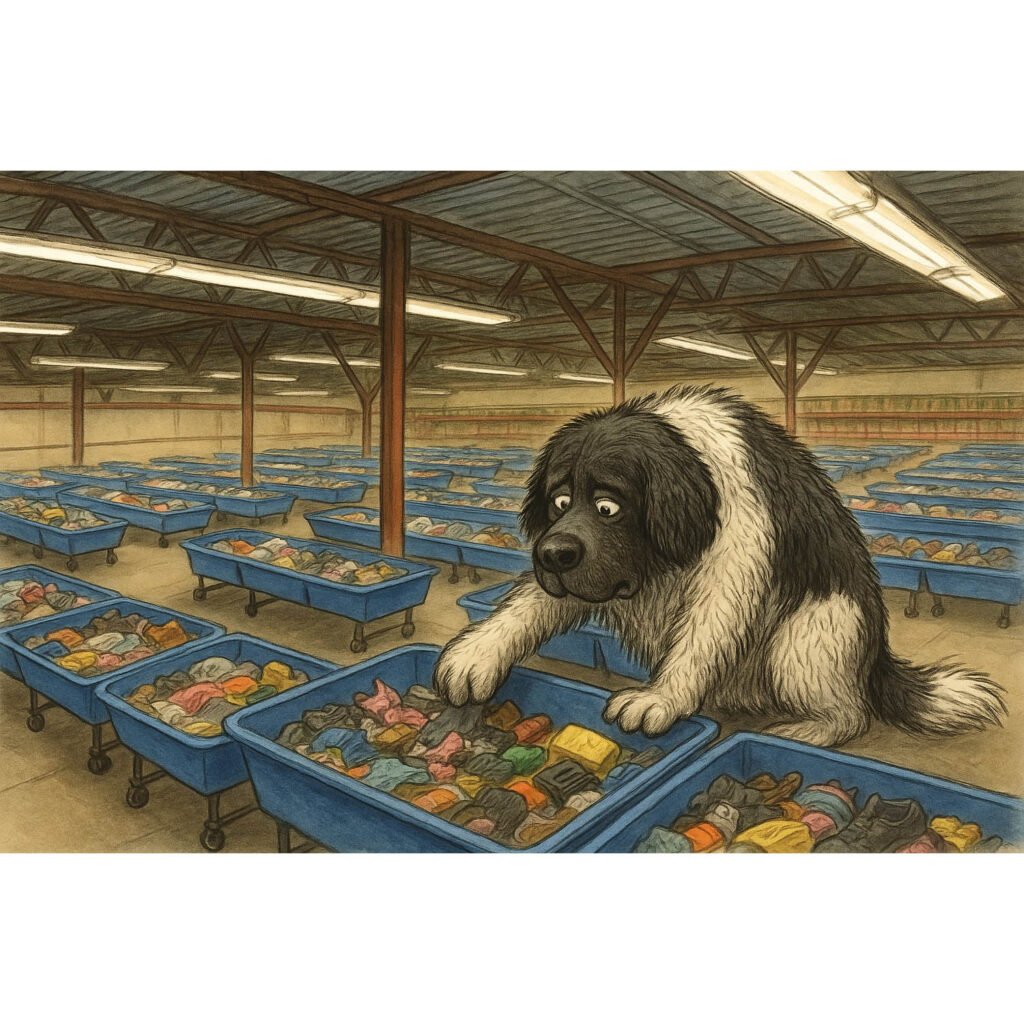
But the real drama unfolds at Yinz Binz—MAC.BID’s brick-and-mortar counterpart, and a spectacle no Beaver County anthropologist should miss. Picture a sea of blue plastic tubs, each brimming with the detritus of modern life: measuring cups, phone cases, Trump 2024 yard signs, dog sweaters in size “medium.” The prices start at five dollars when the bins are filled on Monday and drop a dollar every day until, by Friday, the proudest item is worth fifty cents and is competing with a pile of silicone spatulas for the privilege of being carried home.
Seamus threw himself into the bins with the energy of a forty-niner panning for gold. He surfaced with a rice cooker, a pair of wireless earbuds, and something that looked like a cat hammock. “Do you have a cat?” I asked. He didn’t, but at fifty cents it seemed irresponsible not to prepare for the possibility.
The Poetry of the Bin
There is, I discovered, a strange kind of poetry in the MAC.BID economy. It is America’s consumer cycle rendered in fast-forward: the thrill of buying, the disappointment of owning, the ceremonial return to Amazon, and finally, the bin—where, stripped of its packaging and dignity, the object pleads for one last shot before the landfill. Everything must go, and it does.
Everything Must Go
Walking out, Seamus held his haul like trophies. I asked what he planned to do with them. “Maybe re-gift the earbuds,” he said. “Keep the rice cooker. And who knows? Maybe one day I’ll get a cat.”
And that, in a nutshell, is the allure of MAC.BID. It is part thrift store, part lottery, part sociological exhibit. Some people see bargains. Some see junk. Seamus and I saw the comedy of it all—the nation’s online shopping habit, unpacked one bin at a time, right here in Beaver County.
Everything must go. And in the end, so do we—back home, with a rice cooker, earbuds, and a hammock waiting for a cat that may or may not arrive.