By Rodger Morrow, Editor & Publisher, Beaver County Business
Listen to a podcast discussion about this article.
If you had asked most Beaver Countians a few years ago what Greenland had to do with their livelihoods, the honest answer would have been, “Not much—unless you count the weather.” Greenland was something you saw on a map in school, colored white, floating near the top like an afterthought. It was ice, polar bears, and the occasional geopolitical punchline.
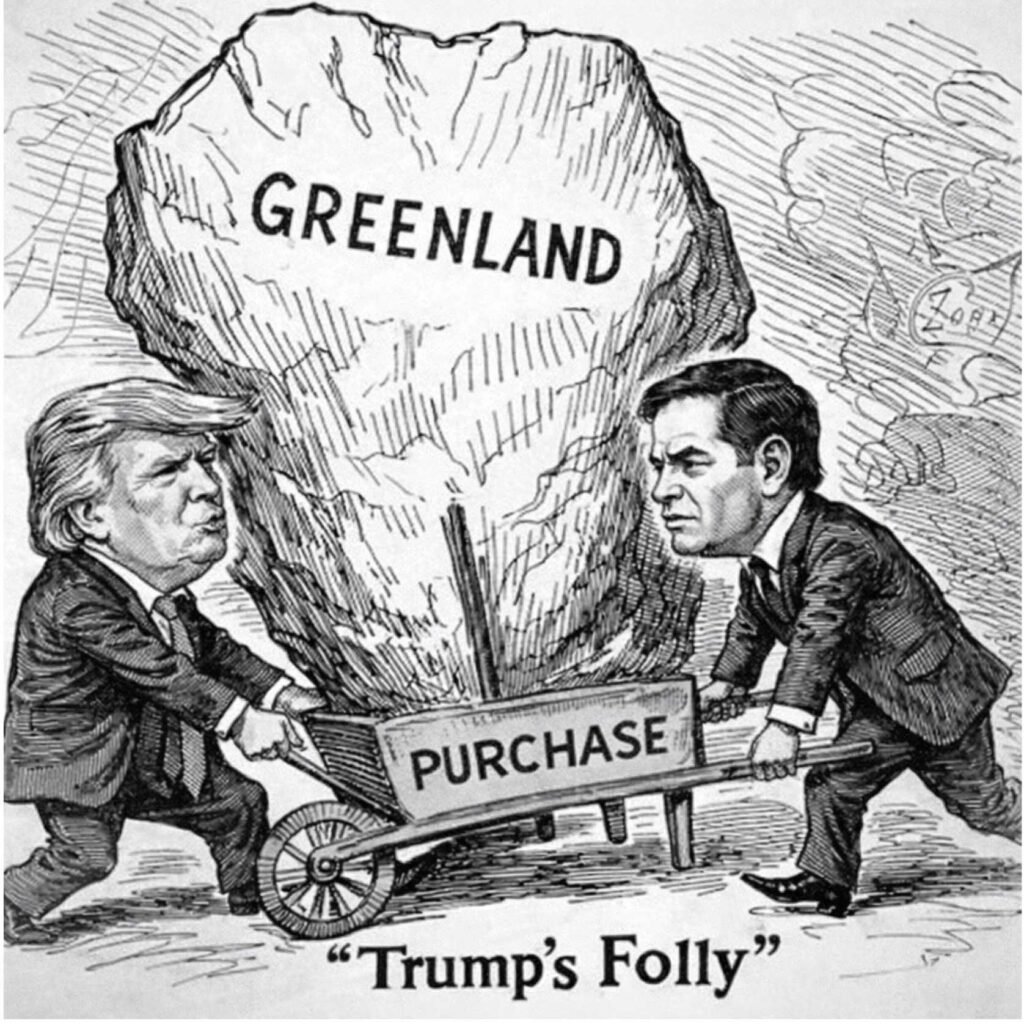
And yet here we are, living in a moment when a slab of rock and ice the size of Mexico may have more to do with Beaver County’s economic future than another ribbon-cutting on Route 18.
The reason, as with most things these days, is China—and the dawning realization in Washington that globalization, like disco, worked fine until it didn’t.
China has declared itself a “near-Arctic state,” which is a bit like Beaver County declaring itself a “near-ocean resort.” The difference is that China has the money, patience, and habit of thinking thirty years ahead. It has rolled the Arctic into its Polar Silk Road, attempted to finance airports and purchase strategic facilities in Greenland, and positioned itself to dominate the materials modern economies actually run on—not slogans, but minerals.
That woke up the United States. Suddenly Greenland stopped being a joke about buying real estate and started sounding like what strategists have called it for more than a century: the Gibraltar of the 21st century.
This isn’t new thinking. William Seward—the same fellow who bought Alaska when critics said he’d purchased a frozen wasteland—saw Greenland as essential to securing North America back in 1867. Harry Truman tried to buy it outright in 1946, offering Denmark $100 million in gold. Since 1951, the United States has quietly operated Thule—now Pituffik—Space Base there, keeping an eye on the skies during the Cold War and beyond.
What is new is the economic urgency. Greenland sits atop vast, largely untapped deposits of rare earth elements—neodymium, dysprosium, praseodymium—the tongue-twisting minerals that make modern life possible. Electric vehicles, wind turbines, smartphones, precision weapons, and advanced industrial catalysts all depend on them. China doesn’t just mine many of these materials; it processes nearly all of them. That’s the choke point.
Now let’s bring this back home, because geopolitics only matter when they show up on your balance sheet.
Beaver County is not a museum of the Industrial Revolution; it’s a working specimen. Our economy still turns on steel, energy, chemicals, and the infrastructure that binds them together. Companies like Tenaris, ATI Flat Rolled Products, and Shell Polymers Monaca don’t run on vibes. They run on inputs—molybdenum for strength, vanadium for durability, rare earths for performance, graphite for energy systems, and reliable power to keep the lights on.
Greenland has all of that. Molybdenum and vanadium for high-strength steel used in pipelines and industrial equipment. Zinc for galvanizing. Titanium for lightweight, corrosion-resistant alloys. Graphite for batteries and lubricants. Even uranium—an awkward word at dinner parties, but a vital one for Energy Harbor Nuclear Corp and for the reliable baseload power our manufacturers depend on.
If those materials remain effectively controlled by China’s processing monopoly, Beaver County businesses live at the mercy of export controls, price spikes, and diplomatic spats half a world away. If they become part of a secure North American supply chain—whether through formal U.S. ownership of Greenland or a de facto economic compact—the story changes.
Think of it this way: when Greenland’s resources are treated as domestic, Beaver County stops
being a downstream price-taker and