Listen to a podcast discussion about this article.
If you want to understand Beaver County, you could do worse than to stand along the Ohio River at dusk and listen carefully.
The mills are mostly quiet now, but if you squint hard enough, you can still see the ghosts clocking in.
They came with lunch pails, rosaries, union cards, and occasionally a phrasebook. They came from Naples and Kraków, from County Cork and the hills of Wales, from villages in Greece and farms in Alabama. They came because steel was hot, America was hiring, and Beaver County was willing to trade sweat for a future.
And steel, being an honest metal, returned the favor. It shaped the men who shaped it.
It also built something larger than payrolls and parish halls. It built what we might now call material sovereignty — the ability of a nation, or a county, to make the things it needs from the ground beneath its own feet.
The First Arrivals: Skill, Nerve, and 200 Chinese Cutlers
Long before Aliquippa roared, Beaver County was experimenting with industry. In 1872, roughly 200 Chinese immigrants were recruited to work at the Beaver Falls Cutlery Works — an early reminder that even in the 19th century, when we imagine everyone spoke with a brogue or a Bavarian accent, global labor markets were already alive and well.
Alongside them came Germans, Englishmen, Irish, and Welsh — “old stock,” as they were called, though there was nothing old about their ambition. They brought with them the hard-earned knowledge of milling and forging. They knew iron the way a baker knows dough: how it behaves under pressure, how it cracks when mishandled, how it rewards patience.
Beaver County, content with modest manufactories, began to grow heavier. Iron became steel. Shops became mills. And the quiet river towns began to hum with the early notes of industrial independence.
The Great Steel Magnet
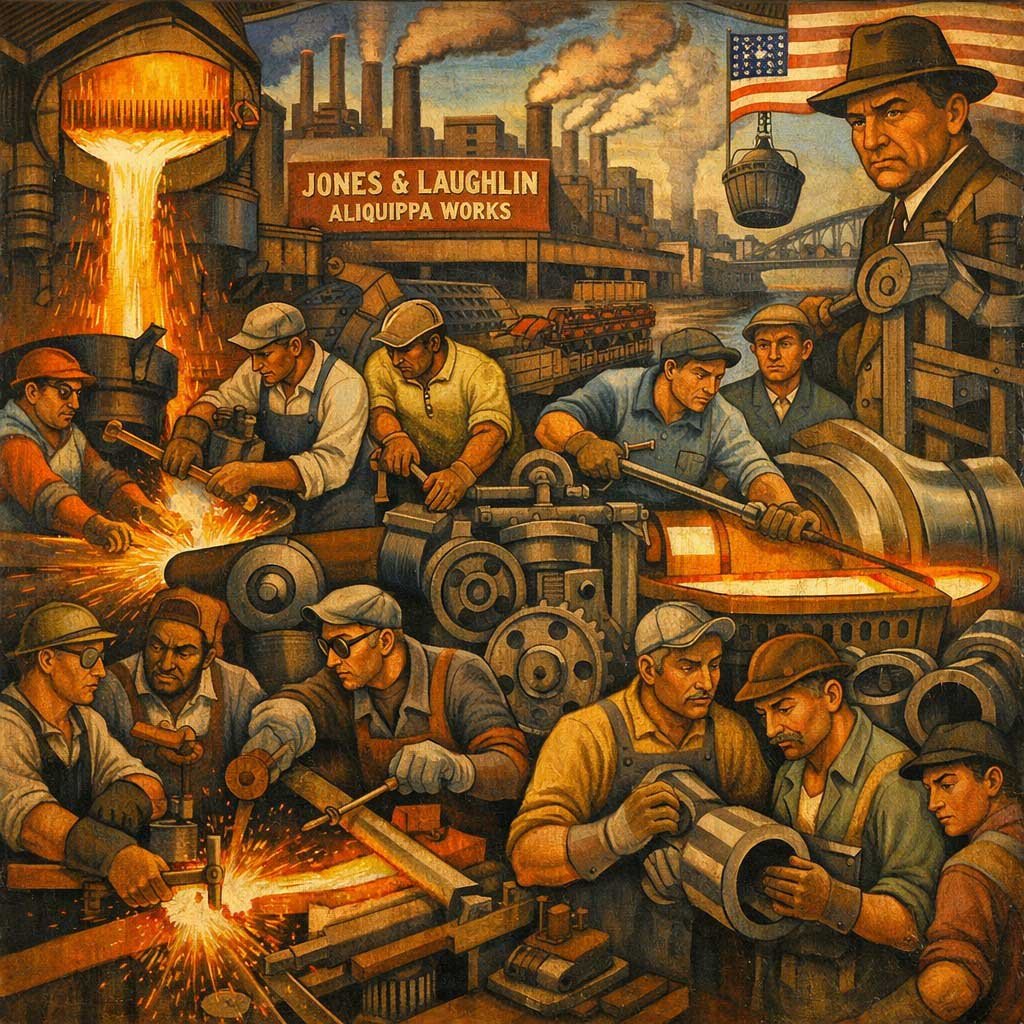
By the early 1900s, the name that echoed through the valleys was Jones & Laughlin Steel Corporation. When J&L built its Aliquippa Works, the borough (once called Woodlawn) transformed into an industrial engine room.
By 1919, the Aliquippa Works employed more than 7,000 men. Many were newly arrived from Italy, Poland, Ukraine, Serbia, Croatia, and Greece. They had fled poverty, conscription, famine, or Europe’s periodic habit of rearranging its borders. They found instead twelve-hour shifts and a river that smelled like ambition.
At the same time, African Americans left the Jim Crow South during the Great Migration, arriving after 1915 to take jobs in mills, mines, and rail yards. The mills needed hands — strong ones — and were less concerned about accent or ancestry than about whether a man would show up for the midnight turn.
Together, these workers powered more than a regional boom. They fueled America’s material sovereignty. Steel from Beaver County flowed into rail lines, skyscrapers, bridges, and battleships. It meant that the United States did not have to ask politely overseas for the bones of its own infrastructure.
It could make them here.
The Company Town: Plans and Paternalism
J&L was not merely a steel company; it was, in Aliquippa at least, a municipal overlord with a payroll.
The borough was divided into numbered “plans,” each housing different ethnic groups. Serbs and Croats in one section, Italians and Poles in another. It was segregation with a filing system — less about ideology than about order. Keep everyone settled, keep everyone separate, keep the steel moving.
The arrangement slowed assimilation but strengthened community. Churches rose quickly — Orthodox domes, Catholic spires. Social clubs and mutual aid societies flourished. If a man was injured, widowed, or simply unlucky, someone passed the hat.
When the Steel Workers Organizing Committee arrived in the 1930s, it discovered that men who prayed together and buried their dead together could also strike together. Solidarity, like steel, is strongest when forged under pressure.
War, Work, and the Making of Men
The World Wars turned Beaver County into a furnace for democracy. Steel from these mills found its way into ships, tanks, armor plate. Production surged. Aliquippa’s population swelled past 27,000 by the 1940s.
Material sovereignty stopped being an abstract concept and became a military necessity. A nation that cannot produce its own steel must borrow its shield. Beaver County helped ensure that America carried its own.
The work was brutal. Burns were common. Hearing was optional. But the mills conferred something else: dignity.
A mill job could buy a brick house. It could send a son to college. It could put a daughter in a white nursing uniform. It could transform a frightened immigrant into a Little League coach, a deacon, a taxpayer.
Steel did not merely produce girders. It produced men who measured themselves by their shift, their handshake, and their word.
The Long Cooling
Then, in the 1970s and ’80s, the furnaces began to cool. Global competition, automation, and the curious American habit of discovering cheaper labor somewhere else took their toll. Plants closed. Families moved. Main Streets lost their shine.
With the decline went not only jobs but a measure of material sovereignty. When you no longer make the materials of your own prosperity, you begin to depend on someone else’s.
And yet, the legacy lingers.
Organizations like Rivers of Steel National Heritage Area preserve the physical remnants. But the more enduring monument is cultural. The surnames on mailboxes still echo Naples, Kraków, Thessaloniki, and Birmingham. The festivals still fry dough in a dozen dialects.
What steel taught Beaver County is this: strength is not accidental. It is forged.
You take raw ore. You apply heat and pressure. You burn away impurities. And you create something stronger than what you began with.
Beaver County did that with its people. And for a time, it did it for the nation itself — supplying the literal substance of American independence.
The mills are quieter now. But if we are wise, we will remember what they represented: not just industry, but sovereignty — the stubborn conviction that a place should be able to stand on its own steel-toed boots.
After all, we have done it before.