By Rodger Morrow, Editor & Publisher, Beaver County Business
Listen to a podcast discussion about this article.
There are two kinds of Americans: those who think the Industrial Revolution was invented by Andrew Carnegie on his lunch break, and those who know it started with a Treasury Department memo.
If that sounds disappointing, consider this: the memo in question was written by Alexander Hamilton, a man who never saw a steel mill in Pittsburgh, never ordered pierogies in Aliquippa, and yet did more to make both possible than most of us who have.
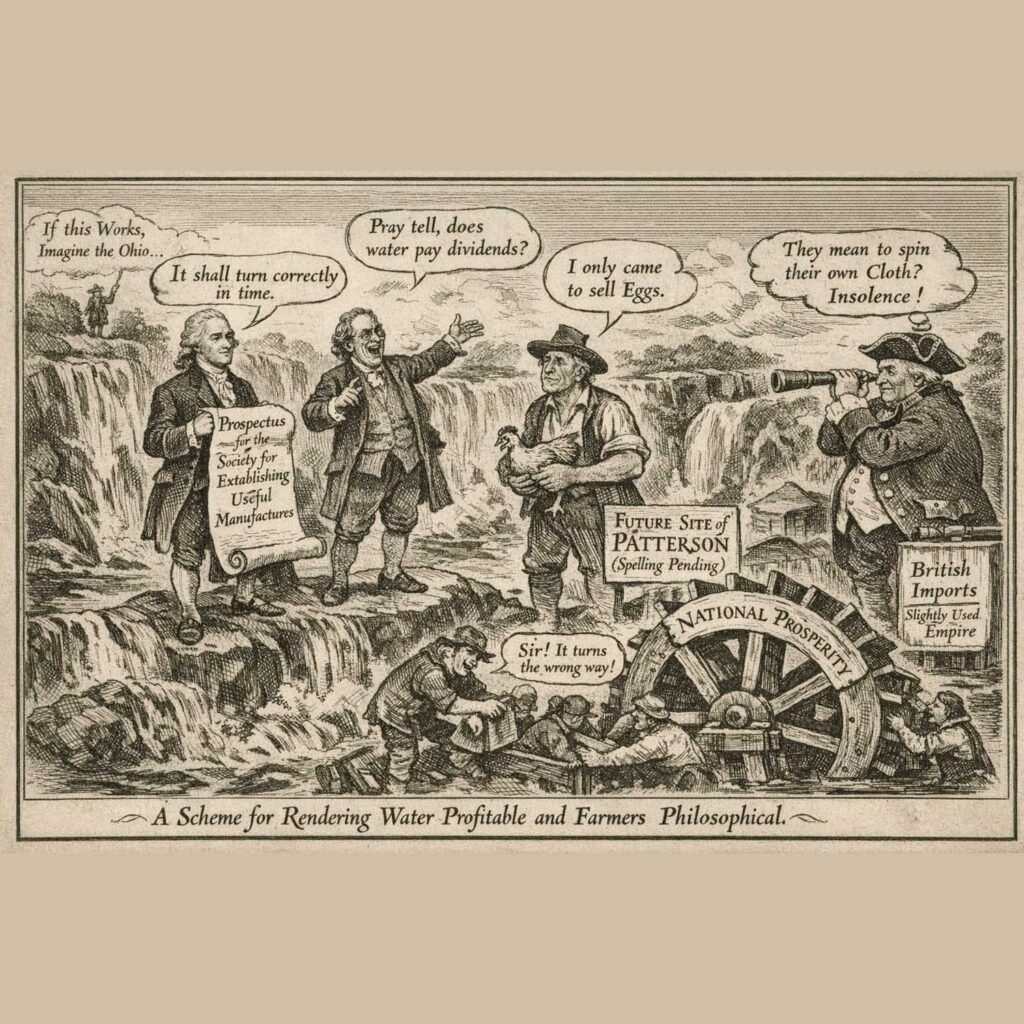
In 1791—while the rest of the country was still arguing about taxing whiskey—Hamilton issued his famous Report on Manufactures. It was, in essence, a polite but firm declaration that America ought to stop buying stuff from Britain and start making a few things of its own. This was a radical notion at a time when “Made in America” meant someone had whittled it in a barn.
Enter Tench Coxe, Hamilton’s assistant secretary and the sort of man who could see a waterfall and imagine not a picnic, but a balance sheet. Coxe proposed something audacious: a large-scale, government-chartered corporation devoted to manufacturing. Not a blacksmith shop. Not a cottage loom. A national manufactory.
Thus was born, in November 1791, the Society for Establishing Useful Manufactures—mercifully abbreviated to S.U.M., presumably because even in the 18th century no one wanted to embroider that full name on a company jacket.
The state of New Jersey chartered the Society and granted it powers that would make a modern economic development authority blush. Ten years’ exemption from property taxes. The right to acquire up to six square miles of land. Authority to build canals, dams, and infrastructure. Even the power to establish a municipal government.
In other words, Hamilton and Coxe invented the industrial park—two centuries before anyone thought to name one after a retired congressman.
The Society selected a site at the Great Falls of the Passaic River, leading to the founding of Paterson as an industrial hub.
Hamilton drafted the Society’s prospectus in August 1791. He argued that political independence without economic independence was a contradiction in terms. A republic that could not produce its own textiles, tools, or arms would remain dependent—economically colonized even after it had fired the last musket shot.
The first manufacturing efforts stumbled. Investors fretted. Machinery misbehaved. The Industrial Revolution did not arrive with a ribbon-cutting ceremony and commemorative tote bags.
But the infrastructure endured.
S.U.M. retained control of the Passaic’s water power for more than 150 years. Cotton mills came. Then locomotives and steel. Then silk, earning Paterson the title “Silk City.” The Society evolved into something more durable than a factory: it became a platform for industrial growth.
Historians now call it an early public-private partnership. In Beaver County, we would call it economic development with a spine.
And this is where the story turns from powdered wigs to red baseball caps.
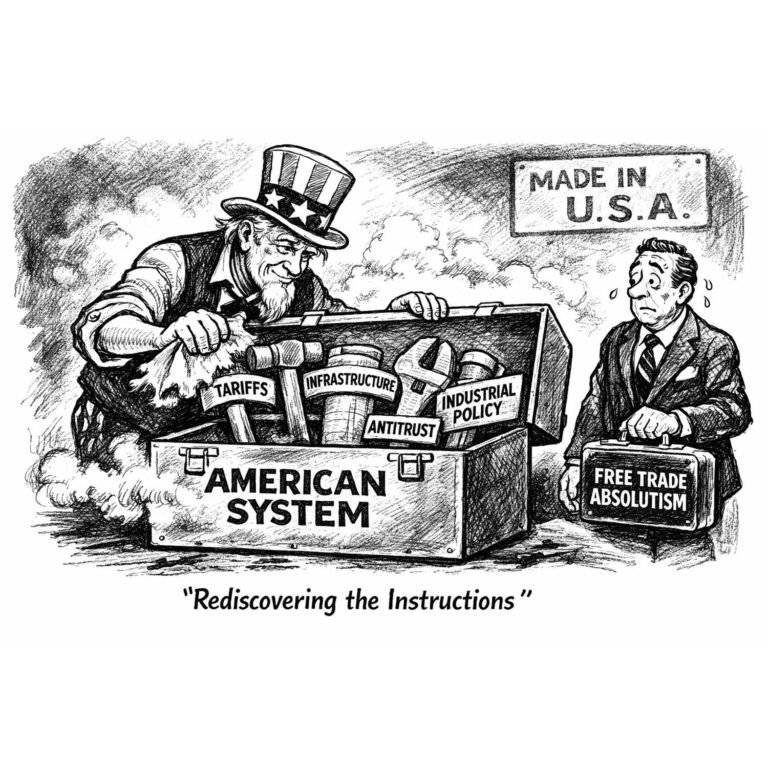
The industrial and trade policies of Donald Trump have, in many respects, revived the Hamilton-Coxe argument that a nation must deliberately cultivate its manufacturing base. Hamilton advocated protective tariffs to nurture domestic industry against more established foreign competitors. Trump imposed tariffs on steel, aluminum, and a broad range of Chinese imports with the stated goal of reshoring manufacturing and correcting trade imbalances.
Hamilton called it “encouragement.” Trump calls it “America First.” The vocabulary has changed. The instinct has not.
Hamilton believed government should actively support strategic industries critical to national strength. Trump’s policies—whether through tariffs, tax incentives, or pressure campaigns on corporations—have emphasized domestic production of steel, semiconductors, pharmaceuticals, and energy infrastructure. The underlying premise is Hamiltonian: economic sovereignty undergirds political sovereignty.
For Beaver County, that’s not an abstraction.
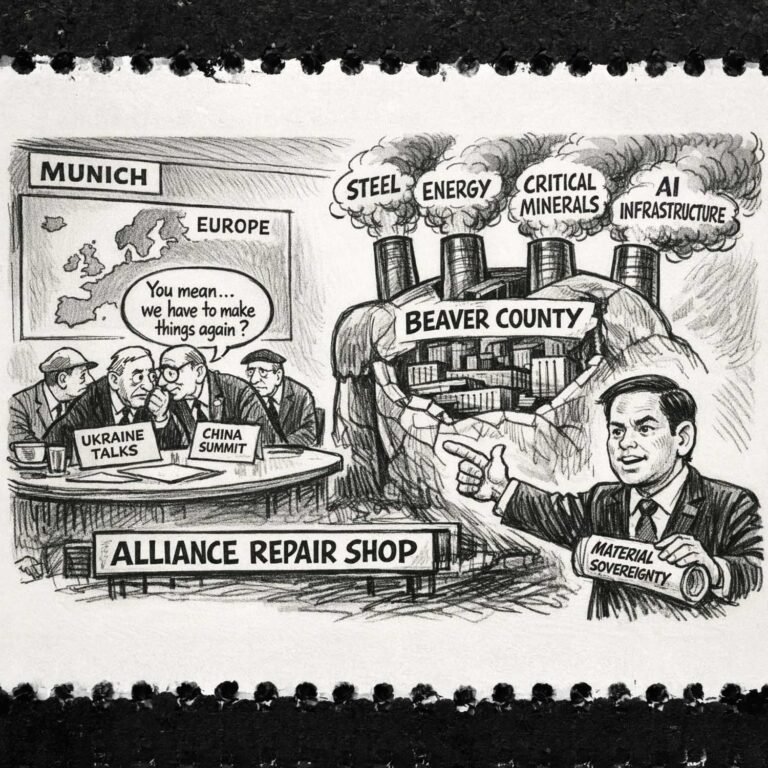
When tariffs were imposed on foreign steel, mills in the Mon Valley and along the Ohio River saw renewed orders. When supply chain disruptions during the pandemic exposed America’s reliance on overseas manufacturing, Hamilton’s old warning sounded less like theory and more like common sense. You cannot build a resilient republic on back-ordered cargo ships.
Trump’s rhetoric is more pugilistic than Hamilton’s prose—less Federalist Paper, more rally microphone—but both share a suspicion of overreliance on foreign industrial capacity.
Hamilton argued that a diversified economy would stabilize wages and broaden opportunity. Trump has framed industrial revival as a defense of working-class communities hollowed out by globalization. The tone differs. The diagnosis overlaps.
Even the emphasis on infrastructure—ports, energy, manufacturing corridors—echoes the S.U.M. experiment at Paterson. Clear the ground. Secure the power source. Attract capital. Let industry follow.
From the Great Falls of the Passaic to the Ohio River Valley, the formula is recognizable: harness energy, align policy, unleash production.
Critics of Trump’s trade policies argue that tariffs distort markets and invite retaliation. Critics of Hamilton once made similar arguments, warning that government favoritism would warp the young republic. Yet Hamilton’s framework helped propel the United States from agrarian upstart to industrial colossus.
Whether one applauds or opposes Trump’s methods, it is difficult to deny the philosophical lineage. The question animating both eras is the same: Should America passively accept the global division of labor, or should it shape its own industrial destiny?
Hamilton and Coxe answered decisively in 1791. They chose waterfalls over wheat fields alone. They chose mills over mere markets.
Today, amid debates about reshoring, supply chains, AI-driven manufacturing, and energy independence, the ghost of that decision lingers.
In Beaver County—where blast furnaces once lit the night sky and data centers now hum with digital ambition—the old argument has come full circle. National power requires industrial power. Sovereignty requires production.
From Paterson to Pittsburgh, the water kept running.
Now, once again, so does the idea.