By Rodger Morrow for Beaver County Business
Listen to a podcast discussion about this article.
On July 15, a cavalcade of important people in expensive shoes gathered at Carnegie Mellon University for a White House-hosted economic summit. The theme, in case you missed it, was “Building the Future,” which turns out to involve everything from clean hydrogen and artificial intelligence to something called “resilient infrastructure,” which may or may not be code for “patching potholes before the next election.”
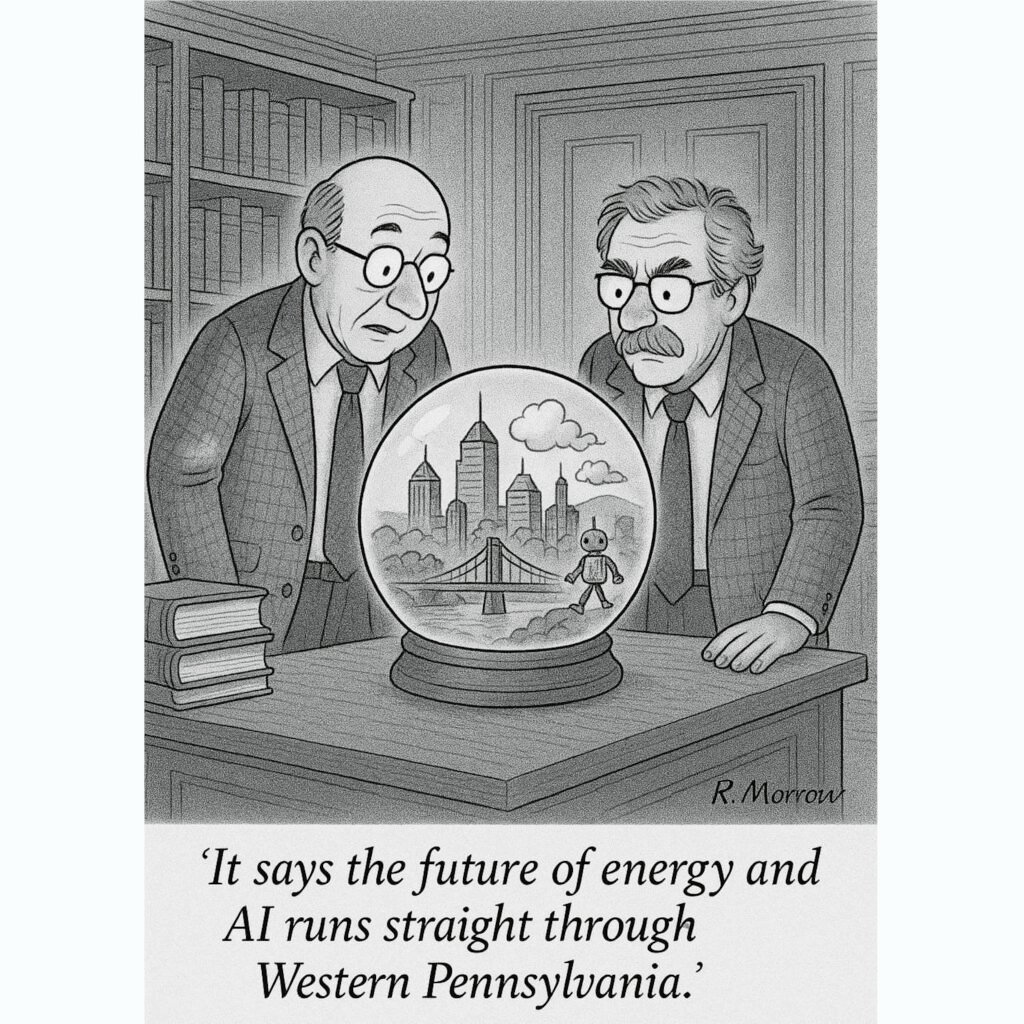
Naturally, there were many uplifting PowerPoint slides, and everyone nodded solemnly at phrases like “innovation corridor” and “21st-century connectivity.” But as the summiteers gazed into the bright future, I found myself wondering if any of them bothered to look a few miles downriver—toward the past.
Because sitting right there between Beaver and Monaca, carrying rail freight like it has since the days of steam, is the Beaver Bridge. And in a moment obsessed with what’s next, it might just have something useful to say about what we’ve forgotten.
The Wisdom of Old Steel
Now, the Beaver Bridge isn’t glamorous. It doesn’t light up at night or host yoga classes. It doesn’t have a bike lane or a catchy Instagram hashtag. What it does have is 1,710 feet of steel truss, planted squarely over the Ohio River since 1910, doing the kind of honest, unassuming labor that Washington often claims to admire but rarely funds.
Its designer, Albert Lucius, was an engineer back when that meant a slide rule, not a TED Talk. He built it in the wake of the Quebec Bridge disaster—a 1907 catastrophe in which 75 workers died because someone got their math wrong and no one double-checked. Lucius took notes. He didn’t abandon innovation; he tightened it up, added guardrails, metaphorical and otherwise, and delivered a cantilever bridge that’s been chugging along ever since.
It’s not pretty. But it works. In fact, it’s a master class in what happens when you combine humility with competence—two qualities currently on the endangered species list in federal infrastructure planning.
Meanwhile, Back at the Summit
At Carnegie Mellon, the conversation focused heavily on the future. There was talk of semiconductors and carbon capture, of transforming the Rust Belt into something shinier.
I’m all for it. Let the future have its moment.
But as someone who lives in a place where the past hasn’t quite left the building, I offer this humble suggestion: before Washington tries to reinvent America’s infrastructure, maybe it should take a closer look at the parts that are still holding up.
Because infrastructure isn’t just about tomorrow’s breakthroughs—it’s about yesterday’s decisions, still working their way across the river. The Beaver Bridge isn’t some nostalgic relic. It’s living proof that good engineering, when given half a chance, can outlast an entire century of congressional budgets.
And for every bridge like it, there are a dozen others straining under the weight of deferred maintenance and forgotten promises. Some of them are triumphs of foresight. Others are structural metaphors waiting to collapse.
Lessons from a County With One Foot in Each Century
Now, I’m no think tank. But I do know Beaver County. We’ve got power plants and server farms, freight trains and fiber optics. We’re a place trying to keep one hand on tradition while reaching for the next rung of economic relevance.
So when I hear about trillion-dollar packages for infrastructure, I hope someone remembers that it’s not just about pouring concrete. It’s about honoring the memory of people like
Lucius—people who knew that innovation without integrity is just a faster way to fail.
Do we build fast and cheap, or wisely and well? Do we throw money at ribbon-cuttings, or do we trust the quiet competence of the people who actually make things stand?
A Bridge Worth the Detour
The Beaver Bridge was never meant to be iconic. It was meant to be useful. It still is. And in that way, it reminds me of a lot of places like this—overlooked, underfunded, but still doing their jobs.
So to the policymakers who left Pittsburgh this week with fresh ideas and federal lanyards: take a drive up Route 51. Stop for a moment. Look at the bridge. It doesn’t sparkle. But it endures.
The future doesn’t just need vision. It needs ballast. It needs rivets and restraint. And maybe, just maybe, it needs a little more Beaver County in it.
Driving Western Pennsylvania’s Economic Transformation
Summit at a Glance
- Event: Pennsylvania Energy & Innovation Summit
- Date & Venue: July 15, 2025, at Carnegie Mellon University, Pittsburgh
- Purpose: To position Pennsylvania—including its Western region—as a national hub for AI, energy, and infrastructure innovation .
Infrastructure & Energy Investments
- Massive Investment Commitments
Over $90–92 billion in private-sector investments were committed across energy, data centers, power infrastructure, and workforce development—marking one of the largest investment pledges in Pennsylvania’s history .
- Major Infrastructure Projects
- Blackstone: $25 billion for data centers and power infrastructure in Northeast Pennsylvania (creating thousands of construction and permanent jobs).
- Google (Alphabet): $25 billion for AI infrastructure and data centers, plus a $3 billion deal with Brookfield to repower two Pennsylvania hydropower plants.
- CoreWeave: $6 billion for a new AI data center in Lancaster.
- Frontier Group: ~$3.2 billion to convert the Bruce Mansfield coal plant in western PA into a natural gas facility—creating over 15,000 jobs.
- Enbridge: $1 billion to expand natural gas pipeline capacity, with projects to be defined over 6–18 months.
- FirstEnergy: $15 billion to upgrade and modernize the electric grid, covering 56 counties.
- PPL Corporation: $6.8 billion through 2028 to expand grid capacity and modernize transmission to meet rising energy demand.
- Constellation Energy: $2.4 billion to uprate Limerick nuclear plant— adding 340 MW capacity and approximately 3,000 jobs annually.
- Energy Capital Partners: $5 billion for a new data center and 51 community solar projects, generating 2,500 jobs.
- Anthropic: A $2 million investment over three years for cybersecurity education and energy research at CMU.
Workforce & Training
- The Energy Innovation Center Infrastructure Academy—a first-of-its-kind regional training campus—is poised to support and develop over 7,000 energy and AI infrastructure jobs across Southwest Pennsylvania.
Regional Impact & Long-Term Promise
- Pittsburgh and broader Western PA are uniquely positioned as AI and energy innovation hubs, thanks to:
- Rich natural gas, nuclear, and hydropower resources.
- A skilled workforce and top-tier universities like CMU (noted globally for AI leadership) and Penn State .
- The ability to co-locate data centers close to power sources, reducing infrastructure costs and accelerating development .
Why It Matters for Western Pennsylvania
- These investments deliver a multi-billion-dollar infrastructure boost—powering economic growth, expanding energy capacity, and building out frontier AI capabilities locally.
- They bring a pipeline of construction and permanent jobs, stimulating employment and municipal revenues—with training programs ensuring long-term workforce readiness.
- Institutions like CMU and the Energy Innovation Center are central engines—bringing research, talent, and innovation synergy to the region.
- Collectively, the summit’s outcomes signal a broader economic renaissance—transitioning Western Pennsylvania from its historic industrial roots into a modern AI-and-energy powerhouse.