By Rodger Morrow, Editor & Publisher, Beaver County Business
Listen to a podcast discussion about this article.
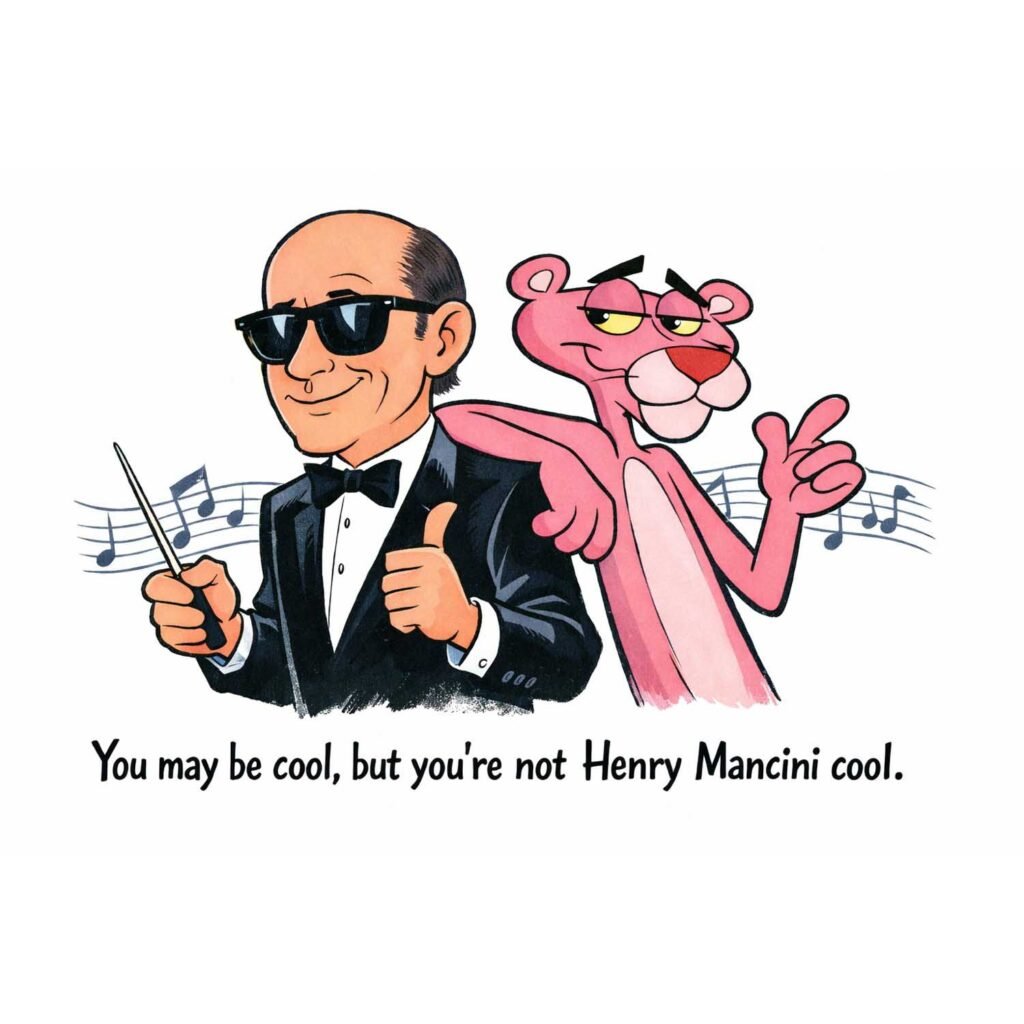
Beaver County has produced many things of note—steel, sparks, and a certain admirable stubbornness—but none quite so cool as Henry Mancini.
Cool, in this case, is not a temperature but a condition of the soul: the ability to write a melody that strolls into the room wearing sunglasses, tips its hat, and immediately improves everyone’s outlook.
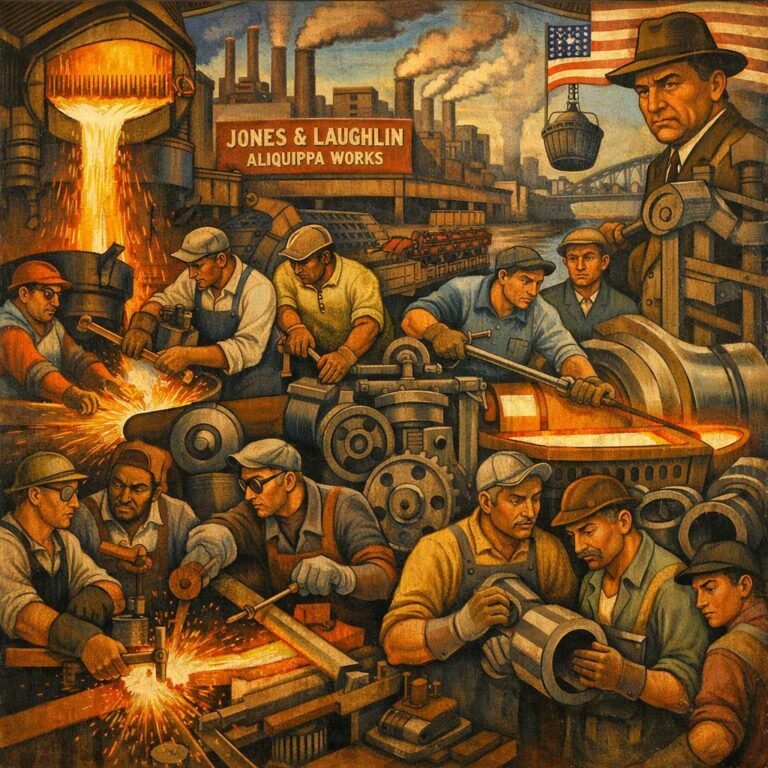
Mancini was born Enrico Nicola Mancini in Cleveland in 1924, but his real formation occurred a little downriver in West Aliquippa, where the Jones & Laughlin mills worked overtime turning iron ore into smoke and boys into men. His father, Quinto, a steelworker and amateur flutist, had the radical idea that his son might prefer a life with fewer blast furnaces. So at age eight, Henry was handed a piccolo—an instrument roughly the size of a corncob, but capable of changing a life.
By thirteen, Mancini was already arranging music and sitting first chair flute in the Pennsylvania All-State Band. This is the age when most boys are mastering the complex social art of not being noticed. Mancini, instead, was studying harmony. He attended Juilliard, was drafted during World War II, and afterward joined the Glenn Miller Orchestra, then under Tex Beneke. The swing era didn’t just influence Mancini; it moved in and rearranged the furniture.
His career truly ignited when he began collaborating with director Blake Edwards. Their first television venture, Peter Gunn, did something revolutionary: it treated the small screen like it deserved big music. Mancini’s jazz-driven theme won two Grammys and taught America that television didn’t have to sound like a doorbell.
Then came Breakfast at Tiffany’s, which earned Mancini five Grammys and gave the world “Moon River.” He wrote it specifically for Audrey Hepburn, tailoring the melody to her limited vocal range—a reminder that true artistry often involves knowing when not to show off. The song drifted gently into the culture and never left, much like a particularly polite houseguest.
And then—because no résumé should be without a little larceny—there was The Pink Panther. Mancini later explained that he wrote the stealthy theme in about an hour, a fact that has caused permanent emotional damage among composers who prefer to believe genius requires prolonged agony. The tune’s prowling bass line and sly saxophone became the sound of cinematic mischief itself.
Mancini also proved he could write villainy with style in Disney’s The Great Mouse Detective, crafting Broadway-scale songs for the rat mastermind Ratigan, voiced with delicious menace by Vincent Price. Mancini understood that a good villain, like a good chord, benefits from going just a bit too far.
Over his lifetime, Mancini recorded more than 90 albums, won 20 Grammy Awards, four Academy Awards, and seven gold records. When he died in 1994 from pancreatic cancer, the world lost a composer who made melody feel inevitable—like it had always been waiting for us to notice.
But Beaver County never forgot where he came from. Mancini didn’t either. His orchestral suite Beaver Valley ’37 returns musically to West Aliquippa, with movements titled The River, Black Snow, and The Sons of Italy. It is part autobiography, part love letter—an acknowledgment of soot-covered snow, immigrant bands, and a boy whose future was redirected by a flute.
Today, Beaver County honors Mancini not with marble statues but with useful things: the Henry Mancini Memorial Bridge in Aliquippa, a historical marker at his boyhood home, and the annual Henry Mancini Musical Theatre Awards that celebrate young performers across the region. These are not shrines; they are continuities.
Mancini’s genius was not that he escaped Beaver County, but that he carried it with him—into jazz clubs, sound stages, and symphony halls. His music proves that even in a place where the snow once turned black, melody could still run clear. And that, in the end, may be the coolest trick of all.