By Rodger Morrow, Editor & Publisher, Beaver County Business
Listen to a podcast discussion about this article.
If you’ve lived in Beaver County long enough to remember when “Marcellus Shale” sounded like a minor character in a Roman tragedy, you may be wondering why natural gas keeps turning up in every conversation about our future. Schools, roads, taxes, Shell, the Bruce Mansfield reboot—somehow it all ties back to the stuff humming beneath our feet like a geological slow cooker
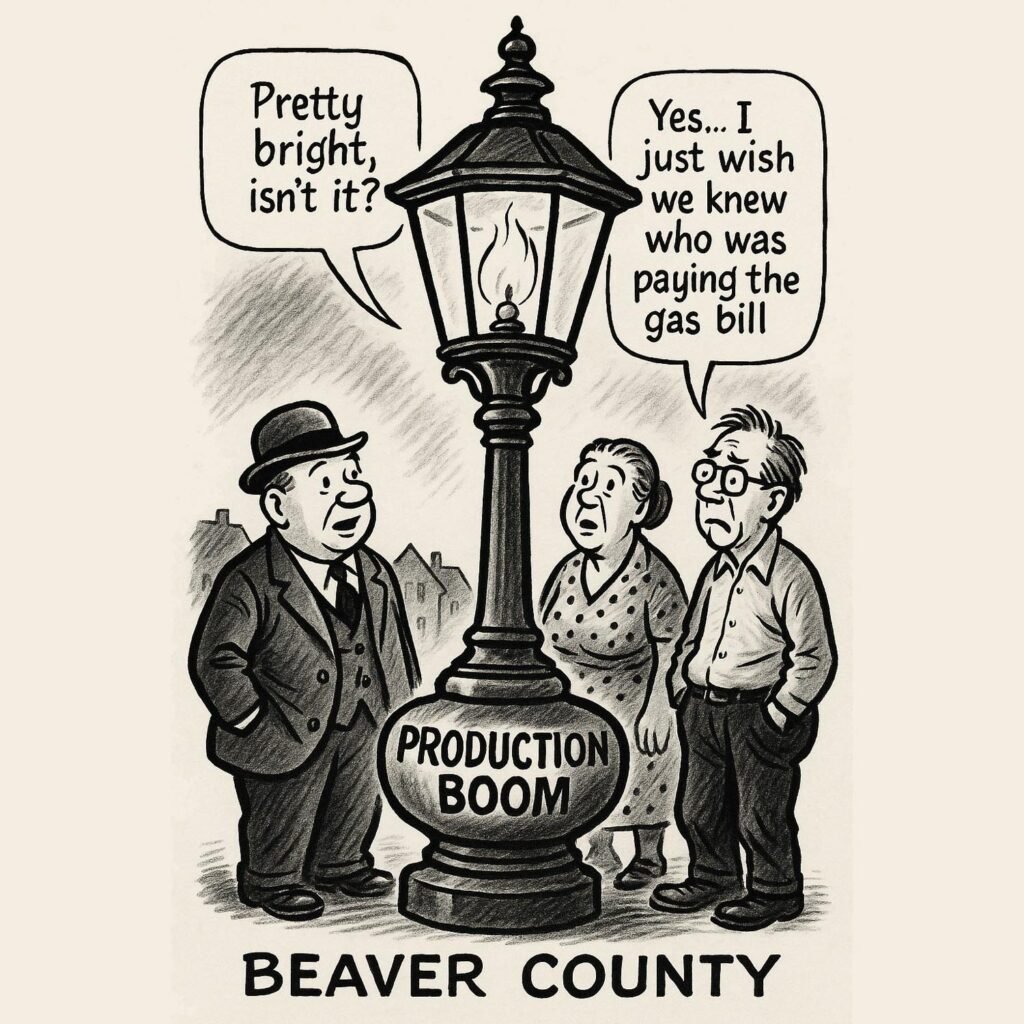
Pennsylvania’s production jumped 5.1% this past quarter, hitting 1.9 billion cubic feet—our third straight quarter of growth and the kind of streak usually associated with baseball teams that can actually afford their rosters. The state drilled 116 new wells, an 84% increase from last year. Natural gas prices, which last year were low enough to depress even cheerful accountants, climbed to $2.18 per MMBtu—still modest, but apparently high enough to coax rigs out of semi-retirement.
Ohio’s Utica Shale, not to be overshadowed, kept pumping out gas at rates usually seen only in malfunctioning calculators. Wells in Jefferson and Columbiana counties are churning out volumes that make it clear Appalachia isn’t done surprising the nation.
So what does all this mean for Beaver County, besides more trucks on Route 18 and people using the word “midstream” in casual conversation? For one thing, our own gas output—6.3 million cubic feet in August—continues a gradual climb. Modest by Texas standards, yes, but still enough to matter in a county where nearly everything, including economic optimism, tends to come in cycles.
Natural gas is powering investments that have become fixtures in our headlines. The $3.2 billion plan to convert Bruce Mansfield into a natural gas–fired plant and AI data center promises 15,000 construction jobs and more than 300 full-time positions, not to mention enough electricity to keep half the world’s servers humming. The Shell plant continues turning local ethane into polyethylene and injecting hundreds of millions each year into the regional economy, depending on which economist you ask and how much caffeine they’ve had. Meanwhile, expansions at Mitsubishi Electric and Versatech lean heavily on the region’s energy reliability, which is the polite way of saying our power grid is less skittish than most.
Impact fees alone handed Beaver-area communities $862,000 this year, and the county has seen $52 million in natural-gas-related taxes, royalties, and fees over the last three years. For residents, lower gas prices have quietly saved families $1,100 to $2,200 a year—enough to cover groceries, a baseball season, or a single enthusiastic trip to Costco.
Of course, nothing involving energy is ever simple. Despite all the drilling, building, and groundbreakings, Beaver County’s population and GDP haven’t exactly soared. The long-promised “20,000 permanent jobs” tied to the Shell project never materialized, unless someone is counting every robot inside the plant as an employee. Shell’s announcement that it may sell the plant has added uncertainty, the corporate equivalent of a “For Sale—Needs TLC” sign posted along the Ohio River.
Environmental concerns persist, too. Air-quality monitors pop up like spring dandelions, and some residents remain unconvinced that the phrase “cleaner-burning fossil fuel” isn’t an oxymoron. And while some wells gush impressively, others follow the classic romantic-comedy trajectory: a dazzling start, followed by a long, awkward decline.
Still, the truth is hard to avoid: natural gas is shaping Beaver County’s future because it’s already shaping our present. It powers our industries, feeds the cracker, lowers household bills, and props up municipal budgets. It provides the economic floor beneath every ambitious plan, from AI data centers to industrial expansions. And with Ohio’s Utica boom roaring just across the border, the regional energy engine isn’t slowing anytime soon.
Whether Beaver County thrives on gas or simply sits atop it will depend on what we do next. Natural gas offers opportunity—big, noisy, imperfect—but still opportunity. The trick is turning temporary booms into long-term footing.
For now, though, the wells keep humming, the plants keep expanding, and Beaver County keeps finding itself at the center of an energy story that refuses to end. And unlike some counties, at least ours comes with a view of the river.