Listen to a podcast discussion about this article.
If you have followed American foreign policy long enough, you develop a mild twitch whenever someone says “rules-based international order.” It is usually the prelude to a PowerPoint presentation and the quiet disappearance of another steel mill.
So when Secretary of State Marco Rubio took the stage at the Munich Security Conference and began talking about “Western civilization,” “national sovereignty,” and the perils of de-industrialization, one could be forgiven for checking whether one had wandered into a history seminar.
But Rubio’s argument was not antiquarian. It was economic. And you don’t have to own a red hat to see why it matters.
The End of the “End of History”
Rubio took aim at the old post–Cold War assumption that global trade and supranational institutions would dissolve national rivalries like sugar in Bavarian coffee. The theory was that if we all bought enough of each other’s stuff, we would never again lob artillery at one another.
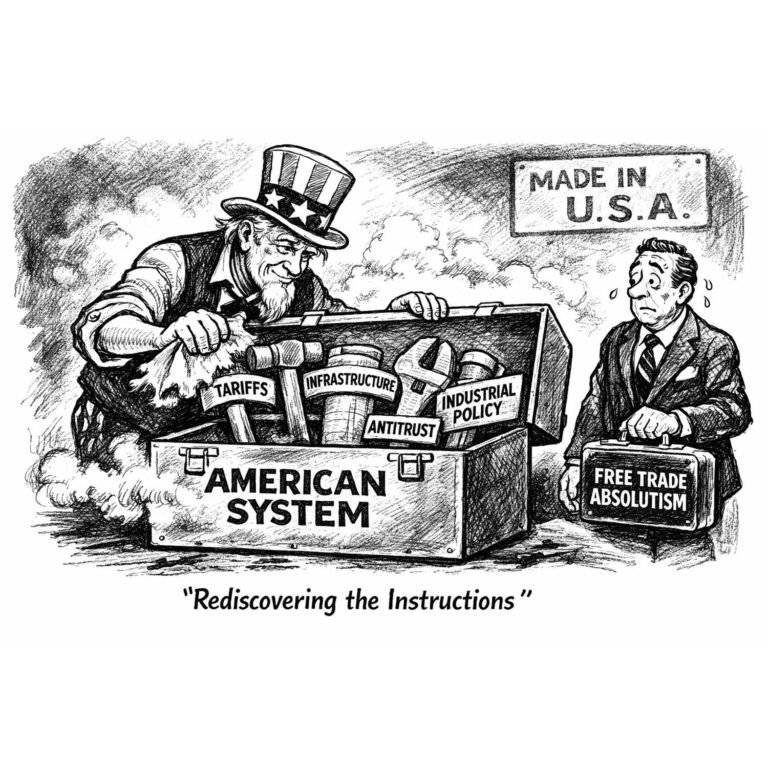
What we actually did, Rubio suggested, was hollow out our industrial base, outsource critical supply chains, and inform the working class that they could always learn to code.
This will sound familiar to anyone who has driven past the ghostly remains of what used to be the industrial backbone of western Pennsylvania, West Aliquippa. Beaver County knows what “de-industrialization” looks like. It looks like an empty parking lot the size of a small nation and a diner that closes at 2 p.m.
Rubio’s rejection of the “End of History” thesis is not a call to isolation. It is a reminder that national interests do not evaporate simply because we prefer not to mention them at conferences with good pastries.
Civilization, Not Just Compliance
One of the more bracing lines in Munich was Rubio’s insistence that the transatlantic alliance rests not merely on treaty obligations but on a shared civilizational inheritance—faith, culture, and a conception of ordered liberty that predates the European Union’s paperwork.
For decades, Western elites have been more comfortable talking about “values” than about the civilization that produced them. Multiculturalism, once sold as a cheerful festival of foods and fabrics, has in practice sometimes functioned as a solvent—dissolving common norms without quite replacing them.
Rubio’s point was not that immigration is evil or that cultures cannot coexist. It was that a society without a confident core will eventually lose the capacity to defend anything, including pluralism itself.
Again, you do not have to be a card-carrying member of any political fan club to observe that Europe is wrestling with this question in real time. Borders matter. Cultural cohesion matters. Sovereignty matters. Pretending otherwise has not made the tensions disappear.
America First—But Not America Alone
Critics hear “America First” and envision a drawbridge rising over the Atlantic. Rubio’s formulation was more prosaic: alliances endure when they are grounded in mutual strength. A United States that cannot produce its own steel, process its own critical minerals, or secure its own semiconductor supply chain is not a reliable partner; it is a dependent one.
Re-industrialization, in this telling, is not nostalgia. It is strategy.
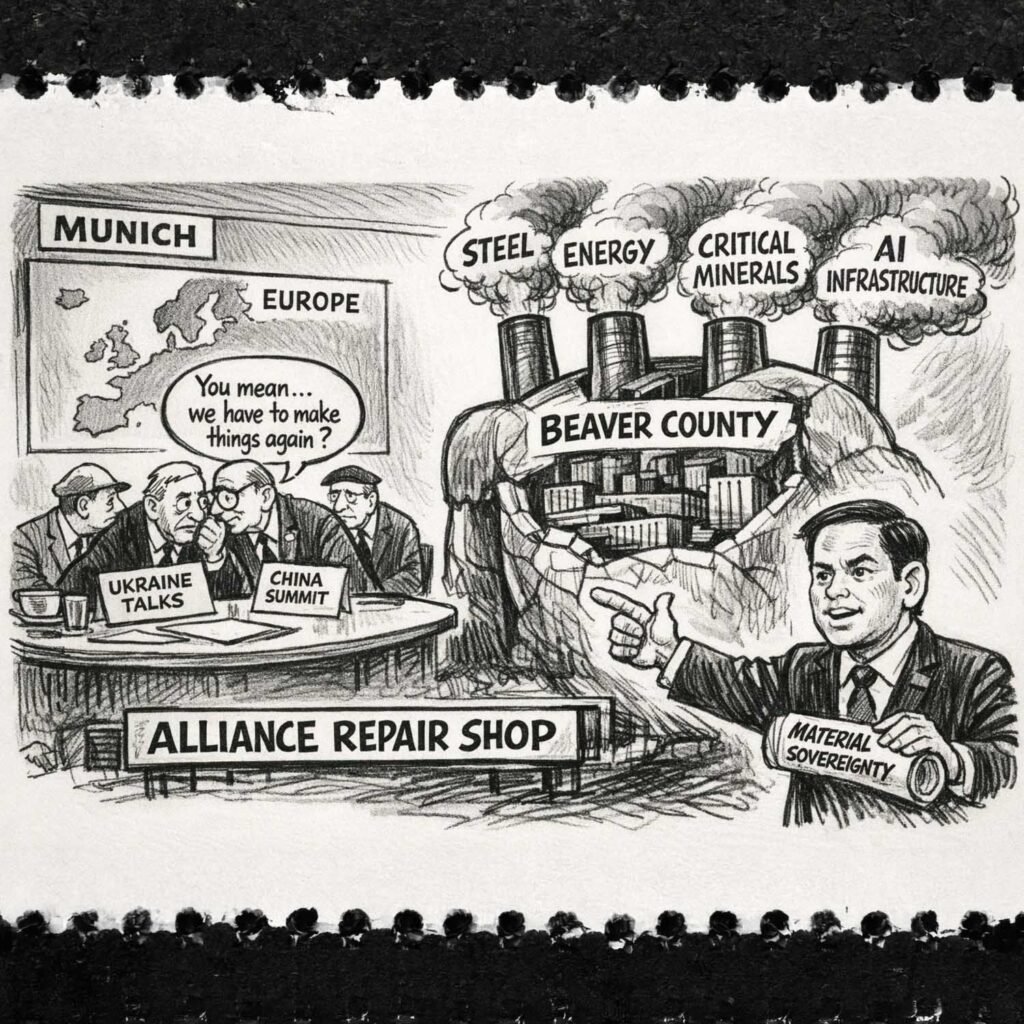
Rubio spoke of rebuilding domestic productive capacity and securing supply chains for critical minerals and technology. That phrase—“material sovereignty”—may not quicken the pulse, but it should. In a world where batteries, chips, and rare earths are the coin of the realm, sovereignty begins with what you can dig, melt, refine, and manufacture.
For a place like Beaver County, this is not abstract theory. We sit within sight of the Beaver Valley Nuclear Station. We have river access, rail access, interstate access, and a workforce that remembers how to make things. We have watched billions in data-center and energy investment swirl around the broader region.
A foreign policy that prioritizes domestic production of energy, steel, advanced materials, and critical minerals is not merely good geopolitics. It is good local development strategy.
Institutional Reform Without Torching the House
Rubio did not propose dynamiting the United Nations or withdrawing from every multilateral body with a logo. He argued instead for reform—an acknowledgment that institutions which have struggled to resolve crises in Ukraine or Gaza require recalibration.
This, too, is less radical than advertised. Institutions are tools. When they cease functioning, you fix them or you replace them. You do not pretend the screwdriver is doing an excellent job of hammering nails.
On China, Rubio was equally clear-eyed. Communication is a “geopolitical necessity,” he said, even as interests diverge. That is not saber-rattling; it is statecraft. Managing competition without drifting into unnecessary conflict is the adult task of diplomacy.
What It Means for Beaver County
Here is where Munich meets Midland.
If Washington’s new posture emphasizes securing domestic supply chains for energy infrastructure, advanced computing, and critical minerals, regions with industrial DNA stand to benefit. The same policy shift that encourages onshoring semiconductor components or battery inputs also encourages investment in power generation, transmission, and heavy fabrication.
Beaver County is already flirting with the future—hydrogen hubs, data centers, advanced manufacturing. A doctrine of material sovereignty tilts the playing field in favor of places that can host, power, and supply those projects.
We know what it is like to be told that globalization will take care of us. We also know what it is like to be taken care of by globalization.
A foreign policy that unapologetically links security to domestic production does not guarantee a renaissance along the Ohio River. But it creates conditions in which one is more plausible.
You need not be a fervent admirer of Donald Trump to concede that prioritizing American economic strength in foreign policy has advantages. Nations that cannot feed, fuel, or equip themselves eventually discover that lofty rhetoric is a poor substitute for steel.
In Munich, Marco Rubio suggested that the West must rediscover the connection between civilization, sovereignty, and industry. In Beaver County, we might simply call that common sense—with a side of molten metal.
And if common sense happens to arrive this time wrapped in the language of “material sovereignty,” we would do well not to sneeze at it.