By Rodger Morrow, Editor & Publisher, Beaver County Business
Listen to a podcast discussion about this article.
There are towns in Beaver County that have been declared “post-industrial” so often they should be eligible for Social Security. Koppel is one of them. Every few years, someone announces that steel is finished, the furnaces are cold, and the future will be delivered by an app. And then—just when the obituaries are being typeset—the mill whistles again.
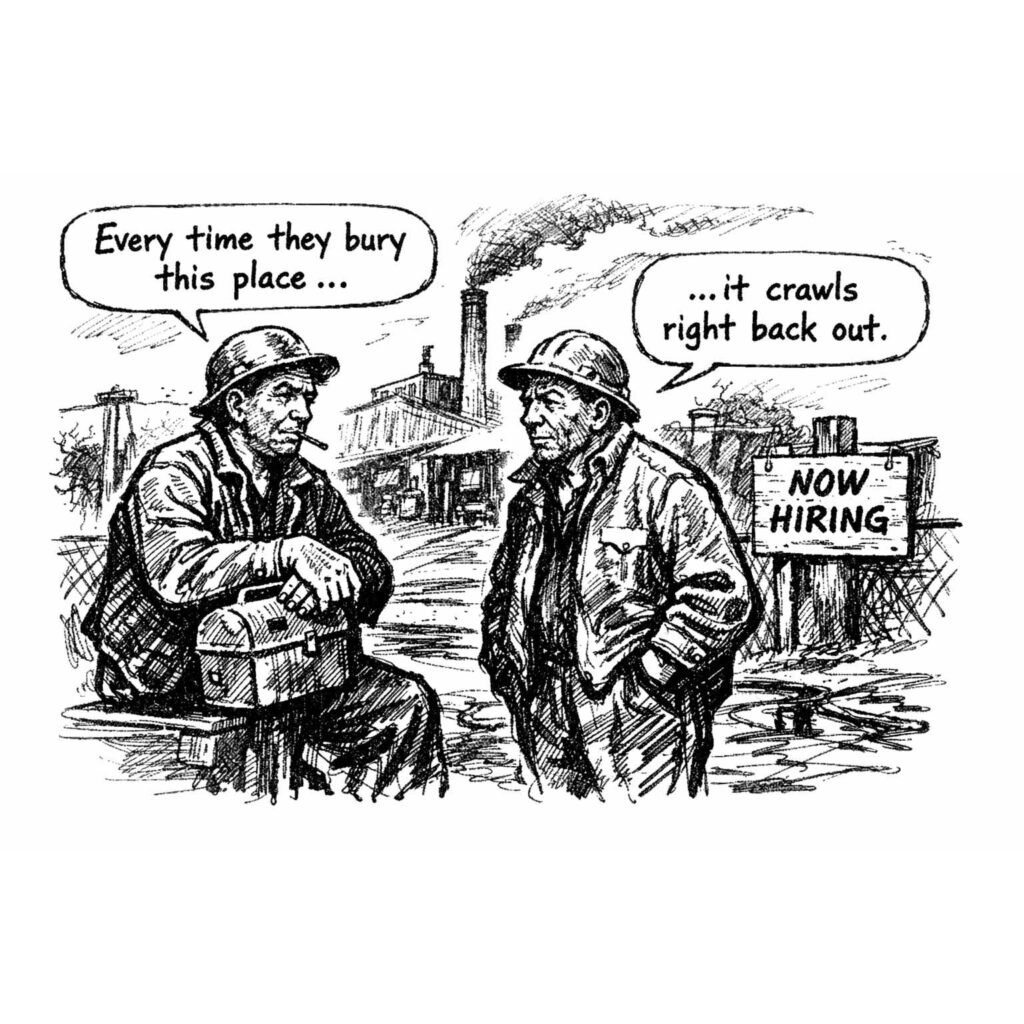
That’s essentially what’s happening this winter at the old steel plant in Koppel, where Tenaris is restarting heat treatment and finishing lines and, in the process, putting about 80 people back to work.
Eighty jobs may not sound like much in Washington, where employment numbers are measured in the tens of thousands and optimism is counted by the press release. In Beaver County, 80 jobs is the difference between a town being “revitalizing” and being “remembered fondly.” It’s the difference between the lights being on and the lights being nostalgic.
Tenaris, which is headquartered in Luxembourg but has figured out that steel pipe tends to work best when it’s made near where it’s actually used, acquired the former Ipsco Tubular Inc. plant in January 2020. This was unfortunate timing, as January 2020 turned out to be the last calm month before the global economy fell into sweatpants and sourdough starter. Oil and gas production was slashed, COVID shut everything down, and the Koppel plant spent much of 2020 and 2021 doing what mills do best when there’s no demand: waiting.
What’s changed is not sentiment but math.
Last year, Tenaris pressed the gas pedal and committed $150 million to the Koppel facility, wagering—quite reasonably—that America would still need American-made steel pipe to move American energy out of American shale. That investment included $85 million for a new air filtration system, a welcome upgrade in a business once known for filtering air by opening a window. It also included $15 million spent in 2021 and 2022 to bring heat treatment and finishing lines back to life, followed by another $2 million in recent months to complete the restart.
This is not nostalgia. It’s logistics.
Marcellus and Utica shale drilling aren’t theoretical concepts dreamed up by consultants in glass offices. They are real holes in real ground that require real steel pipe—pipe that must be heat-treated, finished, and delivered on time. Koppel is positioned to do exactly that, which explains why Tenaris is staffing up to about 300 employees total, with those 80 new hires forming the most encouraging statistic in the entire announcement.
Guillermo Moreno, president of Tenaris US, put it more formally, noting that reopening the heat treatment and finishing lines “reinforces the strength of our domestic production capabilities” and that Koppel “remains a cornerstone” of U.S. operations. Corporate executives tend to speak this way. Around here, it translates to: the mill matters again.
Koppel has been making steel since the early 1900s. It survived wars, recessions, energy booms, energy busts, and at least three generations of people predicting that manufacturing was over. It was idled by a pandemic and a collapse in oil and gas demand that had nothing to do with local workers and everything to do with global panic.
Now it’s coming back for a very old-fashioned reason: people need things, and those things need to be made somewhere.
This isn’t a ribbon-cutting miracle or a “transformation corridor.” It’s 80 people getting up in the morning and going to work. In Beaver County, that’s still the most reliable economic development strategy we have ever discovered.