Listen to a podcast discussion about this article.
There was a time in America when making coffee required exactly two things: coffee and something hot enough to frighten it into becoming liquid.
My mother accomplished this feat with a battered percolator that sounded like a submarine under attack and tasted, depending on the morning, either like motor oil or a miracle. Nobody complained. The point of coffee was not to hold a symposium about it. The point was to wake up.
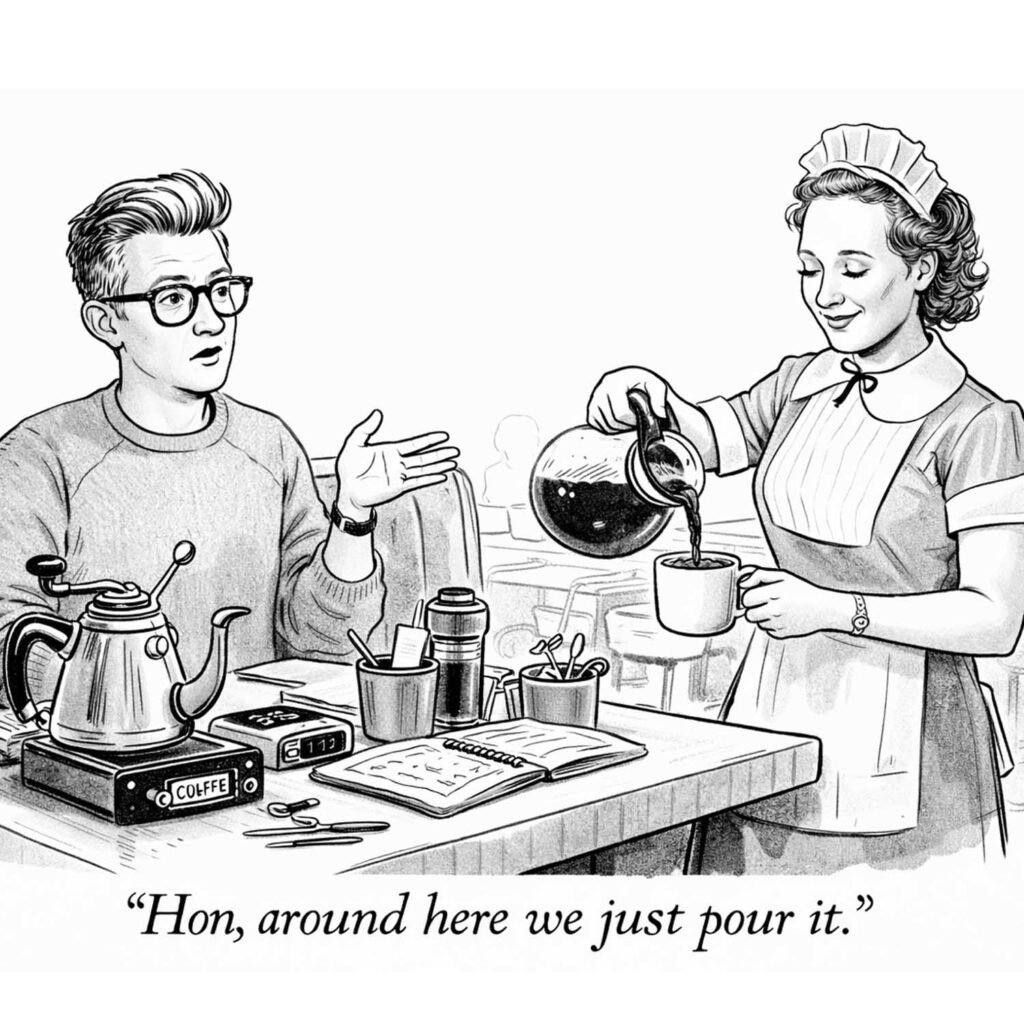
Today, however, coffee has been liberated from such primitive expectations. It has evolved into a lifestyle, a hobby, a technological arms race, and—if one believes the internet—a moral philosophy.
The modern journey begins innocently enough.
Some poor soul types “best cheap coffee grinder” into a search engine. This is the moment his life quietly veers off the highway and onto a winding mountain road full of hairpin turns and $4,000 appliances.
Soon he discovers the gospel according to YouTube. A gentleman named James Hoffmann—who appears to possess the calm authority of a physics professor explaining black holes—begins guiding him through the sacred rituals of coffee.
The first stage is mild.
Instead of buying coffee at the grocery store like a normal mammal, our pilgrim now orders beans roasted by small artisans who speak of “notes of bergamot and caramelized plum.” He purchases a V60 dripper, which resembles laboratory glassware, and a digital scale precise enough to weigh a hummingbird.
At this point, the coffee enthusiast begins speaking in sentences like:
“I’m dialing in my extraction.”
This is how friends start quietly backing away.
Soon comes what experts might call Prosumer Purgatory.
Our enthusiast buys a grinder that costs several hundred dollars, because apparently the previous grinder was “introducing inconsistencies in the particle distribution.” This discovery usually arrives after watching a 27-minute YouTube video featuring a man explaining burr geometry.
Before long, our hero is standing at the kitchen counter with a marker, coloring the metal burrs inside his grinder to check their alignment like a machinist rebuilding a jet engine.
Some enthusiasts even 3D-print replacement parts.
For coffee.
Then comes the ritual stage, which involves techniques whose acronyms sound suspiciously like government agencies.
There is RDT, the Ross Droplet Technique, in which one spritzes coffee beans with water to control static electricity.
There is WDT, the Weiss Distribution Technique, in which a person stirs the grounds with a tiny bundle of needles, a process best described as adult sandbox play.
There are refractometers—$300 gadgets that measure Total Dissolved Solids—so a computer can tell you whether you enjoy your beverage.
This seems to me a remarkable step forward in human progress: outsourcing your taste buds to a spreadsheet.
Another popular ritual is “slow feeding,” where beans are dropped one at a time into a grinder. The theory is that this produces a more even grind.
The practical result is that you look like a man feeding birdseed to a machine while your family waits for breakfast.
Eventually, some enthusiasts reach what might be called the Unobtanium stage.
This is where they begin eyeing $4,000 grinders—machines with names like the Weber EG-1—which resemble equipment used to refine uranium.
At this point, financial creativity enters the picture.
The enthusiast begins telling his spouse things like:
“Oh, that grinder? It was on sale.”
Or:
“It’s basically an investment.”
Historians may someday refer to this phase as the Age of Financial Infidelity.
Meanwhile, inside the coffee community itself, holy wars rage over matters of doctrine.
Flat burrs versus conical burrs.
Blind shaking versus distribution tools.
Filter paper thickness.
Entire friendships collapse over arguments about extraction percentages that differ by half a decimal point.
If medieval theologians had possessed espresso machines, the Crusades might have been about pour-over technique.
Observers of this subculture generally identify four main tribes.
First is the Alchemist, who treats brewing like a chemistry experiment and maintains spreadsheets detailing water temperature, bloom time, and lunar phases.
Second is the Gearhead, who buys espresso machines the size of a Buick and discusses them with the solemnity of a Ferrari collector.
Third is the Aesthetic Purist, who refuses electricity entirely and hand-grinds beans with a crank the size of a pepper mill, usually while wearing linen.
And finally there is the Hoffmann Disciple, who watches every video review and rearranges his entire personality accordingly.
Each group believes it has discovered the secret path to coffee enlightenment.
Meanwhile the rest of humanity is just trying to stay awake.
Here in Beaver County, we have generally taken a more streamlined approach to coffee technology.
You enter a diner.
You sit down.
A waitress arrives carrying a pot that has been on the burner since roughly the Truman administration.
She pours you a cup and calls you “hon.”
The coffee may not contain notes of bergamot or caramelized plum.
But it will wake you up.
And best of all, it doesn’t require a refractometer, a burr alignment marker, or a secret credit card statement.
Which, when you think about it, might still be the most advanced coffee system ever invented.