By Seamus Morrow, Hooman Interest Editor
Listen to a podcast discussion about this article.
Let me begin with a personal note, offered from the dignified perspective of a 140-pound Landseer Newfoundland who has logged more veterinary dollars than most Beaver County residents have logged miles on I-376.
A couple of years ago, my hooman poisoned me.
Not on purpose, of course. He is fond of me, feeds me yogurt from his breakfast bowl, and consults me on important editorial decisions. But one ill-fated batch of salmonella-laced kibble—marketed in a brightly colored bag featuring a Labrador in a field of wheat—nearly sent me to the Great Dog Park Beyond. After a small fortune in vet bills and a long discussion involving words like “liability,” “supply chain,” and “never again,” he switched me to Balto Raw in East Lima, Ohio.
Gentle Reader, I have felt magnificent ever since. My coat gleams. My paws prance. My digestive system runs like a German commuter train.
Which brings me to today’s topic: the skyrocketing cost of veterinary care—and why your hooman keeps pretending the bills arrive by magic and will eventually go away if stacked quietly under a houseplant.
The Rise of Big Vet (And the Fall of Your Hooman’s Savings)
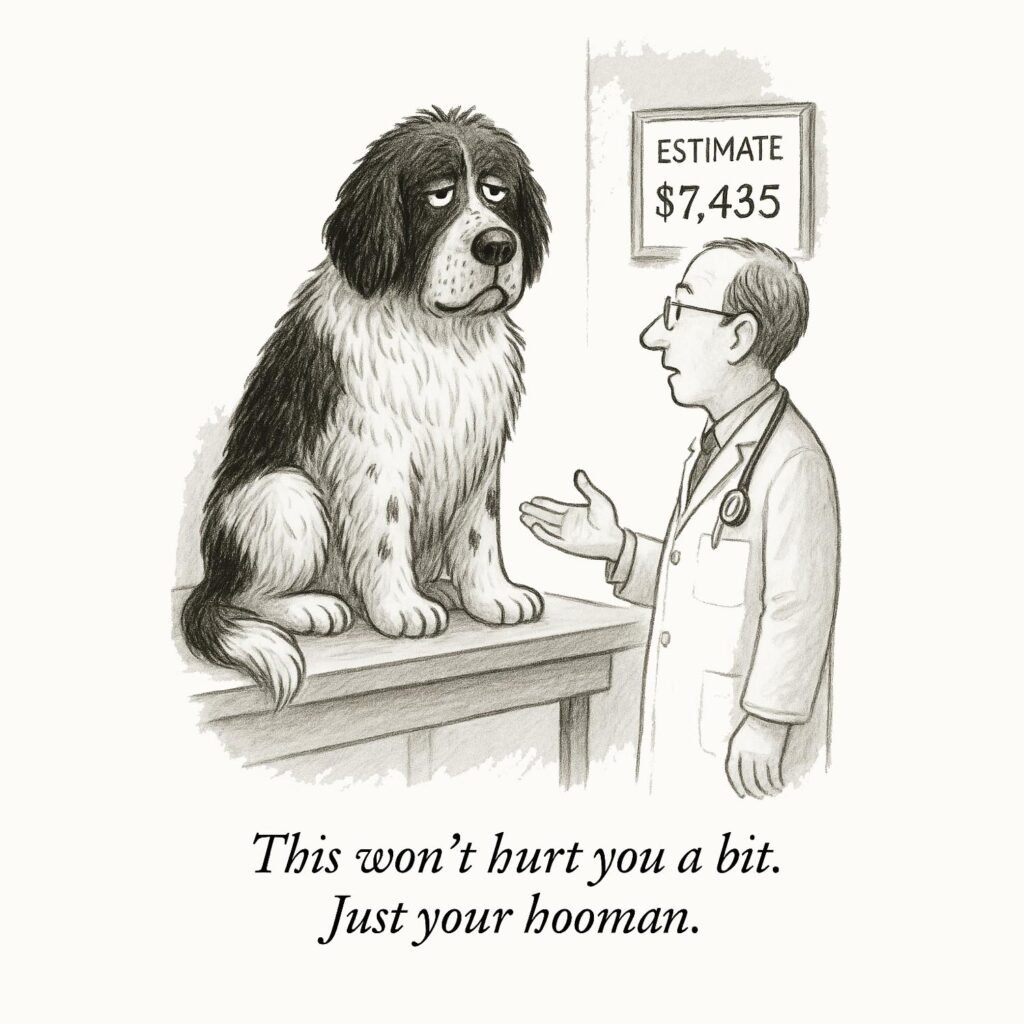
Somewhere in America, a cocker spaniel is undergoing an MRI that costs more than your car. This is not because the dog has developed sudden artistic ambitions. It is because the veterinary industry has become the latest frontier in the corporate roll-up parade—where private equity firms go through independent clinics the way I go through chew toys: compulsively and without regard for hooman financial stability.
The video my hooman showed me—Wall Street’s Shocking Plan for America’s Pets—would have made my fur stand on end if it weren’t already standing from all the static electricity in my apartment. The big picture:
- Vet prices are up 60% in ten years, which is double inflation. Emergency visits now cost more than my adoption fee (and I am a magnificent specimen). The average dog will require $34,000–$35,000 over its lifetime, depending on whether the dog chews electrical cords or merely thinks about it.
- Corporate giants—including Mars, JAB, and private-equity firms like KKR—now own thousands of clinics. Mars owns VCA and Banfield, proving that the company responsible for the Snickers bar is also responsible for the $837 your hooman paid last Thursday for “evaluation and fluids.”
As a dog, I am obliged to report this without editorializing, though I will offer the observation that Snickers has never cost $837 no matter how hungry you were.
What Happens When Wall Street Notices You Love Your Pets
Humans, for all their cleverness with smartphones, are hopelessly tenderhearted about us. Corporate strategists noticed this early.
The logic goes like this:
- Humans will pay anything to keep their pets alive.
- Therefore, anything they will pay should ideally cost more.
That sound you hear is your human quietly cancelling their gym membership to pay for your monthly Apoquel.
Meanwhile, veterinarians stuck inside corporatized clinics report the same symptoms as dogs at bath time: stress, confusion, and the overwhelming desire to run for the exit. They face pressure to meet revenue targets, follow standardized treatment scripts, and suggest “optional” DNA tests that somehow cost more than the genealogy test your aunt bought you for Christmas.
The Economics of the Exam Room
I have been listening in on my hooman’s research, usually from the middle of his lap while he is trying to type. Here’s what I’ve gathered:
- Inflation hit veterinary supplies so hard that even exam gloves cost more, though they taste the same as ever.
- Labor shortages mean fewer techs and longer waits, which give a dog ample time to contemplate mortality.
- Tariffs and pharmaceutical markups have driven medication prices upward, making even routine care feel like applying for a home equity line.
- Technology creep—MRIs, chemotherapy, stem-cell treatments—has turned vet care into tiny, furry versions of human medicine, with correspondingly un-tiny bills.
Pet food costs have jumped, pushing more hoomans (like mine) into raw-food evangelism. Personally, I consider this the lone bright spot in the American economy.
The Inevitable Question
All of this leads to the worst news of all:
Your human is thinking about pet insurance.
This is how bad things are. Your hooman—who once said, “I don’t believe in insurance unless it involves a roof”—is now paying $62 a month so that you may one day swallow a sock without bankrupting the household.
Even pet ownership itself is being reshaped. Shelters report more surrenders. New adoptions skew toward higher-income families. Middle-class homes—the traditional source of tennis-ball chasers and counter-surfers—are being priced out of the companionship market.
Somewhere, an entire generation of dogs is preparing to file an antitrust lawsuit.
A Final Word From Your Editor
On behalf of canines everywhere, I must say: we appreciate the effort. We really do. But the rising cost of vet care is now so alarming that I, a dog, have taken to writing economic analysis for a local business publication.
Your hooman won’t tell you this bad news. They don’t want you worrying. They want you thinking your biggest problem is whether the mailman is plotting a coup.
But I, Seamus Morrow, Hooman Interest Editor—and survivor of the Great Kibble Poisoning of 2023—feel obligated to report the truth:
America’s veterinary system is becoming the Ritz-Carlton of healthcare, except without the turn-down service.
Fortunately, my own hooman wised up, abandoned corporate kibble, and now buys my food from Balto Raw in East Lima, where the ingredients are simple, honest, and noticeably lacking in salmonella.
It won’t fix the vet industry. But it has given me the strength, clarity, and vibrant coat required to break this story wide open.
Now, if you will excuse me, I must attend an editorial meeting, which looks suspiciously like a nap.