Listen to a podcast discussion about this article.
How a curious alliance of integralist theologians, media provocateurs, and geopolitical theorists is quietly trying to rewrite the religious DNA of the American Right
There are days in American politics when one begins to suspect the country is less a republic than a kind of theological flea market. Old doctrines appear on folding tables beside newer ones, all of them loudly advertised by gentlemen who insist they’ve finally located the secret machinery of history.
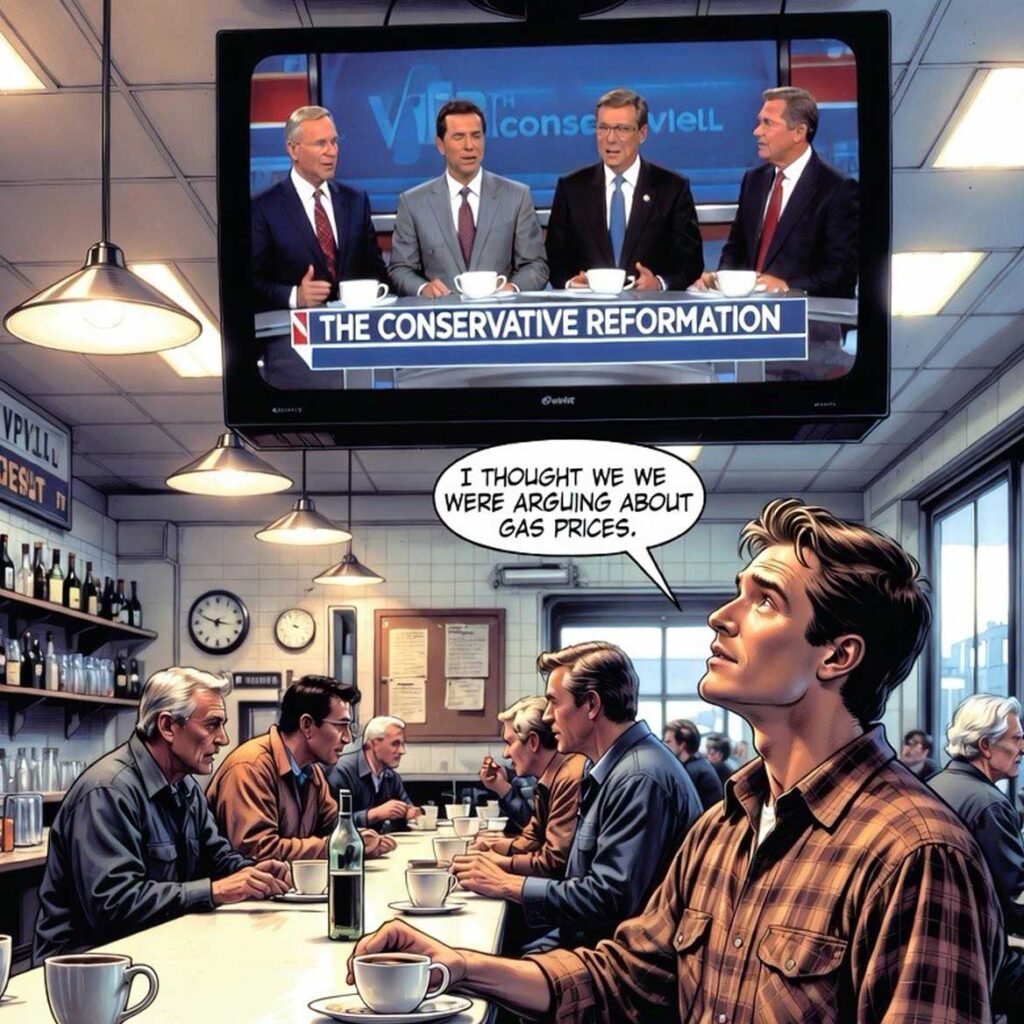
The latest such discovery, circulating vigorously through the internet’s more caffeinated corners, is that the current quarrels inside American conservatism are not really quarrels at all. They are, according to a widely shared analysis, part of a deliberate demolition project aimed at dismantling the evangelical Protestant foundation of the American Right and replacing it with something rather more Old World: Catholic integralism, ethnonationalism, and a dash of Russian geopolitical theory.
If this sounds like the sort of conversation you might overhear in a Washington think tank at two in the morning, rest assured that the theory has now traveled far beyond the Beltway. It has reached podcasts, social media threads, and probably a few coffee counters around Beaver County, where men who spent their lives pouring steel are now discovering that the Republican Party may also be engaged in a spirited theological renovation.
Most people assumed that conservative arguments over the past few years were about fairly ordinary matters—foreign policy, immigration, tariffs, the price of eggs, and whether the United States should keep playing global hall monitor.
But the theory making the rounds insists something far more systematic is underway. What looks like policy disagreement is actually ideological demolition.
For roughly seventy years, evangelical Protestants have served as the theological engine of American conservatism. They represent roughly 30 percent of the electorate and an even larger share of Republican voters. Their churches provide the organizational plumbing of conservative politics. Their pastors supply the sermons. Their reading of Scripture provides much of the movement’s moral vocabulary.
This religious foundation is not an abstraction. In places like Beaver County—where church parking lots fill every Sunday and where pastors often double as community counselors—it is simply part of the civic landscape. Evangelical Christianity has been as steady a presence here as the Ohio River or the old smokestacks of Aliquippa.
One of the most distinctive features of that evangelical worldview has been its approach to Israel. Many evangelicals see the Jewish state not merely as a geopolitical ally but as part of a biblical story unfolding across centuries. Their support for Israel is grounded less in diplomacy than in theology.
The online analysis argues that this entire framework is now under organized attack.
The goal, it says, is not simply to win a policy debate but to replace the religious architecture of the conservative movement. Instead of evangelical Protestantism—with its emphasis on biblical authority and its generally friendly view of Israel—the new framework would draw from Catholic integralism, European-style ethnonationalism, and geopolitical theories imported from Russia.
Before anyone in Beaver County’s sizable Catholic population begins writing letters to the editor, the argument carefully notes that this is not about ordinary American Catholics.
Most Catholics in the United States vote the same way everyone else does: based on family concerns, the economy, and whether their children can afford a house within driving distance of the old neighborhood.
The theory instead focuses on Catholic integralism, an intellectual movement—mostly confined to universities and journals—that argues modern liberal democracy grew out of Protestant errors. In this view, society functions best when civil authority is guided, or perhaps supervised, by the Church. Religious liberty, in this framework, is less a triumph of conscience than a historical misunderstanding.
Several conservative thinkers—Adrian Vermeule, Sohrab Ahmari, Patrick Deneen, and others—have written sympathetically about aspects of this idea. None of them would likely describe their work as part of a religious takeover of the Republican Party, but internet detectives rarely allow modesty to interfere with a sweeping theory.
Into this already crowded theological debate comes an unexpected character: Alexander Dugin, a Russian philosopher whose book The Foundations of Geopolitics argues that the United States can be weakened not by military confrontation but by encouraging internal divisions.
Among the divisions he highlights is religion—particularly the alliance between American evangelicals and Israel.
According to the theory circulating online, some populist strategists in the United States have adopted parts of this geopolitical framework. The idea is that by fracturing the evangelical coalition, the political architecture of the American Right can be reshaped.
If this sounds suspiciously like the sort of strategy devised in a dimly lit European café, that may be because it probably was.
Meanwhile, the American media ecosystem has been busy amplifying the dispute.
Tucker Carlson, now liberated from the constraints of cable television and operating as a podcaster with an audience the size of a medium-sized state, has hosted a series of guests whose views on Israel and Christian theology have stirred intense debate among evangelicals.
Carlson has taken to calling Christian Zionism a “heresy,” which is the sort of statement that tends to produce lively discussion in churches from Texas to western Pennsylvania.
Nick Fuentes, a young provocateur with an enormous online following, promotes a mixture of nationalist rhetoric and traditionalist Catholic theology that has attracted a surprisingly large number of restless young conservatives.
Candace Owens has entered the conversation as well, bringing with her the rare ability to start a national argument before lunch.
Hovering somewhere above this commotion is Steve Bannon, the former Trump strategist who seems determined to assemble a grand coalition of populists, traditionalists, and anyone else willing to storm the intellectual Bastille.
Critics say Bannon’s project resembles a political laboratory in which various Old World ideologies are being tested on American voters like experimental fertilizer.
But the real battleground, according to the analysis, is not cable television. It is the internet.
An enormous ecosystem of YouTube channels, podcasts, and online debates now functions as a kind of digital seminary for young conservatives. Here theological disputes that once took place in seminaries now unfold before millions of viewers.
One frequent topic is sola scriptura, the Protestant doctrine that Scripture alone holds ultimate authority. Catholic commentators argue that the Bible must be interpreted through church tradition.
For older evangelicals—particularly those who grew up hearing sermons in small-town churches—this argument is familiar territory.
But younger audiences, raised in the internet age rather than the church basement, sometimes encounter the debate as if it were a brand-new intellectual discovery.
Polling suggests a generational shift may already be underway. Support for Israel among younger evangelicals has fallen sharply compared with older believers. Some analysts attribute the change to social media narratives that frame the Israeli-Palestinian conflict in colonial or racial terms—categories that would have puzzled many pastors who once preached about it from pulpits across places like Beaver County.
And it is here that the entire debate begins to wander into more dangerous territory.
The line between legitimate political disagreement and ancient prejudice can be thinner than many people realize. Criticism of Israeli policy is not antisemitism, and Americans—conservatives included—have every right to debate foreign policy without being accused of theological treason.
But when political arguments begin drifting into conspiracies about Jewish influence, global manipulation, or civilizational enemies, the discussion stops being political and starts becoming something uglier.
History offers plenty of examples of how quickly that transition can occur. Europe spent centuries wandering down that road, usually with disastrous consequences.
American conservatism, to its credit, has generally avoided that trap. The post–World War II alliance between evangelicals, Catholics, and Jewish Americans helped build a broad coalition around religious liberty, anti-communism, and a shared belief in what people once called the Judeo-Christian tradition.
Allowing internet provocateurs—or foreign geopolitical theories—to fracture that coalition would be a mistake of historic proportions.
Even institutions once considered rock-solid pillars of conservative orthodoxy are showing signs of strain.
The Heritage Foundation—long the Vatican of Republican policy shops—has experienced internal turbulence in recent years. Staff departures and boardroom disagreements have fueled speculation that the organization is drifting away from the old pro-Israel, evangelical-friendly consensus that once defined the conservative movement’s intellectual establishment.
Meanwhile, the Republican Party’s rising leadership finds itself navigating this theological crossfire with the caution of men walking through a room full of mousetraps.
Vice President J.D. Vance, once a senator from neighboring Ohio and now one of the most influential figures in the Trump administration, has tried to keep one foot on each side of the argument without losing his balance. When controversial questions about antisemitism or ideological extremism surface at conservative gatherings, Vance tends to pivot with the graceful evasiveness of a politician who knows that theological disputes rarely produce happy endings.
It is probably the wisest strategy available.
In places like Beaver County—where Catholic parish festivals, Baptist revivals, and Presbyterian church suppers have coexisted for generations—the idea that American politics might devolve into a sectarian brawl would strike most people as faintly ridiculous.
Around here, theological arguments usually end the same way: somebody orders another cup of coffee and changes the subject to the Steelers.
Which brings us to the uncomfortable lesson buried beneath all this theological excitement.
Political movements can survive policy arguments. They can survive personality clashes, foreign policy disputes, and even the occasional cable-television meltdown. What they rarely survive is the revival of old hatreds.
American conservatism, whatever its other disagreements, managed for most of the postwar era to avoid one of the great curses of European politics: the habit of turning Jews into villains in somebody else’s historical drama.
Evangelicals, Catholics, and Jewish Americans spent decades building a broad coalition around religious liberty and the idea—once fashionable in polite company—of a shared Judeo-Christian civilization. It was never perfect, but it was a remarkable achievement in a century that produced far worse alternatives.
The danger in today’s increasingly theatrical arguments is that some participants appear tempted to toss that inheritance overboard in exchange for internet applause and geopolitical theories imported from parts of the world where antisemitism has been a reliable political tool for centuries.
That would be a mistake.
Criticizing governments is fair game in a democracy. Criticizing policies—even Israeli ones—is perfectly legitimate. But once political rhetoric begins drifting toward conspiracies about Jewish power or civilizational enemies, the conversation stops being conservative and starts sounding uncomfortably like the sort of politics that once set entire continents on fire.
Most Americans, fortunately, have little patience for that kind of thing.
In Beaver County, where churches of half a dozen denominations share the same neighborhoods and where the descendants of steelworkers still measure a man more by his work ethic than his theology, grand ideological crusades tend to lose their momentum somewhere between the diner counter and the church parking lot.
Sooner or later someone asks the obvious question: what exactly are we arguing about here?
Once that question is asked, the great internet reformation begins to look less like a revolution and more like what it probably is—a noisy family argument inside a political movement that hasn’t quite decided what it wants to be when it grows up.
Which means the safest course for conservatives may be the same one Beaver County has practiced for generations.
Argue all you like about theology. Just don’t forget your manners—or your history—while you’re doing it.