By Rodger Morrow, Editor & Publisher, Beaver County Business
Listen to a podcast discussion about this article.
Every December, just as reliably as the first snowfall that turns Route 65 into a slow-motion documentary on regret, Americans begin asking the same anxious question: Who exactly is Santa Claus?
This is not a philosophical inquiry. It is a forensic one.
The accepted version of events—recited solemnly by historians, marketing executives, and people who own framed Norman Rockwell prints—goes something like this: Thomas Nast invented Santa Claus in the 1860s, Coca-Cola put him in a red suit in the 1930s, and the rest is a warm, carbonated blur of jingles and mall photography.
It’s a tidy story. Which should immediately make you suspicious.
Thomas Nast did draw a Santa, it’s true. A squat, bearded fellow who looked less like a magical gift-giver and more like a Civil War quartermaster with union rules. Coca-Cola later refined him—fed him sugar, brightened his colors, softened his gaze, and made sure he appeared friendly to small children and large advertisers alike.
But neither Nast nor Coca-Cola ever truly ran Santa Claus. Not in Beaver County.
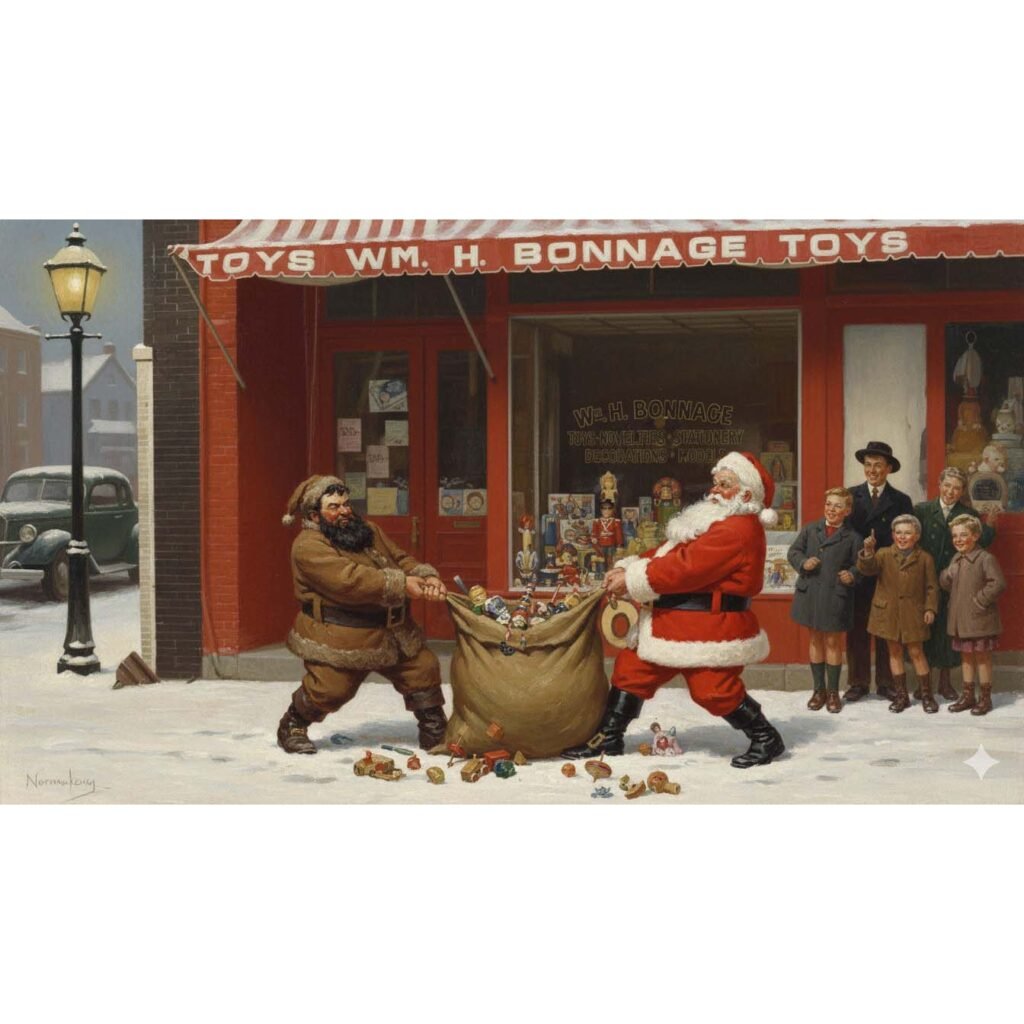
Because for generations of local children, Santa did not live at the North Pole. He lived at Bonnage’s Toy Store in Beaver Falls.
For decades—quietly, efficiently, and without so much as a press release—Bonnage’s held every Beaver County kid’s Santa list. Not digitally, mind you. No cloud storage. No wish-list apps. Just memory, shelves, and an uncanny ability to know whether the G.I. Joe you wanted came with the kung-fu grip or not.
Walking into Bonnage’s in December was a formative experience. The aisles were narrow enough to induce character-building humility. The shelves rose like apartment buildings. Somewhere deep inside the store was the thing you wanted most in the world, and you sensed—correctly—that the adults knew where it was and were not telling you.
This is how belief systems are built.
Bonnage’s was not merely a toy store. It was a distribution hub of Christmas credibility. If Bonnage’s carried it, Santa could deliver it. If Bonnage’s didn’t have it, Santa might still come through—but only if you had been exceptionally well-behaved, and even then the odds were dicey.
Parents understood this hierarchy. Children internalized it. Santa, in Beaver County, did not operate independently. He subcontracted.
Meanwhile, Coca-Cola could run all the ads it wanted. Thomas Nast could redraw Santa until his wrist gave out. None of that mattered if Bonnage’s didn’t stock the toy. This was not capitalism; it was theology.
And here’s the thing about conspiracies: the best ones don’t announce themselves. They just work. Year after year. December after December. Quietly shaping expectations, behavior, and the deeply held conviction that Christmas morning success depended on whether someone at Bonnage’s nodded knowingly when your parent asked, “Do you have one of these?”
So who invented Santa Claus: Thomas Nast or Coca-Cola? I say it was Bob Bonnage, and I defy anyone in Beaver County to prove me wrong.