By Rodger Morrow, Editor & Publisher, Beaver County Business
Listen to a podcast discussion about this article.
Once upon a time, dinner tasted like where you were. In Maine the lobster was local, in Kansas City the steak was proud of it, and in Beaver County you could order a stuffed grape leaf that hadn’t seen the inside of a freezer truck. Today you can eat the same fried pickle in Phoenix, Fargo, or Fallston, PA, and it will taste exactly—depressingly—the same. Our restaurants have become a national franchise of sameness, supplied by a benevolent overlord named Sysco, which decided long ago that what America really needs is the same appetizer everywhere, forever.
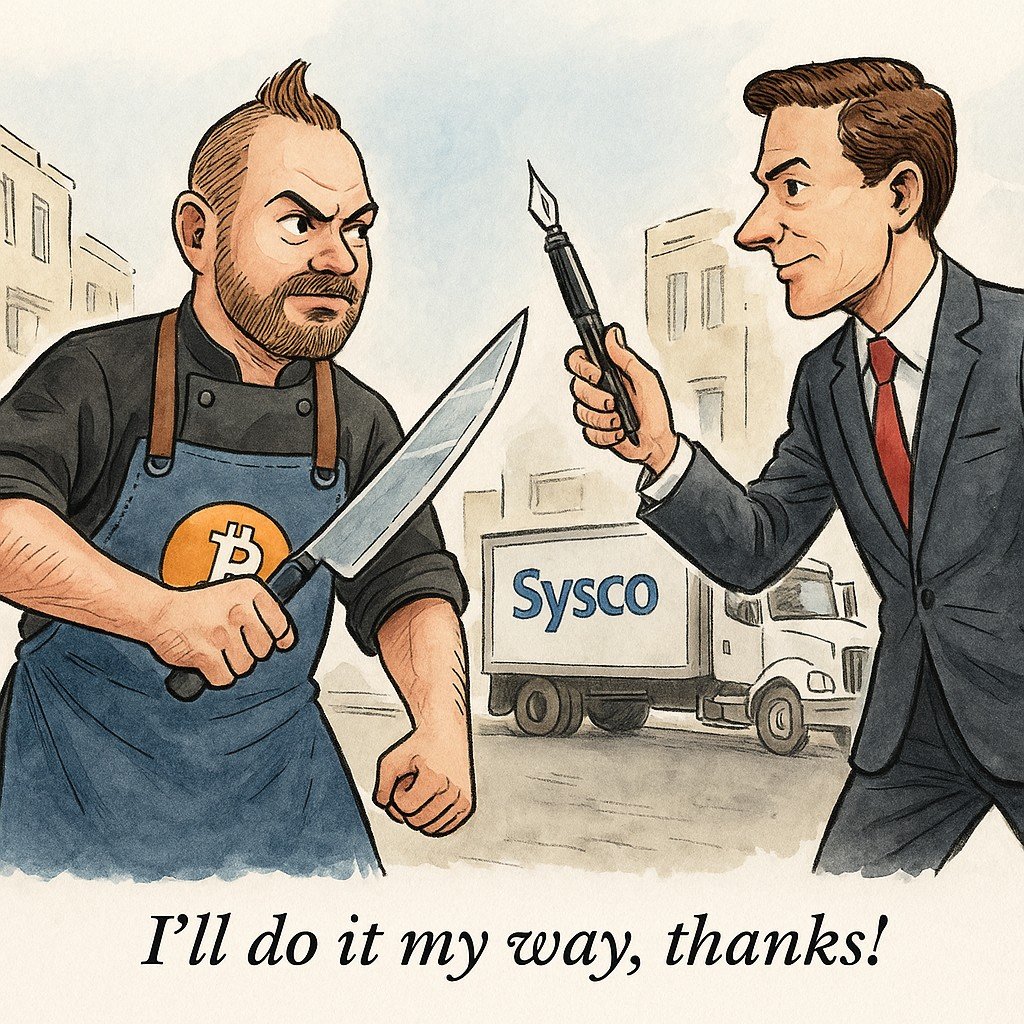
This isn’t a food story so much as a money story. It’s what happens when a civilization acquires a high time preference—the economic impulse to grab the dollar today and let tomorrow pick up the tab. In the short run, that impulse builds empires; in the long run, it hollows them out. Sysco’s empire, built through a stampede of acquisitions, is one expression of national impatience. Another is private equity: buy the business on Monday, load it with debt by Wednesday, lay off the staff by Friday—after collecting an “advisory fee,” of course. They call it “unlocking value.” What they’re really unlocking is the pawnshop door.
High time preference is fueled by our money itself. When the Fed holds rates low and sprays fresh trillions at every market wobble, saving guarantees loss and borrowing feels free. People behave accordingly. Companies binge on leverage; governments live on tomorrow’s taxes; and the fish at the diner tastes like last week’s soybean oil.
Behold the fried pickle. In theory it should be a symbol of regional variety—Texas heat here, Cajun crunch there. Instead it arrives from the same warehouse, in the same box, engineered for the same fryer. Why? Because a national distributor can shave two cents a pound by standardizing everything. Grab the savings now; forget the flavor later.
And yet there are stubborn holdouts. In downtown Beaver, chef-owner Jason Benegasi runs Biba – Latin Kitchen, a small, intimate restaurant that updates its menu constantly—sometimes weekly—to reflect what’s in season. One week it’s roasted beet salad with local greens; the next, Provoleta with peppers grown downriver. Reviews praise the quality and creativity because the ingredients are treated as the point, not an accounting problem. That is low time preference in the wild: invest in quality today because you plan to be here tomorrow.
Private equity has turned the fried-pickle logic into a $3.8 trillion bonfire. Floating-rate loans buy profitable companies, strip their assets, then offload the risk to pension funds via alphabet-soup securities. When rates rise, the businesses drown, but the financiers have already cashed their fees. It’s capitalism without capital—just coupons clipped from the future.
Health care repeats the trick in scrubs. Hospitals merge horizontally, vertically, diagonally—until one chain owns your cradle, your cardiologist, and your cremation. The sales pitch is “efficiency” and “scale,” which in English means “we borrowed a lot and must pay it back quickly.” Care becomes code for market share; innovation suffocates under quarterly guidance. If your hospital now resembles a regional airport with valet parking, blame someone’s bond prospectus.
Enter Bitcoin, the digital currency with the personality of a monk. It promises no bailout, no printing press, and no quarterly miracle—only scarcity: twenty-one million coins, period. The Austrian economist Eugen von Böhm-Bawerk taught that interest is the price of time. When money is elastic, time is cheap. When money is hard, time is dear. In a Bitcoin world, savings retain value; debt actually costs something; plans stretch beyond the next earnings call. The high-time-preference empire begins to look like a house built entirely of fried pickles.
Under low time preference, Sysco’s monopoly tricks and private-equity strip mines lose their magic. With debt expensive and savings valuable, the incentive flips—from strip-mining the present to cultivating the future. A restaurateur like Benegasi doesn’t merely survive; he thrives, not in spite of patience but because of it. Sourcing locally and changing menus with the seasons becomes rational business, not romantic folly. Even the big players must earn loyalty through quality rather than capture it with leverage.
Labor regains dignity. When capital can’t be conjured with cheap credit, skilled people become the irreplaceable asset. It pays to train them, keep them, and stop managing by stopwatch. That’s the difference between hiring a chef and pressing “start” on a microwave.
Bitcoin’s architecture mirrors a healthy economy: decentralized, resilient, a little ornery. There is no headquarters to lobby, no merger to bless, no bailout fund to raid. Participants store value, not promises. That single fact could cool the fever of consolidation more effectively than a century of antitrust. Our colossi—Sysco, CVS-Aetna, and Blackstone—are creatures of easy money. Remove the sugar water and they shrink to human size.
Time becomes scarce again. Families save because they can; firms plan because they must. The get-rich-now schemes that depend on rolling debt meet their actuarial end. Localism stops being a sentiment and becomes an equilibrium. Menus rediscover geography; markets rediscover patience.
Standing atop the world economy yelling “Stop!” may sound futile. But civilizations rarely reform because they see the light; they reform because they feel the interest. Bitcoin, love it or loathe it, reattaches money to time—and tells the princes of consolidation that tomorrow finally matters. If someday your fried pickle tastes different—better, fresher, local—take heart. We may, at last, be saving room for dessert.