Why Pittsburgh needed a smaller airport and what Beaver County can learn from the downsizing.
By Rodger Morrow
Editor & Publisher, Beaver County Business
Listen to a podcast discussion about this article.
For much of the last three decades, Pittsburgh International Airport has been like that oversized house in the neighborhood—the one with six bedrooms, a ballroom, and a mortgage payment no one really wanted to talk about. It was built in 1992 for US Airways, a carrier that promised perpetual prosperity and then quietly packed up in 2004, leaving the region with a magnificent white elephant: 75 gates, an underground train, and a baggage system big enough to haul freight for an entire con…
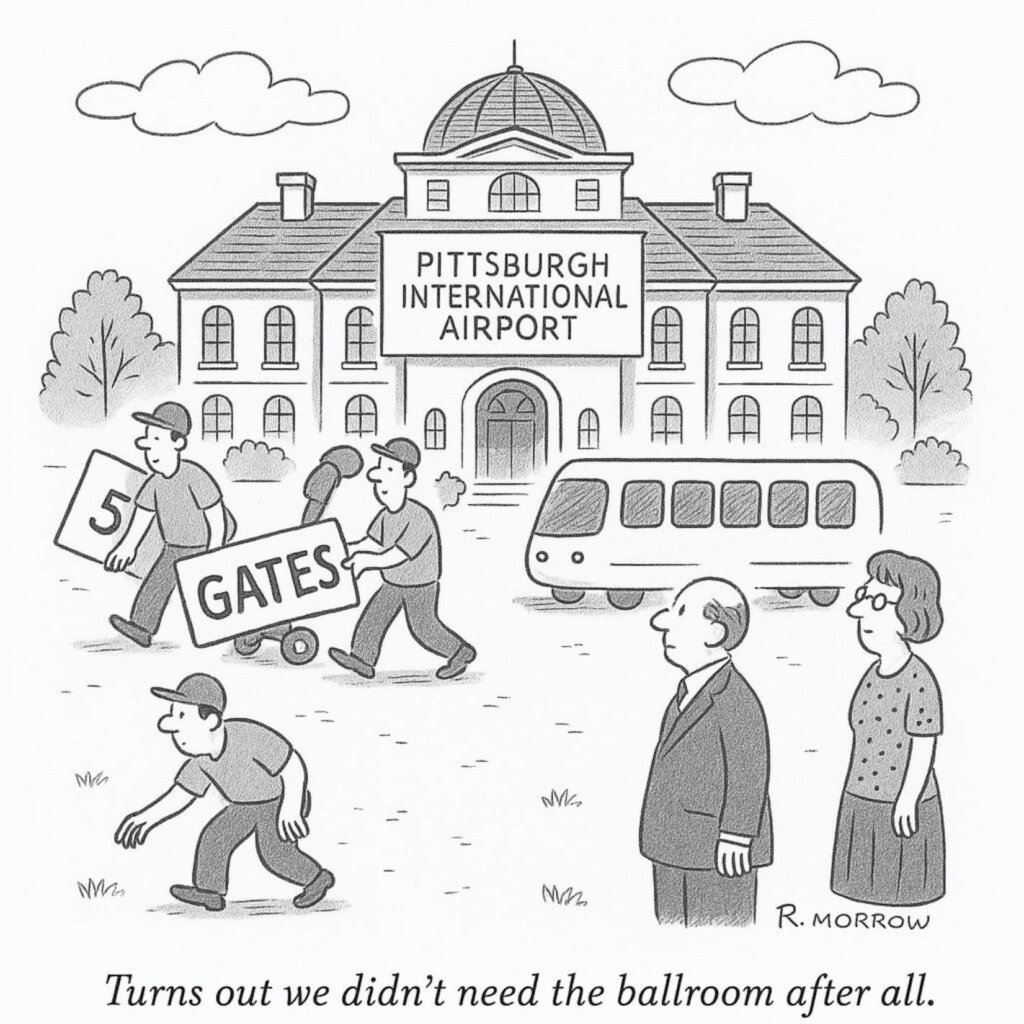
These days, the house is being remodelled to fit its occupants. The new owners have ripped out the extra parlors, knocked down a few walls, and installed windows that actually let in light. The “right-sizing” project at PIT—now estimated at $1.7 billion—was originally budgeted closer to $1.39 billion. And while headlines once suggested a 2023 opening, the true baseline was always January 2025. That date has since been nudged to Fall 2025, because in Pittsburgh we treat timetables the way we treat pothole …
Out goes the eight-mile baggage conveyor, in comes a shorter tunnel that actually delivers luggage before the carousel becomes a long-term parking lot for weary travellers. Out goes the endless train ride between ticket counter and gate, in comes a single head house that consolidates check-in, security, and baggage claim under one roof.
The new design looks more like a cathedral of practicality than a palace for hub traffic. Think butterfly-wing rooflines inspired by Pittsburgh’s bridges, tree-like columns that flood the concourse with daylight, and indoor gardens that make the place feel less like a bus terminal and more like Phipps Conservatory. It’s sustainable, modestly sized, and meant for people who actually start or end their journeys in western Pennsylvania rather than pass through on their way to someplace shinier.
As Chuck Smetana, a retired businessman now living in Beaver County, told me: “The old terminal was a maze. Getting from the gate to baggage to the rental car was a pain I endured for 20 years. The idea of a clean-sheet airport that’s actually usable is to be applauded.”
Why should Beaver County care? Because the region’s economic future has less to do with how many flights land here and more to do with how attractive this place looks to investors. A right-sized, energy-efficient, easy-to-navigate PIT tells a story that Beaver County can borrow: adapt or decline. The airport shed its hub fantasy and built a facility for the world it actually lives in. That’s a lesson for every community with a half-empty industrial park and a dream of Amazon riding in on a white horse.
Then there’s the microgrid. PIT powers itself with a solar-and-gas system—23 megawatts strong—and saves about $1 to $1.5 million annually on utility costs. Not the $20 million miracle sometimes repeated, but still a tidy sum. The larger savings, about $23 million a year, come from overall operational efficiencies: a terminal that’s easier to heat, cool, maintain, and staff.
Transportation matters too. For Beaver County manufacturers shipping precision metal or plastic composites into a global supply chain, shaving ten minutes off a trip through the airport or getting cargo handled more efficiently can mean meeting a contract instead of losing it. A streamlined PIT strengthens the logistical backbone of the Ohio River Valley, where intermodal terminals and highway spurs are every bit as valuable as a new runway.
Of course, costs have ballooned from that $1.39 billion baseline to $1.7 billion, and the timeline has slipped. But in infrastructure, as in life, you get what you pay for. The payoff is not just a prettier terminal but a symbol: western Pennsylvania can reinvent itself without delusion. Beaver County should take note.
The lesson of Pittsburgh International is not “build it and they will come.” It’s “build what you need, build it smart, and don’t be afraid to tear down the parts of the house that never really worked.” That’s a blueprint every county commissioner and business leader should tuck in their back pocket before the next ribbon-cutting.
“The old terminal was a maze… The idea of a clean-sheet airport that’s actually usable is to be applauded.” – Chuck Smetana
📊 By the Numbers: The New Pittsburgh Airport
- $1.7 billion – Current project cost (up from ~$1.39 billion baseline)
- Fall 2025 – Revised opening date (originally January 2025)
- 3 levels – Departures on top, gates in the middle, arrivals below
- 11–12 TSA lanes – Consolidated into a single open hall
- 3,300 – Spaces in the main parking garage (not 4,300)
- $23 million – Total projected annual operational savings (efficiency, staffing, maintenance)
- $1–1.5 million – Annual savings from the on-site microgrid alone
- 23 megawatts – Power capacity of PIT’s microgrid (solar + natural gas)
- Indoor gardens & courtyards – Built-in green spaces to regulate temperature and humidity, supporting LEED goals
- National model – Cleveland, Newark, Sacramento, Kansas City among airports citing PIT as inspiration