By Rodger Morrow, Editor & Publisher, Beaver County Business
Listen to a podcast discussion about this article.
When Benjamin Franklin Published The Way to Wealth
When Benjamin Franklin published The Way to Wealth in 1758, he was addressing a crowd of Colonials grumbling about taxes, inflation, and the high price of living—conditions indistinguishable from 2025, except the Colonials lacked TikTok, Uber, and the irresistible lure of Mac.Bid liquidation pallets.
Franklin’s wisdom came through the voice of “Father Abraham,” an elderly sage who dispensed timeless financial counsel. The crowd applauded politely, then immediately ignored him—just as a modern American might applaud a Dave Ramsey podcast while simultaneously one-click purchasing a refurbished hot tub because “it was only $119 on Mac.Bid.”
What Franklin witnessed in 1758 was human nature. What we witness in 2025 is human nature with Wi-Fi.
If Franklin Lived Today
Franklin believed most financial hardship was self-inflicted—caused not by taxes but by sloth, vanity, waste, and the urge to acquire things that spark joy for approximately nine minutes.
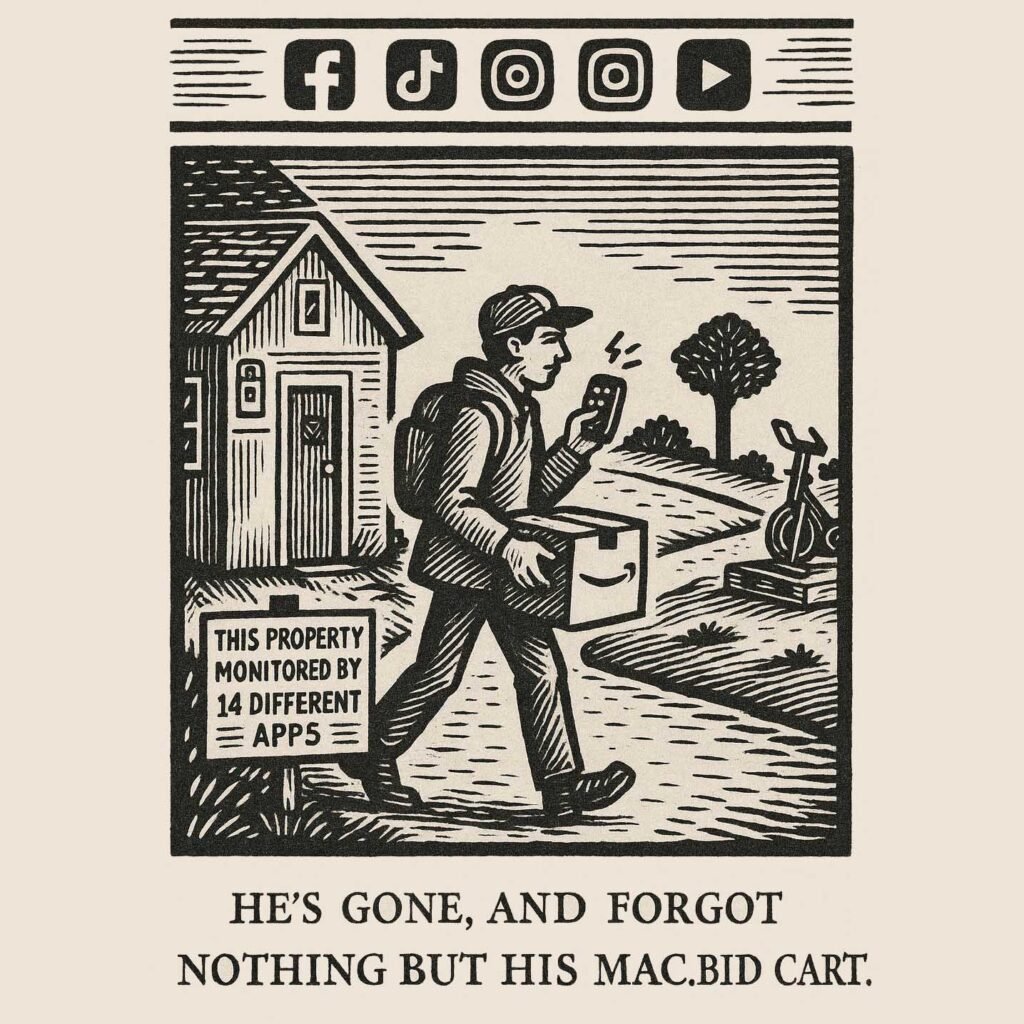
We haven’t changed. We’ve merely moved our foolishness online, automated it with apps, and placed it on Afterpay.
If Franklin toured our modern economy, his updated proverbs would write themselves:
“Early to bed and early to rise makes a man healthy, wealthy, and slightly less miserable than the fellow doomscrolling until 3 a.m.”
“Drive thy business, let not thy business drive thee — and for heaven’s sake, stop checking Slack on weekends.”
“Beware the gig whose profits disappear in gasoline, parking tickets, and whatever percentage Uber keeps this month.”
The man who invented bifocals to save time would surely take a dim view of doomscrolling on TikTok, which saves no time and destroys most of one’s remaining brain cells.
The New American Hustles
The old Colonial vices—ribbons, rum, idle gossip—have been replaced by “opportunities” that promise wealth but mostly deliver exhaustion.
House-Flipping
Franklin warned that “a small leak will sink a great ship.” He had not yet met the 2025 house flipper discovering mold behind a wall, a missing permit, and a contractor who mysteriously vanishes when mercury retrogrades.
AirBnB
In Franklin’s time, “a penny saved was two pence clear.” In ours, “a penny saved” is consumed by AirBnB cleaning fees, HOA warnings, and the guest from Toledo who breaks both the Keurig and the sense of optimism you once had about passive income.
The Gig Economy
Whether driving Uber, delivering DoorDash, or assembling IKEA furniture as a side hustle, the gig worker soon learns Franklin’s rule: “He that riseth late must trot all day—and still waits for the algorithm to give him another order.”
Optimus Robots
Elon Musk assures us the Optimus robot will take over all manual work, leaving us free to engage in higher pursuits. In Franklin’s time, this was called “wishful thinking,” and he warned sternly against it.
Beware of Little Expenses
Franklin’s classic line—“Beware of little expenses; a small leak will sink a great ship”—was practically designed for GrubHub, DoorDash, and Uber Eats.
A $12 sandwich becomes a $31 commitment to sloth:
- $6 delivery fee
- $4 “temporary fuel adjustment”
- $5 service fee
- $3 tip
- $1 “miscellaneous platform charge”
Franklin, who walked to his own printing shop, would advise us to stand up, put on shoes, and retrieve our own sandwich.
Facebook Marketplace
In 1758, Franklin warned:
“At a great pennyworth pause a while.”
If he lived today, he would paste this over the entire interface of Facebook Marketplace, where “lightly used” means “retrieved from the basement after the flood of ’19” and every message begins with “Is this still available?” followed by silence.
Mac.Bid: The Modern Colonial Temptation
Colonial Americans flocked to public auctions.
Modern Americans flock to Mac.Bid, where the thrill of the bargain is matched only by the mystery of why the last person returned it.
Franklin would have used Mac.Bid as his central illustration of self-imposed misery:
“Buy what thou hast no need of, and ere long thou shalt sell thy necessaries… on Facebook Marketplace.”
The Modern Way to Wealth
At the end of The Way to Wealth, the crowd applauds Father Abraham and then promptly resumes spending foolishly.
We do the same—just through apps.
- finance a Peloton,
- subscribe to six streaming services,
- buy an Optimus robot NFT,
- place a GrubHub order for a single iced tea,
- and drive to Mac.Bid to “save money” on an 18-foot inflatable snowman.
Franklin’s message endures: The greatest tax on wealth is not inflation, government, or algorithms. It is human nature—with a smartphone.
Work hard. Spend little. Save often. Beware of bargains.
And if you truly seek the way to wealth, start by deleting half your apps.