Listen to a podcast discussion about this article.
Kennywood Park hasn’t even opened for the season yet, but the energy industry’s already giving Western Pennsylvanians that familiar roller-coaster feeling in the stomach.
Is the car climbing toward the top? Starting its long drop? Or sailing upward once more?
Anyone who’s ever ridden the Thunderbolt at Kennywood Park knows the sensation. The train crests the hill, pauses just long enough to reconsider its life choices, and then plunges toward the Monongahela Valley with an enthusiasm that makes even seasoned riders grip the safety bar.
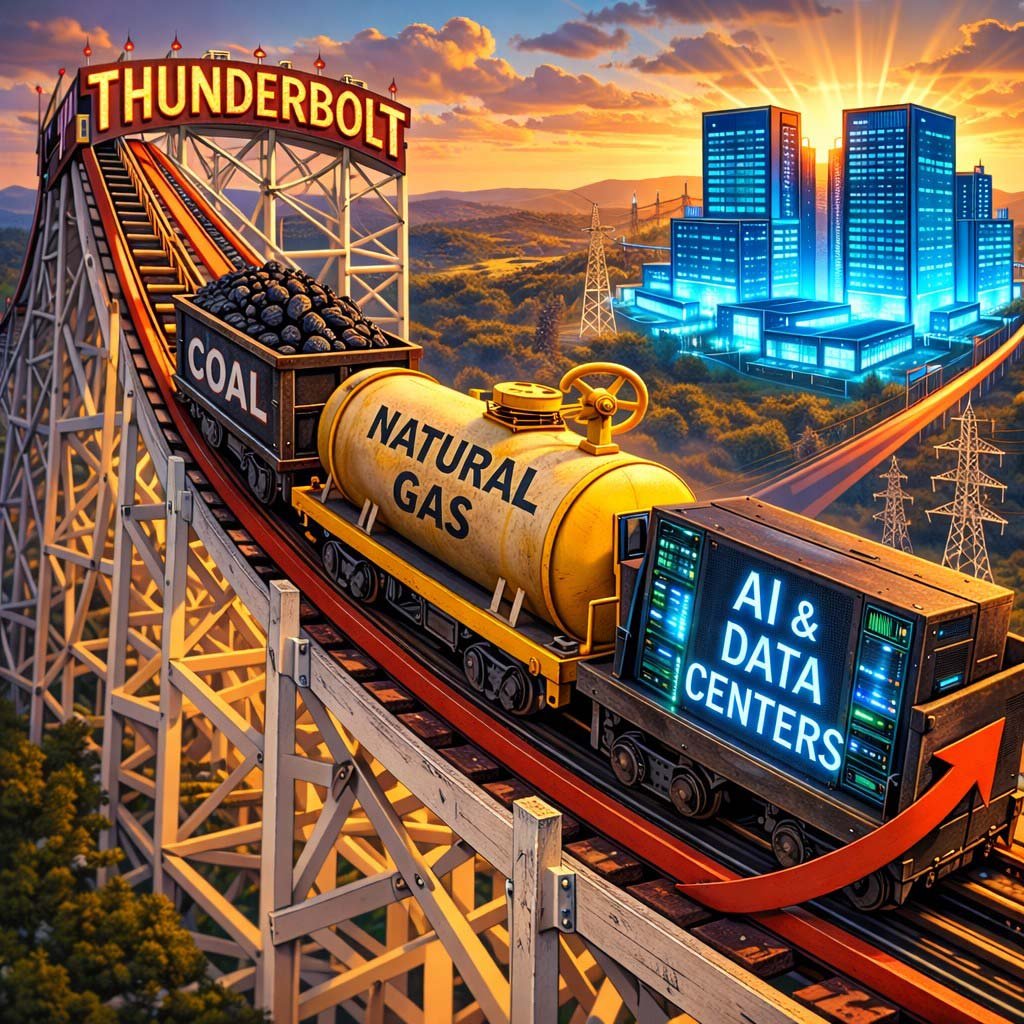
Which, come to think of it, isn’t a bad description of the Western Pennsylvania energy business these days.
Lately, though, several companies in the region are starting to suspect the ride may finally be headed upward. Or at least not straight down.
Take Core Natural Resources, the Canonsburg-based coal producer formed from the merger of Consol Energy and Arch Resources. After what executives politely described as a “turbulent” 2025, the company says the outlook for 2026’s beginning to brighten.
“I think with the demand growth that we’re seeing everywhere in terms of data centers and AI, there’s a lot of potential to benefit from that growth in the East,” Core President Mitesh Thakkar told analysts recently.
Which isn’t something coal executives have been able to say very often over the past decade.
For most of that decade, coal’s been treated in polite policy circles the way people treat rotary phones: interesting from a historical perspective, but not something anyone expects to see in daily use.
Cheap natural gas from the Marcellus shale, combined with environmental regulations and power-plant closures, steadily shrank coal’s share of the electricity market. Utilities that once bought Appalachian coal by the trainload quietly switched fuels or shut down entirely.
But two things are now complicating that narrative.
The first is the explosive growth in electricity demand driven by artificial intelligence and data centers—industrial-scale computing operations that consume staggering amounts of power.
And nowhere is that appetite more visible than here at home.
Several massive data-center campuses are now planned for construction in Beaver County, including projects that could consume as much electricity as small cities. These server farms—vast windowless buildings filled with processors quietly teaching machines how to think—have what might politely be described as an almost bottomless appetite for electricity.
In practical terms, that means utilities are suddenly rediscovering a fondness for fuels capable of producing reliable, round-the-clock power.
Coal, it turns out, still does that rather well.
The second force reshaping the market is politics.
The administration of Donald Trump has made reviving domestic energy production a central economic priority. Among other things, new policies include a 45X tax credit for advanced manufacturing that classifies metallurgical coal as a critical mineral and allows producers to claim a 2.5 percent tax credit.
Core CEO Jimmy Brock told analysts the company views those efforts as “farsighted and prudent,” particularly given the surge in electricity demand.
The company’s already sold large amounts of coal from its Pennsylvania mining complex in Washington and Greene counties, including spot sales triggered by January’s cold snap and the ongoing appetite for electricity from digital infrastructure. Some contracts now extend through 2030.
Not bad for a fuel many analysts declared finished sometime around the invention of the iPhone.
If coal’s staging a modest comeback, natural gas never really left the stage.
In fact, Western Pennsylvania’s gas industry may be more strategically important today than at any point in its history.
Executives gathered recently in Pittsburgh to discuss one reason why: Europe’s growing dependence on American liquefied natural gas, or LNG.
At the center of that conversation was EQT Corporation, the nation’s largest natural-gas producer and one of the biggest players in the Marcellus Shale.
EQT CEO Toby Z. Rice has spent years promoting what he calls an “unleash LNG” strategy—expanding U.S. natural-gas production and exports to strengthen American allies while stabilizing global energy markets.
“Global energy security is American energy security,” Rice said.
Events have a way of reinforcing that argument.
The first major boost to American LNG exports came after Russia’s invasion of Ukraine, which abruptly forced Europe to reduce its dependence on Russian natural gas. In short order, the United States became Europe’s largest LNG supplier.
Now another geopolitical shock—the emerging conflict with Iran—is putting additional pressure on global energy supplies. Natural-gas prices in Europe recently jumped sharply, and disruptions in Middle Eastern energy markets have once again reminded policymakers that reliable fuel supplies aren’t something to take for granted.
Rice sees the situation as another demonstration of America’s energy advantage.
“Starting from the heartland of American soil, to ships that are backed by the strongest Navy in the world, U.S. LNG will flow,” he said.
Western Pennsylvania sits right in the middle of that story.
Producers in the Marcellus now generate roughly 7.7 trillion cubic feet of natural gas annually, much of which flows through pipelines to export terminals on the Gulf Coast or to the Cove Point LNG Terminal facility on the Chesapeake Bay. About 70 percent of U.S. LNG exports now go to Europe.
“Pennsylvania producers are getting into contracts for LNG export because of the opportunity there,” said Jim Welty.
Local companies are positioning themselves accordingly. Among the biggest are Range Resources, Coterra Energy and EQT, with significant volumes already flowing toward export markets.
The challenge now is infrastructure. Pipeline capacity and export terminals remain bottlenecks that limit how much gas Appalachia can send overseas.
“That’s why we need more infrastructure built out,” Welty said. “The bottom line is Pennsylvania producers are ready to meet the needs of our allies in Europe.”
Which brings us back to the roller-coaster ride that is Western Pennsylvania’s energy sector.
Coal, once presumed obsolete, is finding new demand thanks to artificial intelligence and policy changes. Natural gas, long the region’s dominant fuel, is becoming a cornerstone of global energy security.
And geopolitics—from Ukraine to the Middle East—continues to reshape energy markets in ways few analysts predicted even five years ago.
Meanwhile here in Beaver County, another quiet transformation may be underway.
If the planned data centers materialize, the region could soon find itself exporting two things to the rest of the world: electricity and electrons—one flowing through high-voltage transmission lines, the other racing through fiber-optic cables.
Not bad for a county once known mainly for making steel.
Still, veterans of the energy business know better than to celebrate too early.
After all, anyone who’s ridden the Thunderbolt knows what happens next.
Just when the train starts climbing again, there’s usually another hill ahead.
Which is why the smartest executives in Western Pennsylvania are keeping one hand firmly on the safety bar.