
Listen to a podcast discussion about this article.
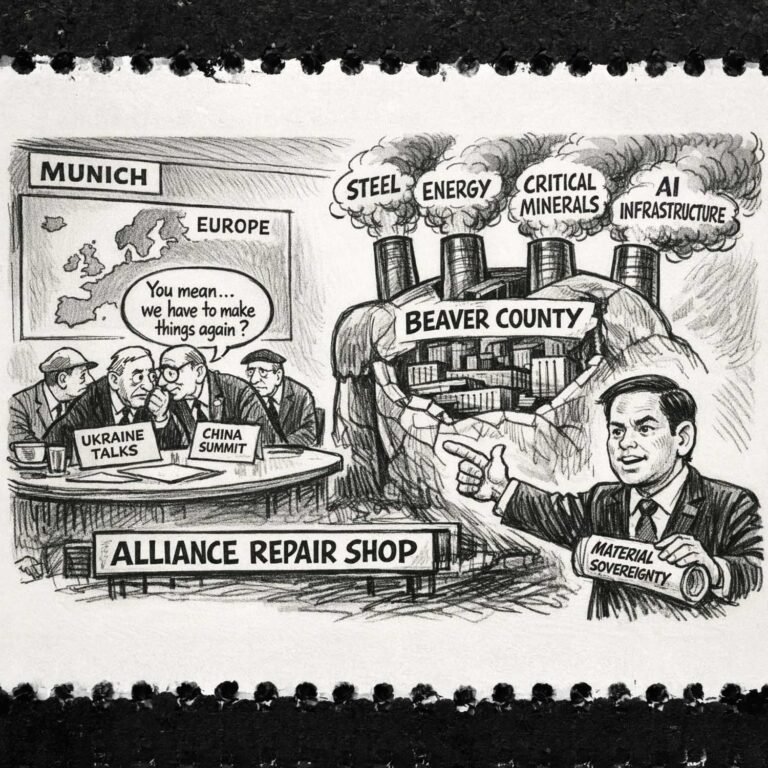
If you’ve lived long enough in Beaver County, you develop a mild allergy to economic fashions. We’ve been an industrial powerhouse, a Rust Belt cautionary tale, a fracking frontier, a hydrogen hub, and now—if the renderings are to be believed—Silicon Valley with better pierogies.
So when Ambassador Jamieson Greer stood up at Davos House USA last month and started talking about the revival of the “American System,” one could be forgiven for reaching for the antihistamine.
But here’s the thing: this one actually has local roots.
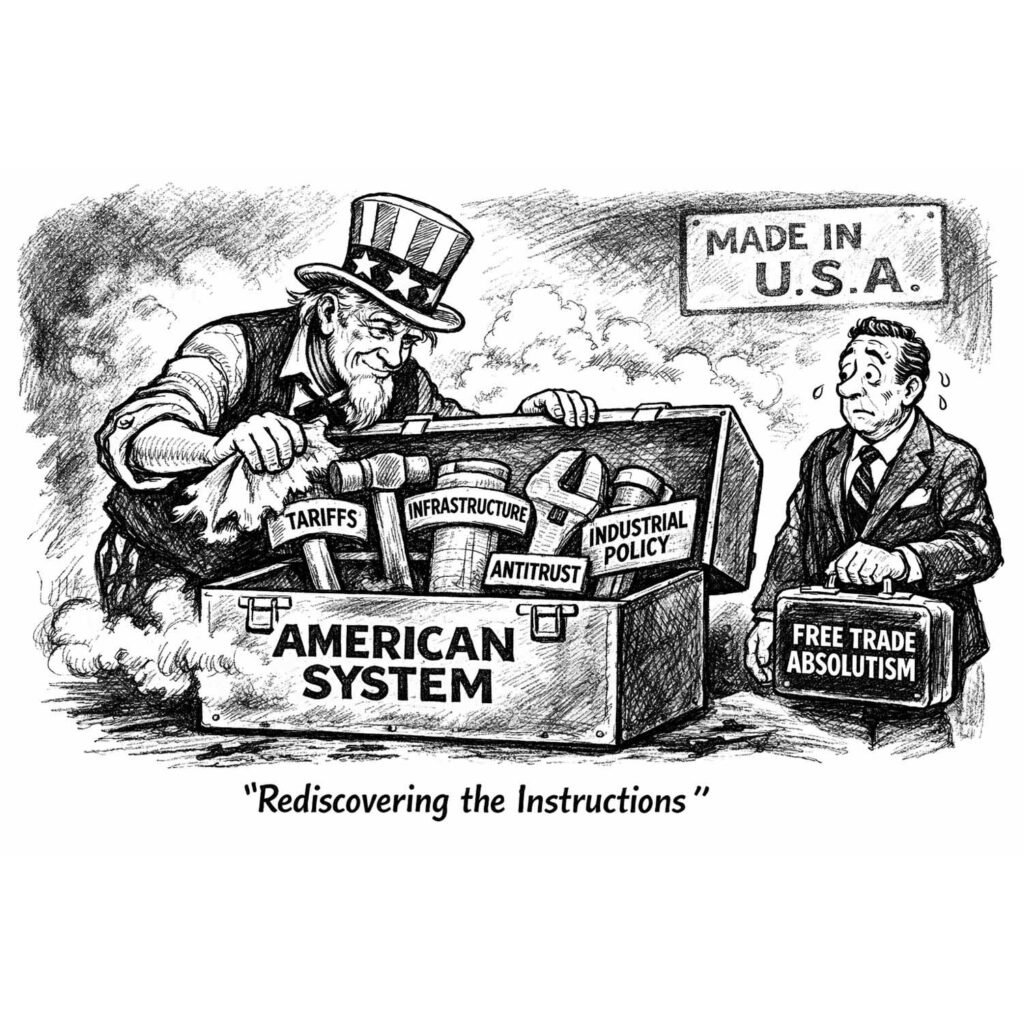
The Original American System
The “American System” is not a new cable bundle. It dates back to:
- Alexander Hamilton, whose 1791 Report on Manufactures proposed tariffs and subsidies so the young republic wouldn’t remain economically dependent on Britain.
- Henry Clay, who formalized the term “American System,” pairing protective tariffs with federally backed infrastructure—canals, roads, and railroads.
- Abraham Lincoln and his adviser Henry Carey, who argued that tariffs created a “harmony of interests”—better domestic industry meant better wages, which meant stronger national consumption.
- Theodore Roosevelt, who kept tariffs but added antitrust enforcement so protected firms didn’t become pampered monopolists.
Greer’s argument is simple enough to fit on the back of a campaign button: America historically used tariffs and industrial policy to build itself into the world’s dominant industrial power.
And then, sometime after the Cold War, we decided that “free trade” was not a tool—but a moral virtue.
Hyper-Globalization and the Rust Belt Hangover
Greer points to places like Paterson, New Jersey—once a Hamiltonian industrial showpiece— as evidence of what he calls America’s “unilateral disarmament.” After NAFTA and China’s entry into the WTO, tariffs fell, global supply chains flourished, and certain American factory towns quietly began hosting more Dollar Generals than machine shops.
Beaver County readers do not require a TED Talk on this phenomenon.
We’ve watched:
- The rise and fall of integrated steel.
- The slow evaporation of manufacturing payrolls.
- The long wait between ribbon cuttings.
Meanwhile, Germany, Japan, and later China continued practicing state-backed industrial strategy—using subsidies, currency management, and domestic industrial coordination. In Greer’s telling, they read Hamilton while we read Milton Friedman.
One can debate the finer points of that interpretation. But it is hard to dispute that the Ohio River Valley did not exactly experience a golden age of wage growth in the 1990s and early 2000s.
The Trump Turn: Interest-Based Trade
Under the current administration, Greer describes a return to “interest-based” trade policy under Donald Trump.
The key elements:
- Rebalancing structural trade deficits, particularly with non-market economies.
- Using tariffs as leverage—not just for economics, but for national security and geopolitical negotiation.
- Focusing explicitly on blue-collar wages, with claims that manufacturing wages and productivity have ticked upward over the past year.
Greer is blunt about Europe’s “non-tariff barriers” and what he calls contradictory energy policies. On China, he frames the strategy as defensive—guarding against overcapacity and unfair trade practices while preserving the possibility of a constructive relationship.
And when critics argue that America runs a services surplus anyway, Greer waves off much of the data as unreliable—“bunk,” in diplomatic phrasing.
Why This Matters in Beaver County
Now we come home.
Beaver County sits at a peculiar intersection of this debate:
- A legacy steel and heavy manufacturing base.
- Proximity to energy assets, including the Beaver Valley Nuclear Station.
- Emerging interest in data centers, hydrogen, and advanced manufacturing.
- A workforce that still understands what a blast furnace sounds like.
If the American System is revived in earnest—tariffs plus infrastructure plus strategic industrial investment—it could favor places like ours: regions with
- Industrial land.
- Energy abundance.
- Transportation access.
- A cultural memory of making things.
Protective tariffs alone do not resurrect a rolling mill. But paired with domestic investment— ports, rail, grid modernization, and vocational training—they can tilt capital back toward production rather than purely financial arbitrage.
That’s the theory, anyway.
The caution, of course, comes from Theodore Roosevelt’s footnote: protection without competition breeds complacency. Beaver County has seen both neglect and overprotection in its time.
The Real Question
The deeper issue is not whether tariffs are good or bad in the abstract. It is whether America believes in making things again—and is willing to align trade, energy, tax, and infrastructure policy toward that goal.
Hamilton thought economic independence was inseparable from political independence. Henry Clay thought canals and railroads were patriotic. Lincoln thought tariffs built national cohesion. Teddy Roosevelt thought industrial strength required discipline as well as protection.
And Ambassador Greer suggests we may be rediscovering that toolbox.
For Beaver County, this is not an academic debate held in alpine conference rooms.
It’s the difference between:
- Warehouses and workshops.
- Service jobs and skilled trades.
- Economic nostalgia and economic renewal.
The “American System,” if it truly returns, will not look like 1890 or 1955. It will involve AI, nuclear power, semiconductors, and supply-chain resilience.
But the underlying wager is familiar.
That a nation—and a county—prospers when it makes more than it merely consumes.
In Beaver County, we’ve tried both.
We know which one feels better.

1 thought on “What’s the “American System” — and Why Does It Matter to Beaver County’s Economy?”
Thank you for providing a clear and concise explanation of the history of tariffs, the evolution of US policies regarding tariffs, and their significance to our region. It will be intriguing to observe the legal proceedings surrounding tariffs and refunds, as well as the potential impact of the American System’s revival on Beaver County. I genuinely appreciate your thought-provoking viewpoints. Keep up the excellent writing!