By Rodger Morrow, Editor & Publisher, Beaver County Business
Listen to a podcast discussion about this article.
There was a time when the evening news was delivered by solemn men in sensible suits who told you what happened that day and then got out of the way so you could worry about your furnace. Those days are gone. Now the news arrives padded with commercials gently suggesting that if you feel sad at a funeral, distracted at work, or tired after dinner, you may be suffering from something with a trademarked name.
That’s the backdrop for a bracing explainer by Dr. Josef, reacting to a segment by Matt Walsh, on how pharmaceutical advertising has quietly colonized American life. The short version is that Big Pharma didn’t just buy airtime—it bought leverage.
Consider the money. The pharmaceutical industry spends roughly $5 billion a year on advertising. About 31 percent of ad minutes on major nightly news broadcasts come from drug companies. At that point, journalism isn’t so much holding power to account as sharing a mortgage with it. Investigating the hand that feeds you is tricky when it’s also paying for the studio lights.
That dynamic isn’t limited to New York or Washington. Even here in Beaver County, where people still trust their doctors and their local news, the national media diet flows straight into living rooms in Beaver, Aliquippa, and Hopewell Township. When the network news goes soft on pharma, that softness trickles downstream—into conversations at the coffee shop, the waiting room, and eventually the exam room.
Medical journals aren’t immune either. Dr. Josef notes that academic research and publishing rely heavily on pharmaceutical funding—clinical trials, journal reprints, institutional grants. Negative findings tend to sink quietly, while positive ones get promoted like a new bridge project. Science works best when it can afford to disappoint its sponsors.
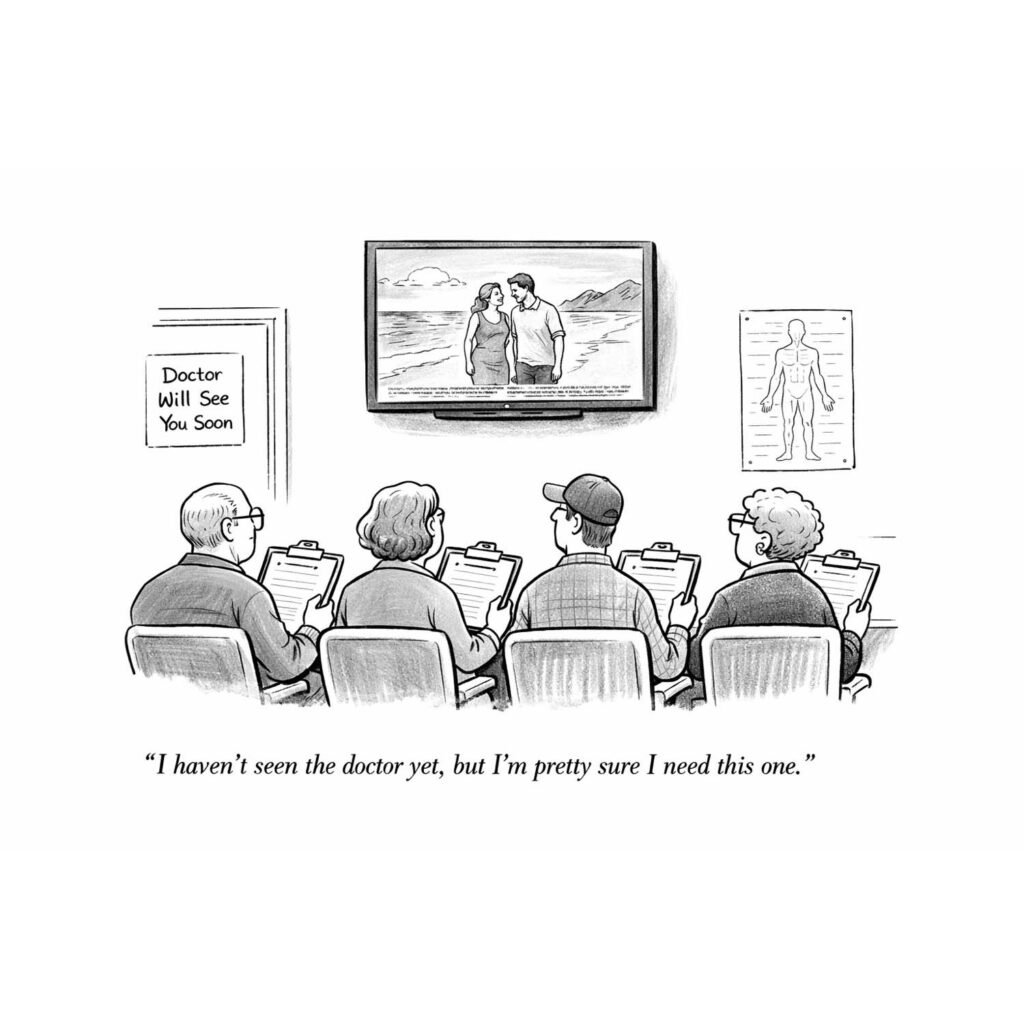
Then there’s direct-to-consumer drug advertising, a practice allowed in only two countries on Earth: the United States and New Zealand. Everyone else took one look at the idea of diagnosing citizens via television commercials and passed. We embraced it.
The result is a peculiar ritual. A patient doesn’t arrive describing symptoms so much as requesting a product. Studies show that patients who ask for a drug by name—Paxil, Prozac, pick your syllables—are far more likely to get it than those who simply explain how they feel. In a seven-minute appointment, writing the prescription is often easier than explaining why grief, stress, or distraction might be normal responses to modern life.
Dr. Josef calls this “transactional medicine,” and it’s hard to argue. Doctors are rushed, patients are primed by advertising, and everyone is nudged toward the fastest possible conclusion. Even in a county with good clinicians and strong hospital systems, the pressure is real.
This feeds what Josef calls “disease mongering”—the steady rebranding of ordinary human experiences as medical disorders. Roughly 20 percent of women in the U.S. are now on antidepressants. Either we’ve discovered a vast hidden epidemic, or we’ve decided that the emotional cost of living in a hyper-competitive economy should be medicated.
ADHD has undergone a similar makeover, marketed less as a complex condition and more as a productivity issue. The message is subtle but clear: if you’re not operating at peak efficiency, help is available—just ask your doctor.
There is, finally, a political wrinkle. Dr. Josef notes that leadership at Health and Human Services under someone like Robert F. Kennedy Jr. could move to ban direct-to-consumer pharmaceutical advertising altogether. That would rattle the media business. Remove a major revenue stream and suddenly investigative journalism might reappear—if only out of economic necessity.
Yes, it would cost jobs and money. But as Josef argues, the health of the American people might matter more than quarterly earnings. That’s a surprisingly radical idea.
None of this means pharmaceuticals are villains or doctors are dupes. Modern medicine performs genuine miracles. The problem isn’t the drugs; it’s the selling. When medicine is marketed like laundry detergent, we shouldn’t be shocked when it’s consumed the same way—habitually, enthusiastically, and without much reflection.
So the next time a commercial asks whether you’ve “talked to your doctor,” Beaver County residents might ask a more local question first: who paid to start this conversation—and who benefits if it ends with a prescription?