By Rodger Morrow, Editor & Publisher, Beaver County Business
Listen to a podcast discussion about this article.
A Vanishing Dateline
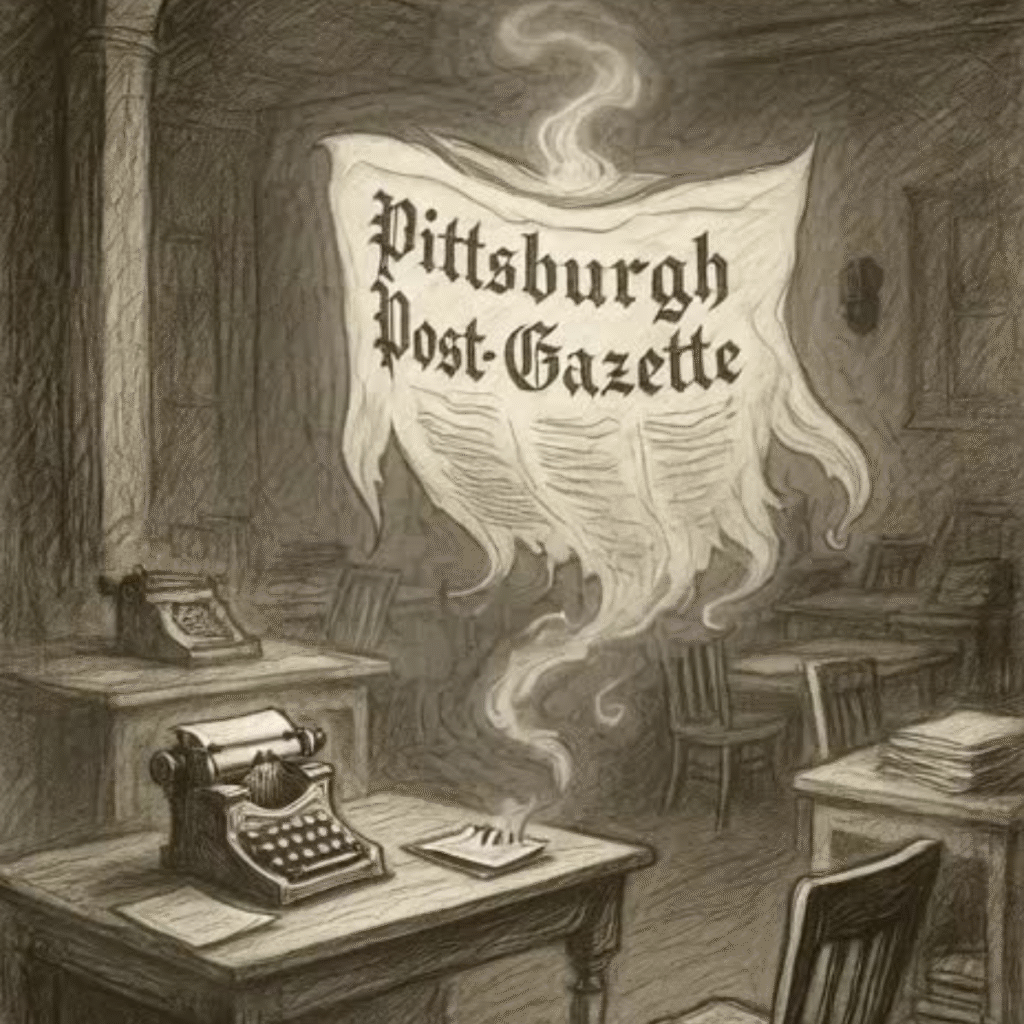
If the Pittsburgh Post-Gazette finally folds, it won’t go quietly—but it may go the way so many proud institutions do: undone not by drama, but by accounting.
On Monday, November 10, 2025, a three-judge panel of the U.S. Third Circuit Court of Appeals ruled the paper bargained in bad faith during its protracted labor dispute and ordered restoration of strikers’ health benefits and good-faith negotiations. The paper’s owners warn that complying could prove ruinous. Translation: after nearly 240 years, the morning agenda-setter of greater Pittsburgh could go dark.
The PG has been the region’s tentpole daily since 1786—the first newspaper published west of the Alleghenies. However you judge its editorial zigzags in recent years, it remained the largest newspaper serving metropolitan Pittsburgh. (Let’s avoid fish stories about “a million readers a week”; the truth is impressive enough without embroidery.)
The newsroom has already been stressed to the snapping point. Striking journalists first walked in October 2022; this spring, production of the print edition was outsourced to the Butler Eagle, eliminating 31 union jobs. The “daily miracle,” as old-timers called it, has been running on fumes and muscle memory.
If the presses go silent for good, it won’t be just a Pittsburgh story. It will ripple through every borough the paper ever covered—Beaver County very much included.
When Nobody’s Watching
The first casualty of a newspaper’s death is accountability. Remove the beat reporter who spends Tuesday nights at zoning hearings, and by Thursday a “consultant” is quietly rewriting the map. The research record is consistent—when local newspapers close, voter turnout, civic engagement, and competition in elections tend to decline—though the exact magnitudes vary by place and period. What’s solid is the direction of travel, not a single one- size number.
We’ve already had a preview. During the strike, the region saw fewer deep-dive investigations and more stenographic press releases. Independent and nonprofit outlets tried to backfill, but there are only so many bodies to throw at a thousand daily chores.
A Digital Rush—More Stampede Than Plan
If the PG falls, the shift from ink to pixels accelerates. The strikers themselves stood up Pittsburgh Union Progress, proof that a determined crew can still put out a paper—minus the paper. Podcasts like City Cast Pittsburgh have found their audience. Yet even the most earnest digital startups face arithmetic: clicks don’t carry beats.
The TV heavies—KDKA, WTAE, WPXI—will fill in as best they can. Big stories will get live- trucked; weather will be breathlessly gestured at. But television is built for spectacle, not school-board budgets. Radio and public media (WESA, et al.) deliver depth, but pledge drives are a fragile business model. Meanwhile, TribLIVE/The Tribune-Review will likely press its advantage in print and digital, with the New Pittsburgh Courier, City Paper, and NEXTpittsburgh each carrying their essential but niche torches. The ecosystem is plucky and collaborative—but persistently under-capitalized for the everyday grind a metro daily once handled by habit.
Economics, the Other Eulogy
A newspaper is both civic trust and small business. Classifieds once underwrote the costly virtues—investigations, far-flung stringers, time to think. Those dollars fled to the internet years ago. In March, the PG’s production and ad workers accepted buyouts after the outsourcing decision; newsroom journalists remained on strike. Cost-cutting can keep the lights on, but it does not print bylines.
Expect a talent drain if closure comes. Some reporters will migrate to the Trib, others to national outlets or out of the industry entirely. This isn’t just a cultural loss; it’s an economic one. Paychecks that used to be cashed in Ambridge or Chippewa don’t circulate at all when a beat gets eliminated.
The Tilt and the Echo
For most of its life, the PG leaned modestly labor-liberal—appropriate for a union town. In recent years its editorial page wandered rightward, prompting agita and unsubscribes. Yet even that awkward centrism served a purpose: we argued over the same facts. Without the PG’s broad platform, the region risks splitting its news diet into silos—TribLIVE on one side, national podcasts on the other—until the middle ground is little more than a traffic island.
(For orientation: the Steelers, an institution the PG covered with liturgical devotion, have won six Super Bowls—four in six years, then two in the new millennium—a reminder that this town’s shared history runs through its paper as surely as through its team.)
What Rises from the Ashes
To be fair, innovation has been the silver lining of this strike. Spotlight PA, launched in 2019 with the PG as a founding partner, has grown into a statewide investigative shop syndicating work across Pennsylvania and evolving into an independent nonprofit. The Pittsburgh Media Partnership coordinates more than two dozen newsrooms on big projects. Philanthropy—from the Heinz and Pittsburgh foundations and others—has shown appetite for underwriting public-service reporting. These are green shoots worth watering.
The test is sustainability. Grants and memberships can fund marquee investigations; they struggle to pay for the humbler beats that knit a region together. If money doesn’t scale, the “news desert” already creeping across rural western Pennsylvania will spread north and west—into townships where misinformation rushes in the moment no one’s at the meeting with a notebook.
When the Paperboy Stops Coming to Bridgewater
Here in Beaver County, a PG shutdown would change how we learn who we are. For decades, the paper chronicled our mill closures, our half-successful rebirths, and our ongoing experiments in tomorrow—from the Shell cracker’s knock-on effects to housing on the riverfront to the stubborn dream of new industry. When the big city paper noticed us, it conferred a kind of regional citizenship: “you’re in the story, too.”
Without it, the burden shifts—downstream and homeward. Smaller outlets (including yours truly) will need to widen our field of view and deepen our reporting bench. We can’t be everywhere; but we can be where it counts, consistently. That’s the assignment now: less romance about the “daily miracle,” more carpentry—building a durable, county-first reporting model that doesn’t depend on a metro daily for oxygen.
A Final Edition
Could the appeals-court mandate yet lead to a labor peace that keeps the PG alive? Stranger things have happened along the Mon. But newspapers rarely die from a single blow. They fade by inches until one morning there’s nothing on the porch but yesterday’s rain. If that morning comes for the Post-Gazette, Pittsburgh loses a habit, and Beaver County loses a witness.
The conversation won’t end, but it will grow thinner. The watchdog won’t be muzzled, but it will nap more than it should. And the public record—our collective memory—will have gaps where the first draft of history should have been.
If you value the part that isn’t missing yet, now’s the time to say so—with your attention, your tips, and yes, occasionally your wallet. When the paper stops coming, the truth doesn’t; someone has to go get it.