By Rodger Morrow, Editor & Publisher, Beaver County Business
Listen to a podcast discussion about this article.
Somewhere Between Prophecy and Particle Physics
Somewhere between the Book of Revelation and a Swiss laboratory, a young genius named Max Laughlin may have misplaced our universe. It’s an easy mistake to make these days. We’ve already lost car keys, passwords, and entire rivers—why not toss a dimension or two into the bargain?
According to a recent viral video, Max—dubbed “the world’s smartest kid”—invented a free-energy device at 13 and now believes CERN’s experiments at the Large Hadron Collider may have nudged us into a parallel universe. It’s an alarming thought, though it does explain why some folks recall Nelson Mandela dying in prison while others swear they watched his funeral in 2013. That collective confusion, called the Mandela Effect, is either a cosmic glitch or proof we should spend less time online.
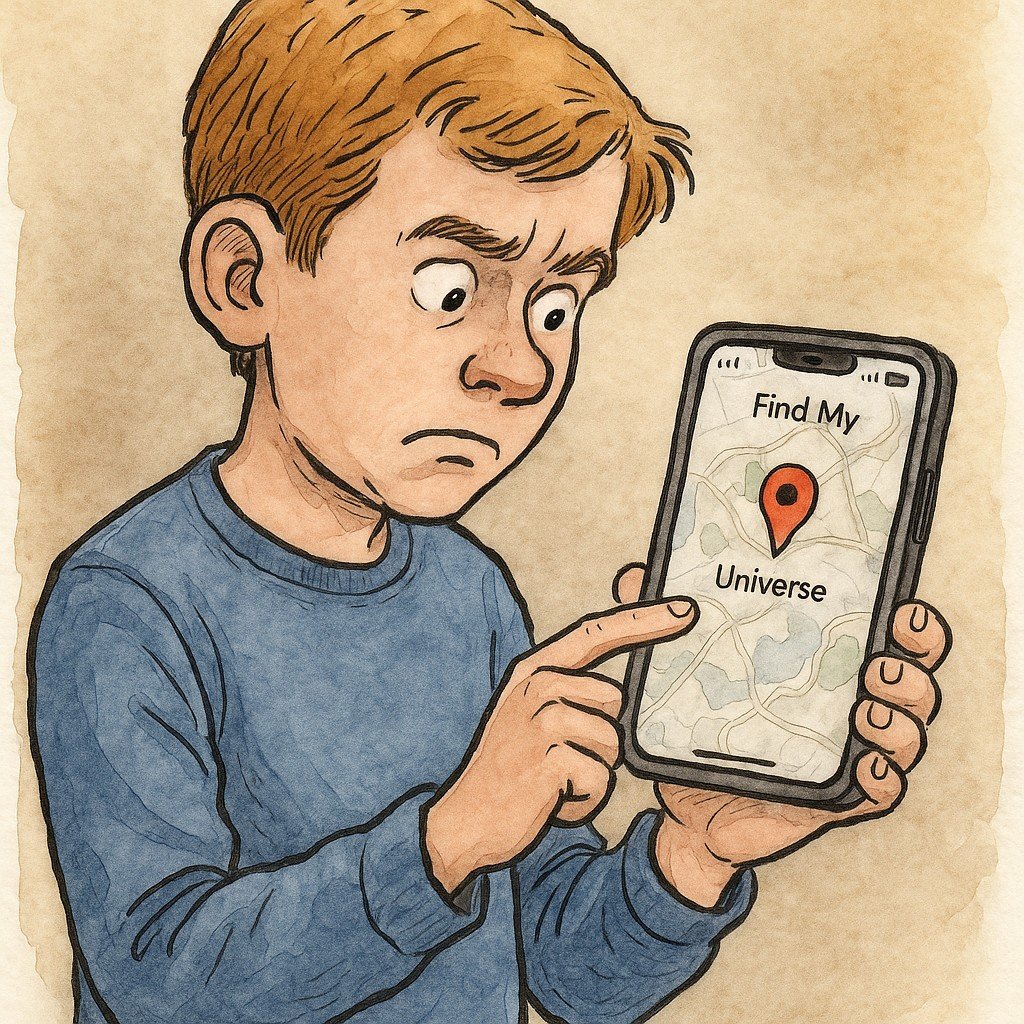
The Boy and the Black Hole
In another era, Max might have been sent outside to play. Today, he’s the oracle of the algorithm. He insists CERN’s particle collider—built to re-create the Big Bang—has been flinging us through parallel realities ever since it powered up. Scientists dismiss this, of course, but they’ve said the same about coffee and heart disease for years.
The Collider has produced genuine marvels: the Higgs boson, mysterious X-particles from the universe’s infancy, and, in 2022, a 14-hour crack in Earth’s magnetic field that let solar winds pour through. CERN insists there’s no connection—but it’s hard not to picture the planet wobbling slightly as someone in Geneva flips a switch marked Do Not Touch.
The Drying of the Euphrates
Meanwhile, down here in the stubbornly un-parallel world, the Euphrates River—cradle of civilization and footnote to every major prophecy—is drying up. The once-mighty river now limps through Turkey, Syria, and Iraq at half its former flow, starved by dams, drought, and the eternal optimism of irrigation. Iraq’s water ministry warns it could vanish entirely by 2040.
As it recedes, the Euphrates reveals what time buried: Byzantine tombs, the ruins of a 3,400-year-old city, and perhaps a few lessons about hubris. The Bible’s Book of Revelation predicted the river would dry before the Second Coming; the Prophet Muhammad foretold it would expose a mountain of gold. Both forecasts are now being taken quite seriously by people who own metal detectors.
Science, Scripture, and YouTube
The viral video stitches all this together—Max’s multiverse, CERN’s collider, and the fading Euphrates—into one grand tapestry of impending revelation. The result is equal parts physics lecture, Sunday sermon, and late-night cable rerun. It warns that we’ve meddled with the machinery of creation itself, upsetting both nature and the divine, which sounds suspiciously like every age-old lament since the invention of the wheel.
Still, there’s something irresistible about the idea that a Swiss machine and a Middle-Eastern river might share the same fate line in the cosmic ledger. Both are human obsessions: one built to uncover the origins of the universe, the other slowly returning them to dust.
Not the End of the World
Maybe Max Laughlin is right and we did slip into another universe—that would explain the price of groceries and the Pirates’ batting averages. Or maybe we’re still right where we’ve always been: staring at the same old mess, blaming the wrong dimension.
Either way, the river keeps shrinking, CERN keeps spinning, and YouTube keeps monetizing the apocalypse. The end of the world, it seems, won’t arrive with trumpets but with a thumbnail, a subscribe button, and a teenage genius who can’t decide whether to save the planet or reboot it.
Rodger Morrow is Editor & Publisher of Beaver County Business, still operating in this universe—pending further confirmation from CERN.