By Rodger Morrow, Editor & Publisher
Beaver County Business
Listen to a podcast discussion about this article.
I had an encounter in the elevator last night.
A fellow tenant in my building, friendly enough, looked at me and asked the question that seems to be our national password: “You see the Steelers game?”
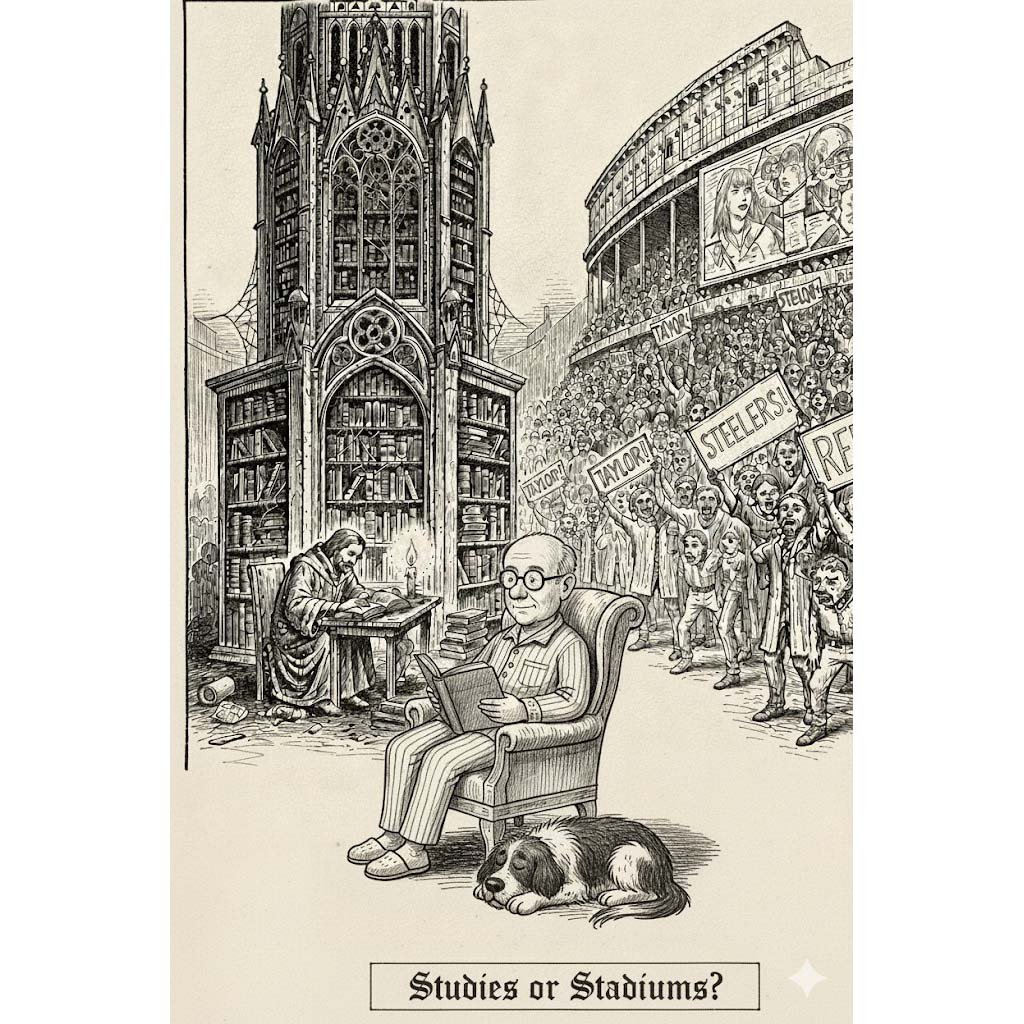
Now, the Steelers had just finished up their latest international junket—an early-morning contest beamed to us from Ireland. I mumbled something evasive, though in truth I hadn’t watched. I was halfway through rereading Neil Postman’s Amusing Ourselves to Death, which made for better company than yet another fourth-quarter collapse.
Postman’s Warning
Postman, you’ll recall, argued forty years ago that television had transformed public discourse into entertainment. He compared the thoughtful, text-driven world of Lincoln and the Federalist Papers to our own era of soundbites, jingles, and show business politics. He thought we were drowning not in lies, but in amusement.
Small Talk as National Language
Which brings us back to my elevator friend, who was only making small talk, but small talk has grown into the national language. Sports, celebrity gossip, and the latest Taylor Swift sighting are the conversational coin of the realm. You can spend your days without ever touching upon history, philosophy, science, or faith—unless they’ve been adapted for Netflix or turned into a podcast with funny sound effects.
The Digital Marketplace
The digital revolution has only deepened the trend. Social media is an attention marketplace where novelty is king, where the currency is dopamine, and the economy is self-pleasure. Some of it plays out in private—think OnlyFans—but most of it parades in public as a culture that can’t stop refreshing the feed, can’t stop asking if you’ve seen the latest highlight reel, can’t think beyond the next meme.
Books as Resistance
Books, by contrast, ask for your time, your patience, your sustained attention. They remind us that the mind is more than a dopamine dispenser. They are what stand between us and what Aldous Huxley foresaw in Brave New World:
“People will come to love their oppression, to adore the technologies that undo their capacities to think.”
By the Numbers
A snapshot of our shrinking attention span
- 17 minutes — Average daily time Americans spend reading books.
- 2 hours, 25 minutes — Average daily time spent on social media.
- 3 hours, 4 minutes — Average daily time spent watching television.
- 8 seconds — Estimated human attention span in the smartphone era (down from 12 seconds in 2000).
- 1 in 4 — U.S. adults who admit they haven’t read a single book in the past year.