By Rodger Morrow, Editor and Publisher
Beaver County Business
Listen to a podcast discussion about this article.
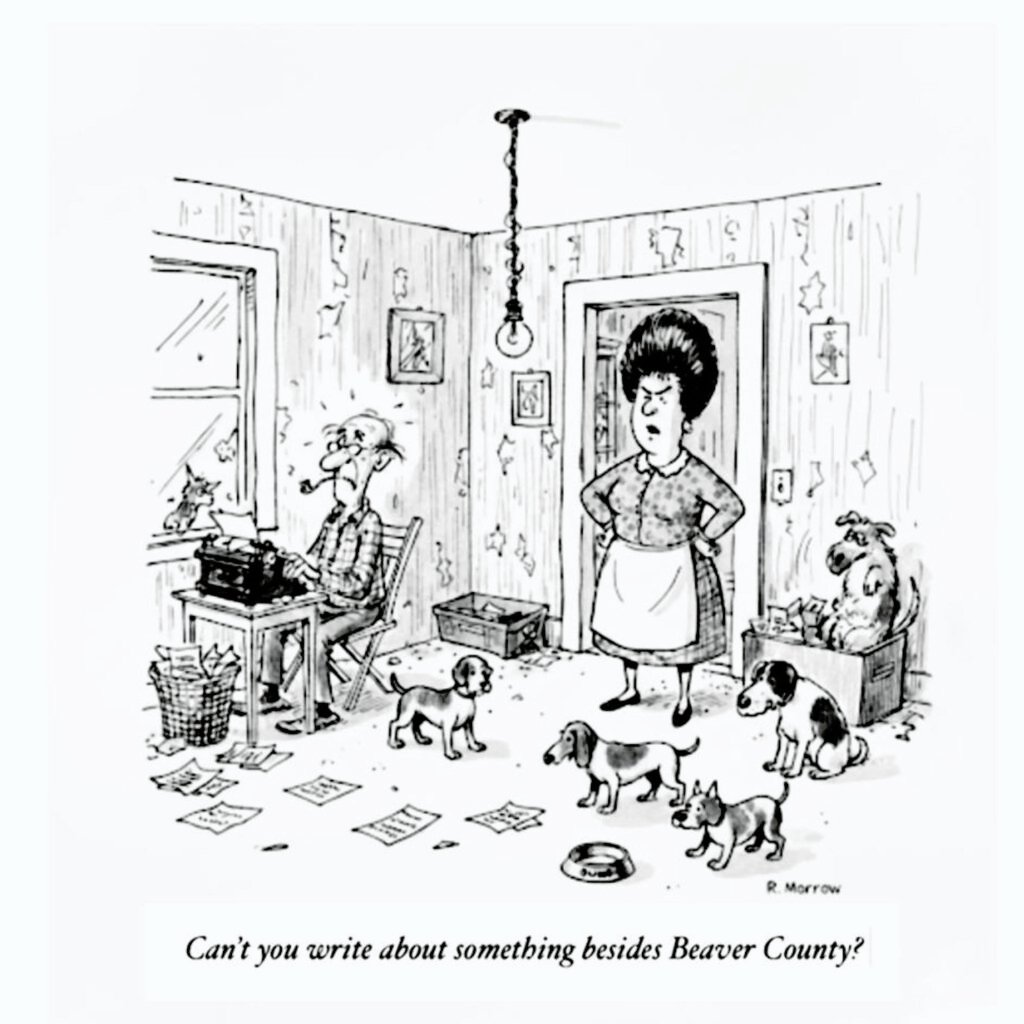
I sometimes wonder if Faulkner would have gotten anywhere if he’d been saddled with Beaver County instead of Yoknapatawpha. He might have looked around, taken in the muddy Ohio, the faded steel mills, the Dairy Queen at the corner of Third and Third, and thought, “Nope. Not enough grandeur. I’ll just move to Hollywood and write screenplays about horses.”
But then again, Faulkner was on to something.
He shrank his geography to enlarge his imagination. Lafayette County became Yoknapatawpha County, and suddenly the petty squabbles of small-town Mississippians stood for the human condition. Hardy pulled the same trick with Dorset, rebadging it Wessex and using it to wring high tragedy out of sheep shearing. Sherwood Anderson made Clyde, Ohio, look like the beating heart of the universe—though in Winesburg, the most dramatic event is often somebody quietly losing hope in a boarding house parlor.
It’s a neat conjuring act: confine yourself to one county, really squeeze it, and—presto!—
universal truth oozes out like sap. Which brings me back to Beaver County.
Now, I don’t claim our 444 square miles are ready for Norton anthologies, but I do know
this: every time I think I’ve seen it all, Beaver County coughs up another story. You can walk down Merchant Street in Ambridge and pass the ghosts of the Harmonists, the steelworkers, and the newest batch of coffee-shop entrepreneurs—all within a block and a half. You can stand on the hill in Midland and survey both the ruins of an aluminum empire and the humming servers of a Bitcoin mine. You can drive ten minutes and go from the world’s most photogenic covered bridge to the world’s most frustrating pothole.
It’s not Yoknapatawpha, but it’ll do.
What Faulkner, Hardy, and Anderson figured out is that place is character. The dusty roads, the moors, the small-town main streets—those are not backdrops. They’re co-conspirators. And Beaver County is nothing if not a co-conspirator in the lives of its people. It builds us up (Shell cracker plant, anyone?), knocks us down (ask anyone who lived through the 1980s layoffs), and always leaves us wondering what the next chapter will be.
Yes, we sometimes mistake ourselves for smaller than we are. People here will shrug and say, “There’s nothing much in Beaver County.” But try telling that to the men who once built pipelines to Alaska from drafting tables in Rochester, or the women who now run tech startups out of old storefronts in Beaver Falls. Or to Seamus, my long-suffering dog, who knows every inch of the towpath but still insists it hides new smells.
What fascinates me endlessly is not that Beaver County is unusual. It’s that it’s ordinary in the most extraordinary way. Like Faulkner’s Mississippi or Hardy’s Wessex or Anderson’s
Winesburg, it is one small place stubbornly insisting on being itself. And if you pay attention long enough, you start to realize that this insistence is the very stuff of literature: small towns, big themes, played out daily at the VFW fish fry and the Sheetz gas pump.
I could spend a lifetime writing about Beaver County, and still not get to the bottom of it. But maybe that’s the point. Writers don’t choose their counties—counties choose their writers. And Beaver County, for better or worse, seems to have chosen me.