Listen to a podcast discussion about this article.
For most of the last century, scrap was simply what happened after the real industry was done with something. A rail spur was abandoned, a mill closed, and an old truck rusted quietly into retirement behind somebody’s garage in Aliquippa. Eventually a fellow with a cutting torch showed up and hauled it away.
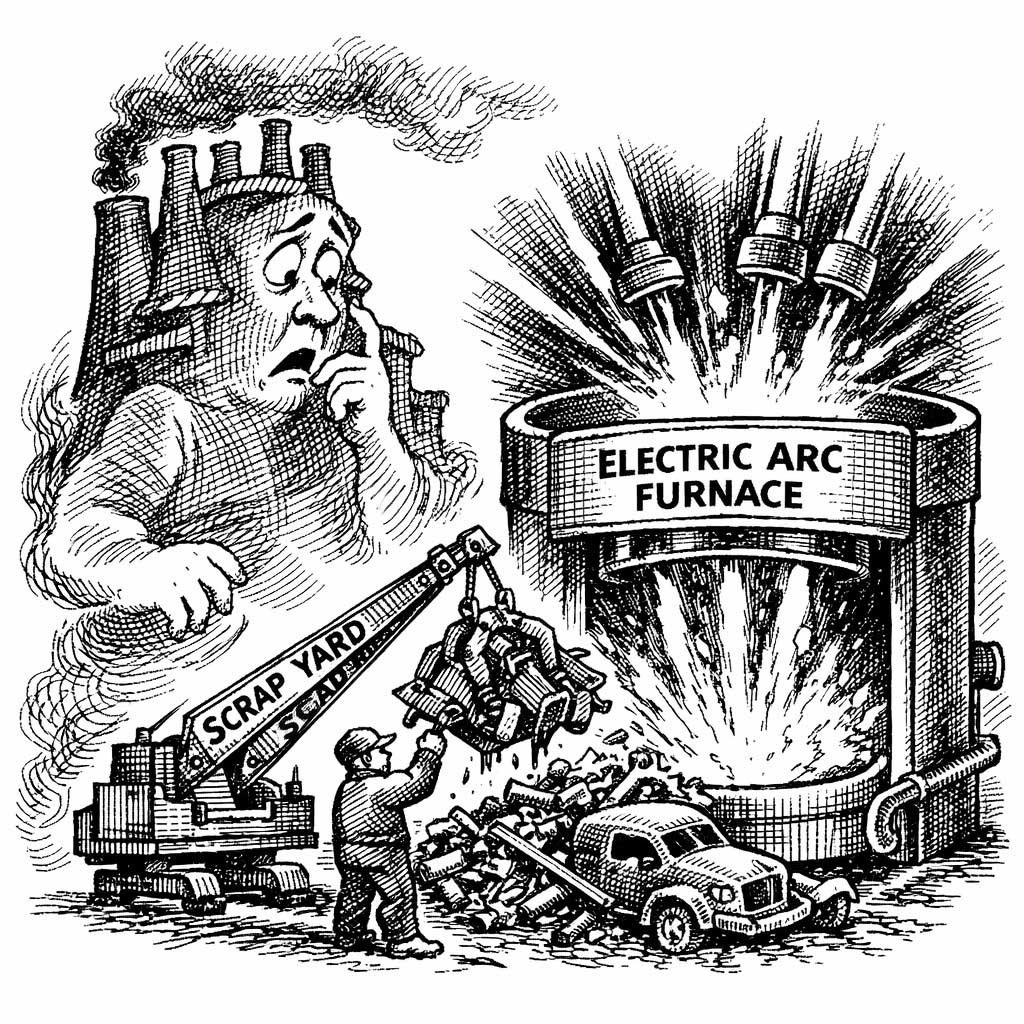
In other words, scrap was the epilogue to the industrial story.
Now, somewhat to the surprise of anyone who remembers when blast furnaces lit the night sky from Midland to Ambridge, scrap has become the prologue.
That small but meaningful shift helps explain why Tenaris has just spent $13.3 million acquiring a 39-acre scrap processing yard in Beaver Falls, adjacent to its growing steel operation in nearby Koppel. The purchase—completed by Tenaris subsidiary Steel Recycling Services—gives the global steelmaker something modern steel production increasingly depends on: a reliable stream of high-quality scrap metal.
Which, if you stop to think about it, is an oddly fitting twist in the long industrial saga of Beaver County.
For more than a century this region turned raw iron ore into finished steel. Today the process increasingly runs in reverse: old steel becomes the raw material for new steel.
From Ore to Old Chevrolets
To understand why Tenaris wants a scrapyard as much as a steel mill, it helps to understand how steelmaking itself has changed.
The traditional American steel plant—the kind that once defined places like Aliquippa and Midland—was built around the blast furnace. Iron ore went in, coke and limestone joined it, and molten steel came out the other end after a heroic display of heat and chemistry.
Modern plants increasingly rely on something different: the electric arc furnace, or EAF.
Instead of cooking iron ore, an EAF melts recycled steel using enormous electric arcs that generate temperatures approaching those on the surface of the sun. The technology, invented in the 19th century, has become the backbone of modern “mini-mill” steel production.
But there’s a catch.
Electric arc furnaces don’t run on iron ore.
They run on scrap steel.
Which means the most important ingredient in modern steelmaking may be yesterday’s pickup truck, a retired pipeline, or the skeleton of a demolished office building.
Why Tenaris Wants the Scrap Next Door
Tenaris’s Koppel facility—acquired in 2020 and now undergoing more than $150 million in upgrades—is built around an electric arc furnace. The plant melts scrap into billets that eventually become seamless steel pipe, the kind used in oil and gas wells across the Marcellus Shale.
From there the production chain runs like a carefully choreographed industrial relay race across the Ohio River valley.
The steel pipe is produced in Koppel. It’s finished at Tenaris’s plant in Ambridge. Then it travels to Brookfield, Ohio, where it’s threaded before heading off to energy customers around the country.
The newly acquired Beaver Falls scrapyard fits neatly into that chain.
By controlling its scrap supply right next door to the furnace, Tenaris gains several advantages at once.
First, logistics get easier. Scrap no longer needs to be hauled long distances before it reaches the furnace.
Second, quality improves. Scrap varies widely in composition, and modern steelmaking requires precise control over alloy content and contaminants. Owning the scrapyard gives Tenaris more control over what goes into its furnaces.
Third, costs stabilize. Scrap markets can swing wildly, and steelmakers who depend entirely on outside suppliers often find themselves bidding against competitors for the same pile of rusted metal.
Owning the yard helps insulate Tenaris from those swings.
As Tenaris President Guillermo Moreno put it in announcing the acquisition, securing access to high-quality scrap allows the company to “boost efficiency, optimize steel quality from start to finish, and deliver high-performance steel solutions for our energy customers.”
That’s the corporate version. The Beaver County version is simpler.
If you run an electric arc furnace, you’d better have a steady diet of scrap steel.
Koppel’s Earlier Life in Recycling
In a way, scrap recycling at Koppel isn’t entirely new.
Long before Tenaris arrived, the facility had a second life that many people outside Beaver County never heard much about. In its previous incarnation the plant processed nickel-cadmium batteries shipped in from all over the United States, extracting valuable metals and recycling them for industrial reuse.
It was an early glimpse of the circular economy before anyone thought to call it that.
So the idea that the site now melts scrap steel into new pipe for America’s energy infrastructure is less a revolution than a continuation. Koppel has been quietly turning yesterday’s materials into tomorrow’s products for decades.
The Circular Economy Comes to Beaver County
There’s also something quietly poetic about this arrangement.
For generations Beaver County helped produce the steel that built America’s bridges, pipelines, skyscrapers, and railroads. Eventually those structures age, collapse, or get replaced.
Now their steel comes back.
An old drilling rig might become part of a new pipeline.
A demolished warehouse might return as a piece of oilfield tubing.
It’s a circular industrial economy, and Beaver County sits comfortably inside it.
The environmental benefits are real as well. Producing steel from scrap requires far less energy than making it from iron ore and generates significantly fewer carbon emissions.
That’s one reason Tenaris has also invested heavily in environmental upgrades at the Koppel plant, including an $85 million air filtration system that began operating last year.
If the 20th-century steel mill was a roaring dragon of smoke and fire, the 21st-century version is something closer to a high-voltage laboratory.
Still noisy, of course—but considerably cleaner.
Steel’s Quiet Comeback
It’s tempting to think of the steel industry in western Pennsylvania as something that vanished sometime around the Reagan administration.
Yet steel never entirely left.
It simply changed shape.
Instead of giant integrated mills employing tens of thousands, the modern industry consists of highly specialized plants—mini-mills, finishing facilities, pipe operations, and recycling yards—connected by sophisticated supply chains.
Tenaris has been steadily expanding its Beaver County operations with investments in finishing lines, heat treatment, environmental controls, and now scrap supply.
The scrapyard acquisition may not sound glamorous. Nobody erects statues to scrapyards.
But in the world of electric arc furnaces, scrap is the lifeblood.
And in Beaver County, turning old metal into something new has always been part of the job description.