Listen to a podcast discussion about this article.
Back when Beaver County still had enough smokestacks to support a serious industrial civilization, my father, Frank Morrow, set out to change the world. Maybe not the entire world, but certainly his corner of it. He started car dealerships, helped launch banks, pushed for the Beaver County Airport, lobbied for steel and autos in Harrisburg and Washington, and generally behaved like a man convinced sleep was something other people indulged in. To the public he looked like ambition with a necktie and a Ford franchise.
At home, though, there were days when he could barely get out of bed.
Back then folks didn’t talk much about mental illness unless somebody started chasing squirrels with a rake. A man was called “difficult,” which covered a multitude of afflictions the way “light traffic” covers the Parkway East. My father could explode over nothing. He chased excitement, deals, and grand plans with the desperate optimism of a gambler convinced the next roll of the dice would finally fix everything. Then the depression would roll in like river fog and settle over the whole house.
Sometimes he stayed in bed for days. Sometimes he lashed out at whoever was nearest. Sometimes he simply vanished inside himself while the rest of us tiptoed around the silence, wondering which version of him would come downstairs.
I spent years pretending none of this had anything to do with me. I was the writer in the family. Words were my trade. I thought if you could explain human misery elegantly enough, you might avoid participating in it.
That theory collapsed right around the time the words stopped showing up.
The blank page became an enemy. Relationships unraveled. My marriage went south with the determination of a snowbird fleeing Beaver County in February. I became moody, restless, irritable. Sleep turned into a rumor. At three in the morning I’d pace the house conducting imaginary arguments with people who were peacefully unconscious and probably dreaming about normal things, like mulch.
About fifteen years ago, during one of those late-night rambles through YouTube University, I stumbled across a discussion of low-dose lithium orotate. Not prescription lithium—the heavyweight psychiatric version with blood tests and side effects that make you wonder whether sanity is worth the paperwork—but a low-dose supplement sold over the counter.
At two in the morning this struck me as perfectly reasonable. Beaver County men have tried stranger remedies. Half the old millworkers I knew believed Vicks VapoRub could repair transmission damage and possibly restore constitutional government.
So I ordered a bottle.
Nothing dramatic happened. No heavenly choir. No sudden urge to tap-dance through Sewickley. But after a few weeks something subtle shifted. The emotional static quieted down. Minor irritations stopped escalating into Supreme Court cases. I could concentrate again. The blank page no longer looked like a personal insult mailed directly from God.
Most surprising of all, I began seeing my father differently.
I knew he’d once been prescribed lithium carbonate, the standard psychiatric treatment of his era. He hated it. The tremors made his hands shake. The mental fog dulled him. Here was a man who made a living persuading people and organizing projects, and the medication made him feel as if he were thinking through damp cement.
Then one day an old family joke suddenly snapped into focus.
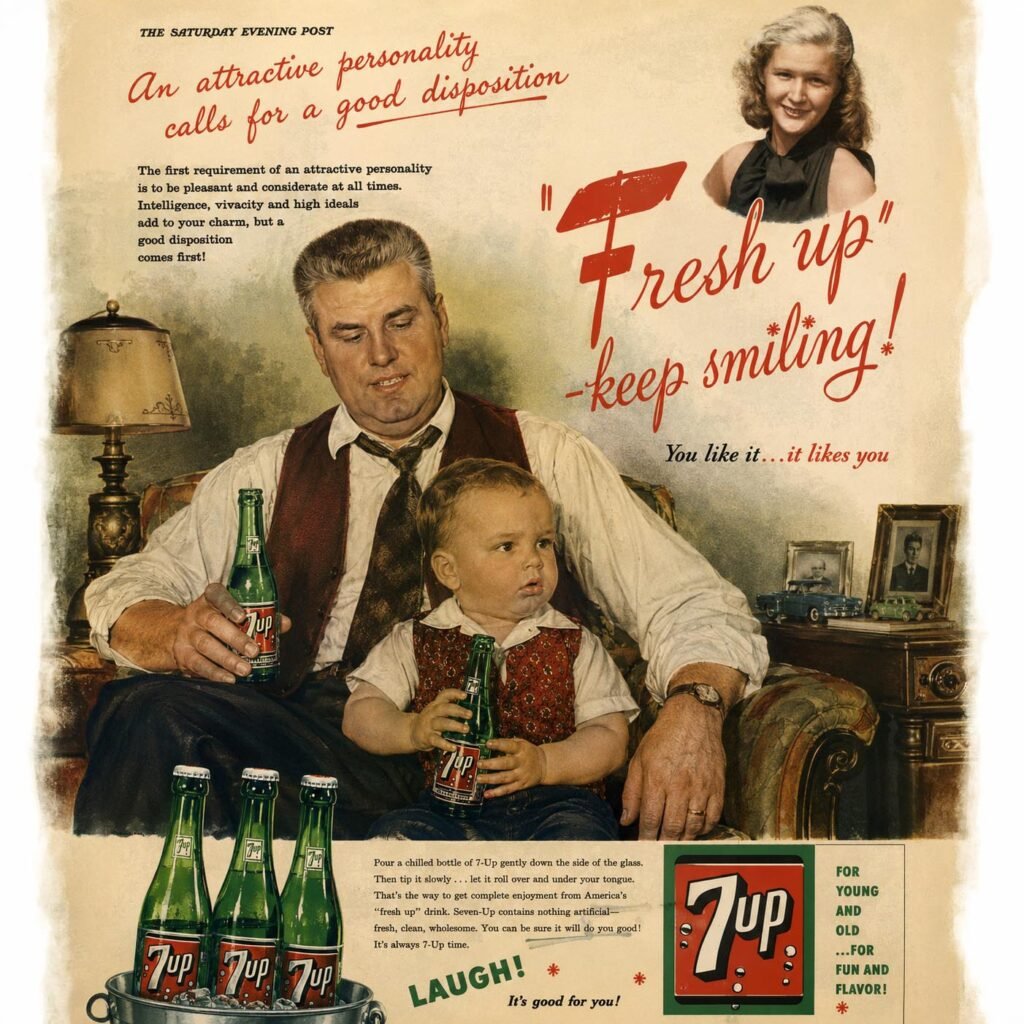
My father loved 7-Up. Not Coke. Not Pepsi. Always 7-Up.
And if you’re old enough—or peculiar enough—to read old advertising, you discover that 7-Up originally had a considerably longer and less refreshing name: Bib-Label Lithiated Lemon-Lime Soda. The drink actually contained lithium citrate until the late 1940s, when regulators decided Americans probably shouldn’t receive psychiatric compounds alongside hot dogs and potato chips. Modern 7-Up contains no lithium whatsoever, though I suspect my father never entirely forgave them for taking it out.
The irony would have delighted him.
The man who couldn’t tolerate prescription lithium had unknowingly spent years self-medicating with the soft-drink version.
Now before anybody races to the Beaver Super and wipes out the soda aisle, let me say plainly: this is not medical advice. I’m not a physician. I’m a newspaper publisher who still occasionally eats chili dogs after nine o’clock despite mounting evidence this is a tactical mistake.
Low-dose lithium orotate helped me. That’s all I can honestly say. What helps one person may do absolutely nothing for another besides lighten his wallet.
But it did give me back a degree of peace I didn’t realize I’d lost. More importantly, it helped me stop seeing my father merely as a difficult man and start seeing him as somebody who spent most of his life fighting an invisible war with defective equipment.
And Beaver County has always produced men like that.
The entrepreneur who can electrify a banquet room and then spend three days unable to leave the house. The salesman everybody envies without realizing he’s hanging on to his composure the way a man hangs on to a guardrail during an ice storm. The business owner who keeps the whole operation afloat while privately wondering why getting through a Tuesday afternoon feels like pushing a blast furnace uphill.
Back then nobody talked much about brain chemistry unless they were discussing St. Joe Lead. A troubled man was told to toughen up, say a prayer, have another drink, or keep his mind occupied. Suffering silently was practically considered a skilled trade around here.
Which is why I keep thinking about my father every time I open that little bottle of supplements. Not because I imagine I’ve discovered a miracle cure. America already has enough traveling salesmen peddling miracles. But because I can’t help wondering what might have happened if somebody had told him, early enough, that the storm inside his head wasn’t entirely a moral failing.
Maybe nothing would have changed.
Or maybe he’d have had a few more mornings when the fog lifted instead of settling in. A little more quiet. A little more peace.
And in the end, that may be all most of us are after anyway: the ability to sit quietly inside our own minds for a little while without feeling the roof cave in.