Listen to a podcast discussion about this article.
In Beaver County, where folks once considered “mental health treatment” to mean fixing the porch roof, walking the dog, or hollering at the Steelers on television, the medicine cabinet has grown suspiciously crowded. One in five Americans now takes antidepressants the way earlier generations carried house keys. One in three women over sixty could stock a reasonably efficient Rite Aid from the contents of her purse alone.
And the psychiatrist lately explaining all this with unnerving calm—Dr. Josef Witt-Doering—sounds like the last man in America who hasn’t yet confused the television with reality.
Dr. Josef (I practiced pronouncing his surname the way a nervous Presbyterian rehearses ordering espresso in an airport café) recently sat down on The Daily Wire with Michael Knowles and committed the sort of modern heresy that tends to get a man quietly uninvited from pharmaceutical conferences.
For forty years we’ve been sold a soothing little bedtime story: depression is caused by a chemical imbalance, easily corrected with selective serotonin reuptake inhibitors. Top off the happy fluid, tighten a few mental screws, and return the citizen to productive participation in the economy.
Then came Prozac in 1987. Eli Lilly struck oil. Television filled with gloomy cartoon blobs who swallowed one capsule and suddenly felt ready to reorganize the garage and reconnect with their inner child. America, being America, swallowed right along with them.
The science, unfortunately, turned out to be less cooperative than the marketing department.
Spinal taps, brain autopsies, gleaming MRI scans that look like weather radar over Kansas—none ever reliably uncovered the famous “low serotonin” defect that was supposed to separate the clinically depressed from ordinary people merely enduring a rotten season of life.
What the pills often seem to provide instead is emotional shrink-wrap. Less weeping, certainly. But also less laughter. Less passion. Less urgency. Less of whatever once made getting out of bed seem preferable to staying under the blanket until baseball season.
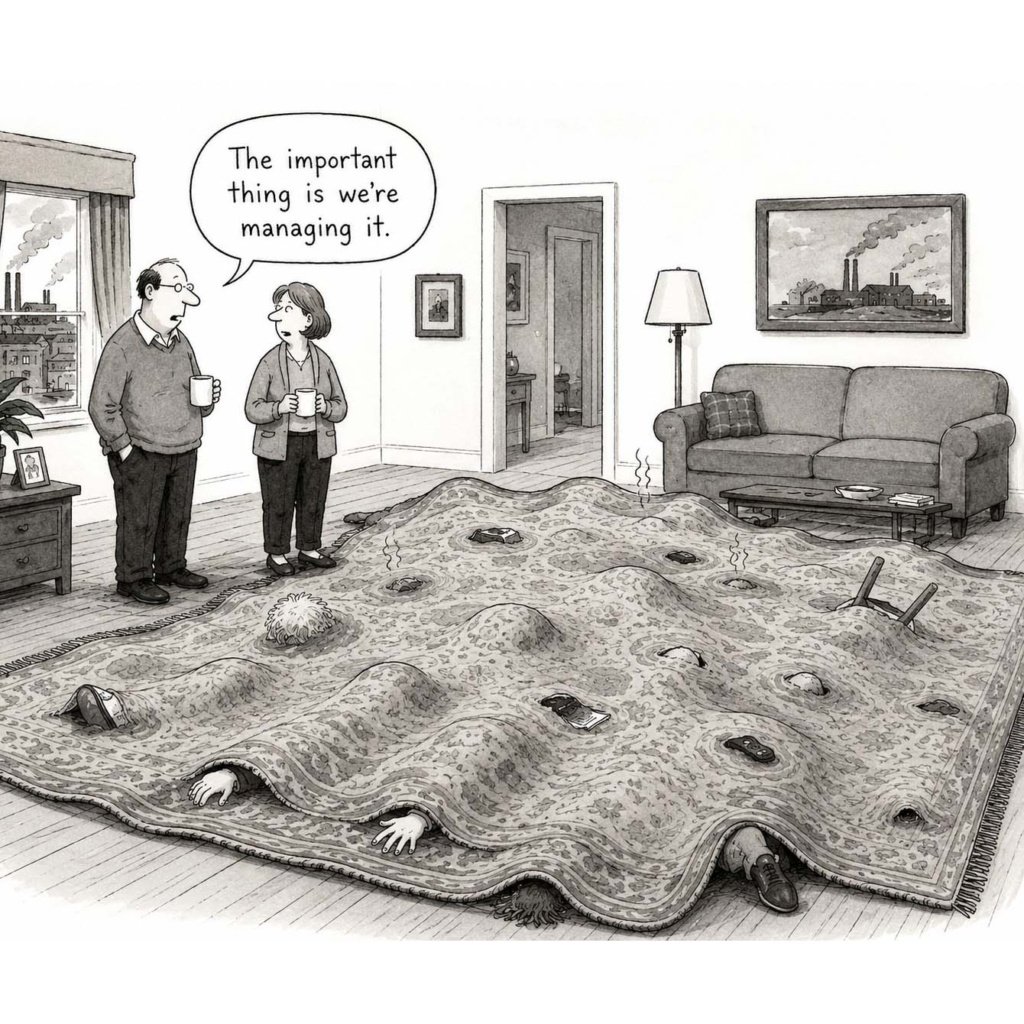
Grandma used to warn against sweeping problems under the rug. Modern psychiatry responded by manufacturing a rug roughly the size of Texas and billing Medicare for it.
You can see the results shuffling around every Walmart in America.
People remain in marriages colder than leftover pierogies. They stay in jobs that hollow them out like termite-eaten porch beams. They soften physically, spiritually, socially. The brain’s smoke detector gets politely unplugged, and everyone congratulates themselves on the reduction in noise.
Then, when the numbing effect eventually fades—as brains have a stubborn tendency to do—the doctor strokes his chin gravely and announces “treatment-resistant depression.” This naturally requires another medication. Perhaps an antipsychotic if the patient becomes inconveniently animated. Soon the diagnoses breed like rabbits in springtime.
Weight climbs. Libido vanishes. Energy disappears. Meanwhile the official warning labels quietly mention aggression, suicidal ideation, violence, especially among younger users, in the same tone hotel managers use to mention there may occasionally be bedbugs.
Courts, in some cases, have even found pharmaceutical companies partly liable in horrific acts of violence tied to these drugs. The media generally handles this subject the way families handle an embarrassing uncle at Thanksgiving: avoid eye contact and keep passing the mashed potatoes.
Any reasonably sober-minded reader in Beaver County might therefore ask the obvious question: Is it really wise for 15 or 20 percent of the country to drift through life chemically half-awake?
Dr. Josef’s answer was polite, clinical, and devastating.
In his estimation, about 95 percent of people taking these drugs probably should never have started them in the first place. Many were approved after trials lasting barely a year before being handed out for decades like after-dinner peppermints.
Withdrawal, he says, can be brutal. Some patients describe it as living with a lingering concussion. Sexual side effects reportedly affect upwards of 70 percent of users, and for some unlucky souls the damage appears permanent—a condition with the charmingly bureaucratic name “post-SSRI sexual dysfunction.”
Europe, Canada, and Australia now openly warn about it.
The FDA has reportedly been “reviewing the evidence” for six years, which in federal time is roughly equivalent to a medieval cathedral project.
One sometimes suspects the agency’s unofficial motto is: First, do no harm to quarterly earnings.
Now, none of this means suffering isn’t real. Life remains perfectly capable of flattening a person like a pothole on Route 65. Bad marriages, loneliness, purposeless work, old wounds, grief, financial fear—human beings come factory-equipped for sorrow.
Dr. Josef allows for temperament and genetics. What he rejects is the fashionable urge to classify every ordinary anguish as a permanent brain disease requiring patented intervention.
Loneliness depresses people. Bad relationships depress people. Spiritual emptiness depresses people. Living on fluorescent lighting, fast food, doomscrolling, and four hours of sleep depresses people.
This should not require a billion-dollar research grant to uncover.
Fixing those things, however, requires effort. Sunlight. Exercise. Better food. Honest conversations. Friendship. Maybe even church, which modern America now regards with the same suspicion earlier generations reserved for carnival barkers and used-car salesmen.
Instead, too many people receive twelve hurried minutes with an exhausted family doctor who reaches for the prescription pad the way a weary parent reaches for the television remote.
The “natural remedy” crowd fares only slightly better. Those cheerful little jars of ashwagandha and lion’s mane can hit the nervous system harder than advertised. High-potency cannabis increasingly sends vulnerable users ricocheting directly into psychiatric wards. Even excessive caffeine and nicotine pouches leave people vibrating like refrigerator compressors by suppertime.
We have become a nation of amateur chemists searching desperately for the correct combination of substances that will allow us to feel nothing uncomfortable ever again.
Then comes the larger cultural question, the one nobody discusses unless Thanksgiving has gone on too long.
A civilization obsessed with radical autonomy—transcending biology, dismantling tradition, severing itself from family, faith, and inherited obligations—has not produced especially cheerful citizens.
The data stubbornly show that marriage, children, church attendance, and stable community ties correlate rather strongly with happiness. Conservative women generally report lower rates of depression than liberal women. The old social guardrails, imperfect as they were, at least gave people a map.
Now the map has been burned, and Rite-Aid stands ready to medicate the confusion.
Dr. Josef also tiptoes into territory considered impolite in respectable company: the overlap among SSRIs, autism-spectrum diagnoses, and the explosion in transgender identification. Pregnant women taking these medications pass them directly to developing babies. Animal studies show neurological and developmental effects. Human imaging studies suggest lasting changes.
Correlation is not causation, the experts endlessly remind us, usually moments before cashing another grant check.
Still, when an entire society’s mental weather changes alongside mass pharmaceutical saturation, a reasonable person begins to wonder whether we’ve accidentally turned the country into the world’s largest uncontrolled chemistry experiment.
And Dr. Josef’s actual advice sounds almost offensively old-fashioned.
Exhaust sunlight, movement, nutrition, relationships, purpose, and faith before turning to medication. Use drugs sparingly, cautiously, and briefly if possible. Taper slowly if already dependent. Build community. Talk honestly. Join groups that demand accountability and humility.
He even speaks warmly of Alcoholics Anonymous, where people still commit the unfashionable act of admitting fault and surrendering to something larger than themselves.
Sometimes the supposedly backward rubes stumble closer to wisdom than the credentialed experts with laminated conference badges.
America’s body politic lies stretched on the couch these days, staring at the ceiling and waiting for another refill.
But perhaps the diagnosis was never low serotonin.
Perhaps it was loneliness. Meaninglessness. Isolation. A civilization that traded front porches, church pews, bowling leagues, backyard horseshoes, and the Lions Club for chemical upholstery and therapeutic jargon.
The rug, in any event, is getting awfully lumpy.
Sooner or later we may have to stand up, shake off the haze, and face our troubles the old-fashioned way: awake.