Listen to a podcast discussion about this article.
Americans have a weakness for technological fairy tales.
We like to imagine every great economic revolution beginning with a brilliant young man in a black turtleneck staring thoughtfully into the middle distance while contemplating the future of humanity. At some point venture capitalists arrive. TED Talks are given. Fortunes are made. Somebody ends up on the cover of a magazine.
What we tend to forget is that sooner or later somebody also has to pull the wire.
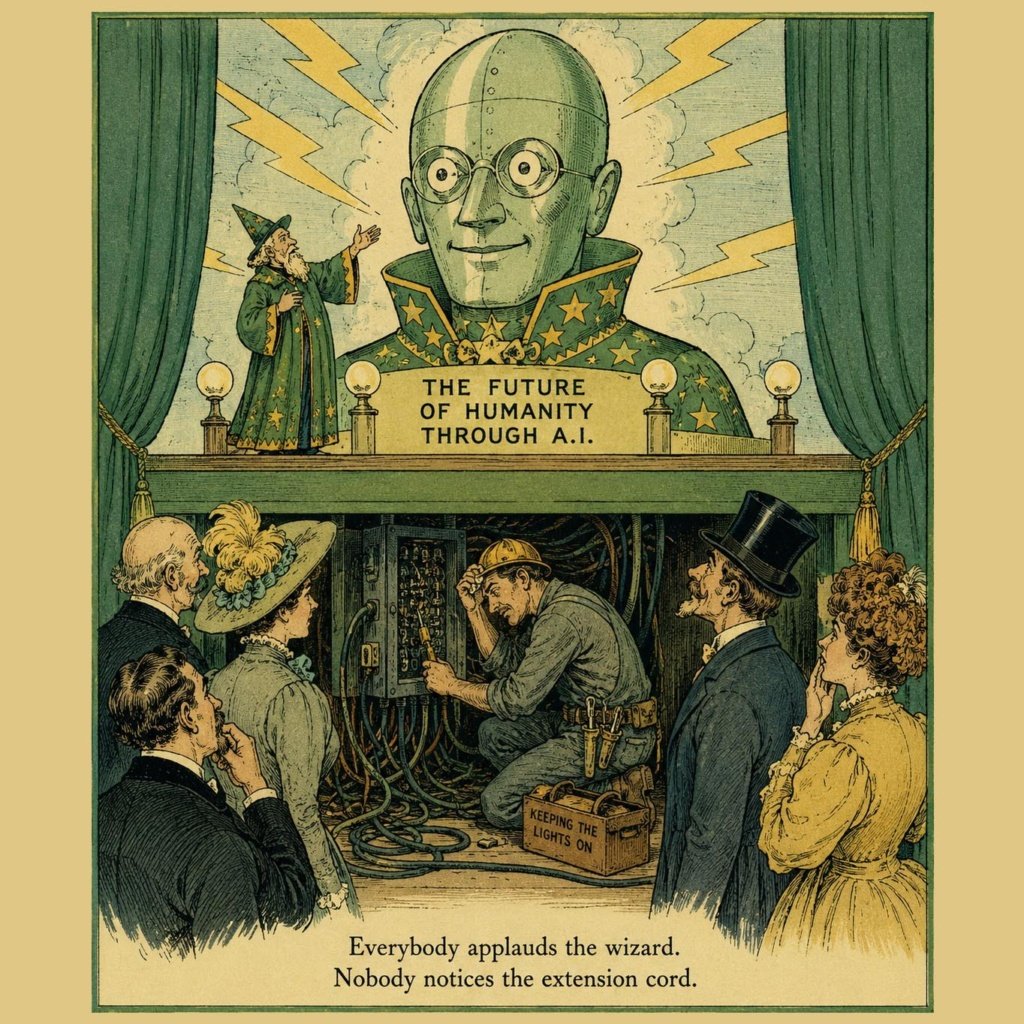
The Industrial Revolution wasn’t built by visionaries. Visionaries supplied the speeches. The revolution itself was built by machinists, welders, pipefitters, electricians, and an army of people willing to get out of bed before sunrise and spend the day wrestling with machinery that occasionally tried to kill them.
The AI revolution, for all its glamour and mystery, appears destined to follow the same pattern.
Lately we’ve heard a great deal about Beaver County’s emergence as an artificial intelligence hub. The numbers being tossed around are large enough to make an ordinary taxpayer reach for smelling salts. There’s the proposed $10 billion Project Phoenix data center campus at Shippingport. There’s the planned 3.6 gigawatts of power capacity. There are billions more in infrastructure, energy, and technology investments.
These are impressive figures.
They also have a way of distracting us from a simple reality.
Data centers don’t build themselves.
Artificial intelligence may run on sophisticated semiconductors, but semiconductors sit inside buildings. Buildings need electricity. Electricity needs wiring. Wiring needs electricians. Cooling systems need HVAC technicians. Networks need fiber-optic specialists. Cybersecurity requires trained professionals. And every piece of that infrastructure eventually requires somebody to show up on a rainy Sunday afternoon when a machine costing several million dollars decides it no longer wishes to cooperate.
That somebody will not be ChatGPT.
This is where things begin to get interesting.
For years, communities across America have pursued economic-development projects with the enthusiasm of nineteenth-century prospectors chasing rumors of gold. We admired the artist renderings. We attended the ribbon cuttings. We counted the investment dollars.
What we didn’t always count were the people.
Today, workforce shortages have become one of the biggest obstacles facing the data-center industry. In survey after survey, operators say the same thing: they can find the capital. They can find the customers. What they can’t always find are enough electricians, technicians, network specialists, controls experts, and operators.
In other words, the shortage isn’t money.
The shortage is human beings.
Which brings us to Midland.
For most of its history, Midland was known as a steel town. It made things. Real things. Heavy things. Things that occasionally required cranes.
Now it has an opportunity to manufacture something entirely different.
Skills.
Not a bad business, when you think about it.
Unlike steel, skills don’t rust. They don’t need warehouses. And they tend to appreciate in value over time.
Located only minutes from Shippingport, the Midland Innovation + Technology Center sits in a position most communities would envy. If Project Phoenix becomes what its developers envision, Midland will find itself standing at the front door of one of the largest AI infrastructure projects in the northeastern United States.
The opportunity isn’t merely to train workers.
It’s to become the place where the workforce itself is created.