Listen to a podcast discussion about this article.
“There are two ways of getting home, and one of them is to stay there. The other is to walk round the whole world till we come back to the same place.”
— G.K. Chesterton, The Everlasting Man
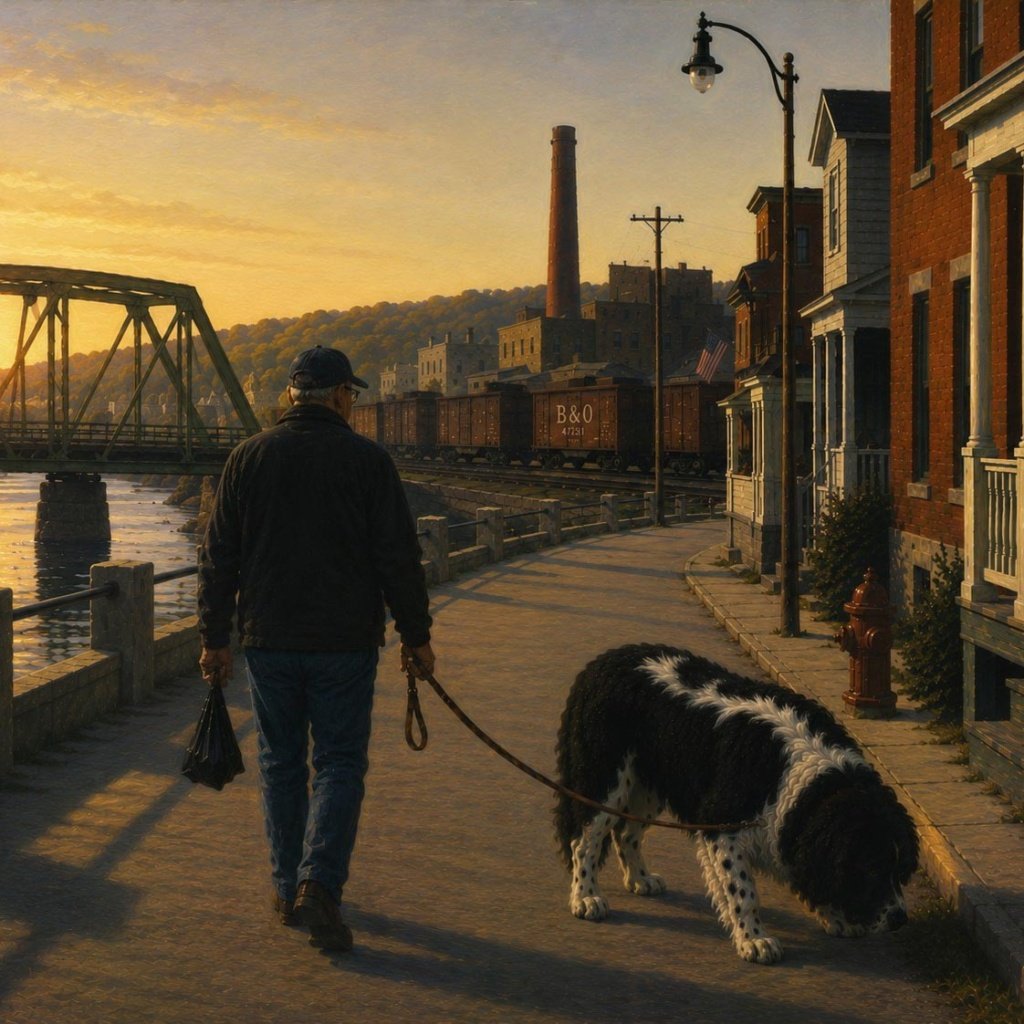
There comes a time in every man’s life when he discovers he no longer takes the dog for a walk. The dog takes him.
In my case, the dog is Seamus, a Newfoundland weighing somewhere between 140 pounds and a modest grand piano. When he decides the morning has begun, I am invited to accompany him. The leash is included chiefly for legal purposes.
So, on Sunday mornings, while sensible people are lingering over coffee or wondering whether the sermon will run longer than the Steelers’ offensive drives, Seamus and I set out through Bridgewater. He proceeds with the calm confidence of a creature who has never doubted that the world was put here largely for his inspection. I follow behind, carrying the little plastic bags that remind a man how democracy really works. No matter your station in life, sooner or later everybody cleans up after somebody.
Bridgewater is a fine town for walking because it never tries very hard to impress you. It simply waits. The river lies quietly beneath the bridges. Freight trains idle as though considering whether another century of commerce is really worth the effort. Front porches are occupied by people who somehow know everything happening in town while giving the appearance of knowing nothing at all.
Chesterton wrote that there are two ways of getting home. One is never to leave. The other is to walk around the whole world until you arrive back where you started.
Most of us imagine we’re doing the second. In truth, Seamus and I only make it around a few blocks. To a Newfoundland, however, every shrub deserves an inspection worthy of a federal investigation. Every fire hydrant appears to contain confidential intelligence left by previous administrations. We stop often enough that I sometimes wonder whether we’re walking through Bridgewater or conducting a census.
The remarkable thing is that the same streets never seem entirely the same.
A patch of sunlight finds the river differently. A neighbor offers the brief Beaver County wave—not enough to interrupt your morning, but enough to remind you that you’re recognized. Somebody has planted flowers where there weren’t flowers last week. Somebody else has forgotten to mow again. Civilization, I’ve concluded, advances and retreats one lawn at a time.
Age has a way of making these discoveries seem larger than they once did. When you’re young, you believe happiness lives somewhere else—in another town, another job, another house, another chapter. Then one morning you find yourself standing at the corner while a very large dog contemplates a mailbox with deep philosophical interest, and it occurs to you that perhaps this has been the destination all along.
We pass railroad tracks that once carried steel, coal, and enough ambition to build half the country. Today they mostly carry long trains and older memories. History settles gently here. It doesn’t announce itself. It simply waits for someone walking a dog to notice.
Eventually Seamus decides we’ve seen enough of civilization for one morning and turns toward home. It is one of the few decisions on which we agree immediately.
When my apartment at Bridgewater Crossings comes into view, it looks somehow more welcoming than it did an hour before. Nothing has changed except the traveler. Chesterton understood that. Sometimes you have to leave a place—if only for forty-five minutes and three hundred interesting smells—to see it clearly again.
Perhaps that’s why Sunday morning walks matter.
They don’t take us very far geographically. They simply return us to the ordinary with fresh eyes. That turns out to be farther than most journeys manage.
And if I happen to arrive home with sore shoulders from steering 140 pounds of determined Newfoundland, well, wisdom has always exacted a price.