Listen to a podcast discussion about this article.
There was a time—not all that long ago, although it now feels like the Jurassic Period—when reporters actually left the newsroom.
They got dirt on their shoes.
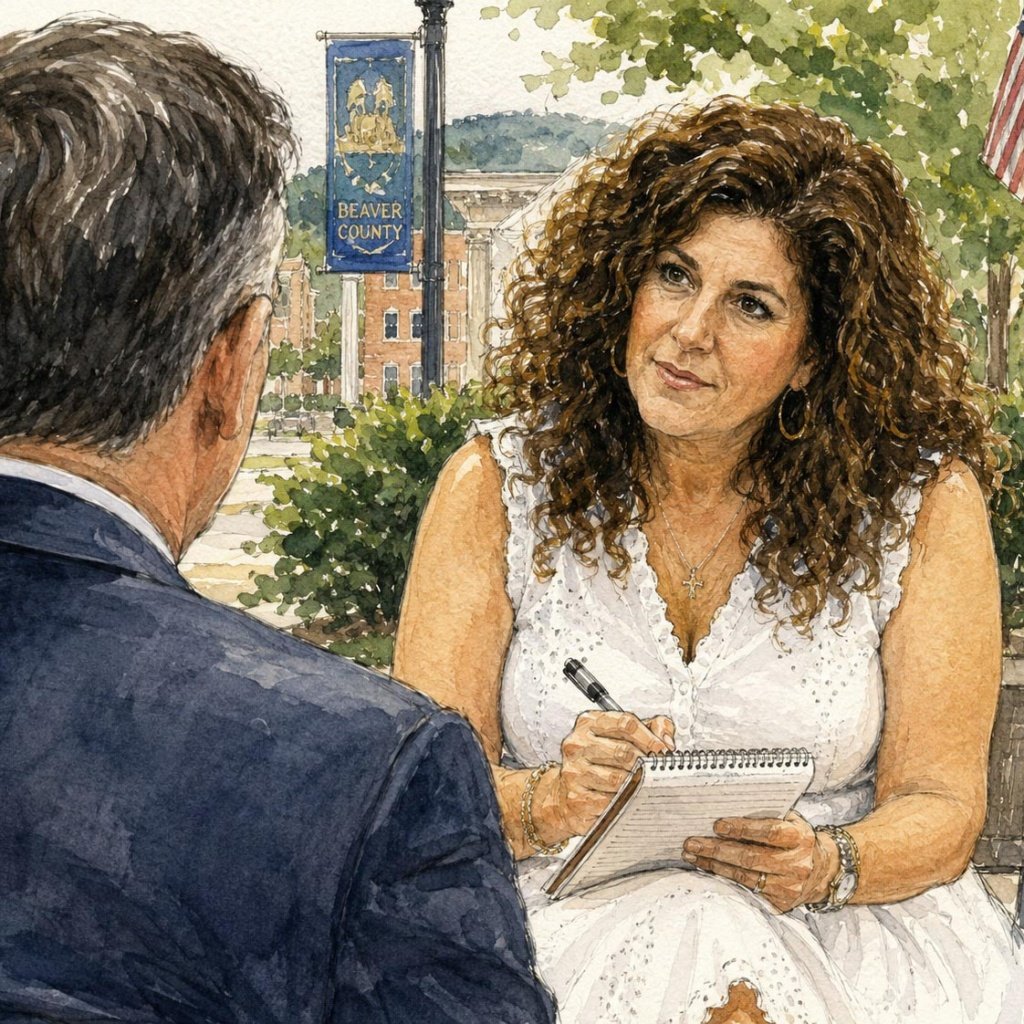
They drank bad coffee in volunteer fire halls. They stood in VFW parking lots talking to people who had grease under their fingernails instead of opinions downloaded from social media. They knew the mayor’s first name, the dogcatcher’s nickname, and which waitress served the strongest coffee in town.
Then journalism discovered Twitter.
The profession largely abandoned Main Street for the Beltway, replacing conversations with polling data and replacing curiosity with certainty. Reporters became experts without ever leaving Washington.
Which is one reason Salena Zito stands out.
Whether you agree with every conclusion she reaches is almost beside the point. The important thing is how she gets there.
She goes.
That sounds almost embarrassingly simple. Yet in modern journalism it has become almost revolutionary.
While cable television debates America from climate-controlled studios, Salena drives America. She has built a career on what used to be called shoe-leather reporting—logging hundreds of thousands of miles on back roads, stopping in diners, county fairs, VFW halls, union picnics, church suppers, manufacturing plants, Little League games, and places that rarely appear on the itinerary of national reporters. (Hachette Book Group)
She listens.
That may be the rarest journalistic skill of all.
The temptation in our profession is to arrive with a theory and collect quotes that support it. Salena seems to begin with questions instead.
That makes her writing interesting even when it challenges your assumptions.
She understands something many national journalists forgot somewhere between Manhattan and Georgetown: America is not an argument. It is a place.
And places matter.
Western Pennsylvania has always produced reporters with a certain temperament. We are naturally suspicious of fashionable wisdom. We have spent enough time around mills, mines, railroads, farms, machine shops and family businesses to recognize the difference between someone who has studied ordinary people and someone who actually knows them.
Salena belongs to that tradition.
She writes about politics, certainly. But beneath the politics she is really writing about culture—how families live, why communities endure, what working people worry about, and why voters so often surprise professional pundits.
Her reporting reminds me that journalism is not supposed to be performance art.
It is field work.
Some reporters collect followers.
Others collect stories.
The latter generally age better.
One reason I admire Salena’s work is that she has resisted the gravitational pull of ideological journalism. Every newsroom today is under pressure to become a cheering section for one tribe or another. That makes reporting much easier. It also makes it much less useful.
Real reporting requires the willingness to discover something you did not expect to find.
That takes humility.
Humility is not exactly the hottest growth industry in American media.
Local journalism has suffered from the opposite problem. We have lost thousands of community newspapers over the past two decades. The disappearance of those papers has left enormous blind spots across America. There are fewer reporters sitting through township meetings, fewer people asking uncomfortable questions, fewer eyes watching local government.
When local journalism disappears, communities become quieter—but not necessarily healthier.
That is why journalists like Salena deserve appreciation. She demonstrates that reporting still matters when it is done the old-fashioned way.
Get in the car.
Drive somewhere.
Meet someone unlike yourself.
Ask questions.
Listen longer than you talk.
Write what you found—not what you expected.
Imagine that.
Readers who would like to sample her work have several excellent options. She is a national political reporter and columnist for the Washington Examiner, where many of her feature stories and columns appear. Her nationally syndicated columns are also distributed through Creators Syndicate. She has contributed to the The Washington Post and is the author of several books, including Butler: The Untold Story of the Near Assassination of Donald Trump and the Fight for America’s Heartland, which became a bestseller. (Hachette Book Group)
Whether your politics lean left, right, or somewhere in that mysterious territory inhabited by people who simply want the potholes filled, you’ll find something refreshing in her work.
It reminds us that journalism, at its best, is not about winning arguments.
It is about understanding neighbors.
That’s a lesson worth remembering in Beaver County.
And, for that matter, everywhere else.