Listen to a podcast discussion about this article.
There are towns that trumpet their history with banners, plaques, and the occasional man in a tricorne hat pointing vaguely toward destiny. And then there are towns like Beaver, which possess history of genuine national consequence and have, for reasons known only to modesty and municipal inertia, treated it more like a family secret.
“A Revolutionary War fort once stood in Beaver,” said Beaver Area Heritage Museum board chair Mark Miner. “What we’ve done really well over the years is to keep it a secret—and fail to adequately interpret it for the young families and children who are our future.”
The fort in question—Fort McIntosh—was not a decorative outpost where soldiers passed the time carving initials into fence posts. For one brief, remarkable stretch, it was the center of the American military universe.
From December 1784 to November 1785, Miner noted, the troops stationed here comprised—aside from small detachments at Fort Pitt and West Point—the entire United States Army.
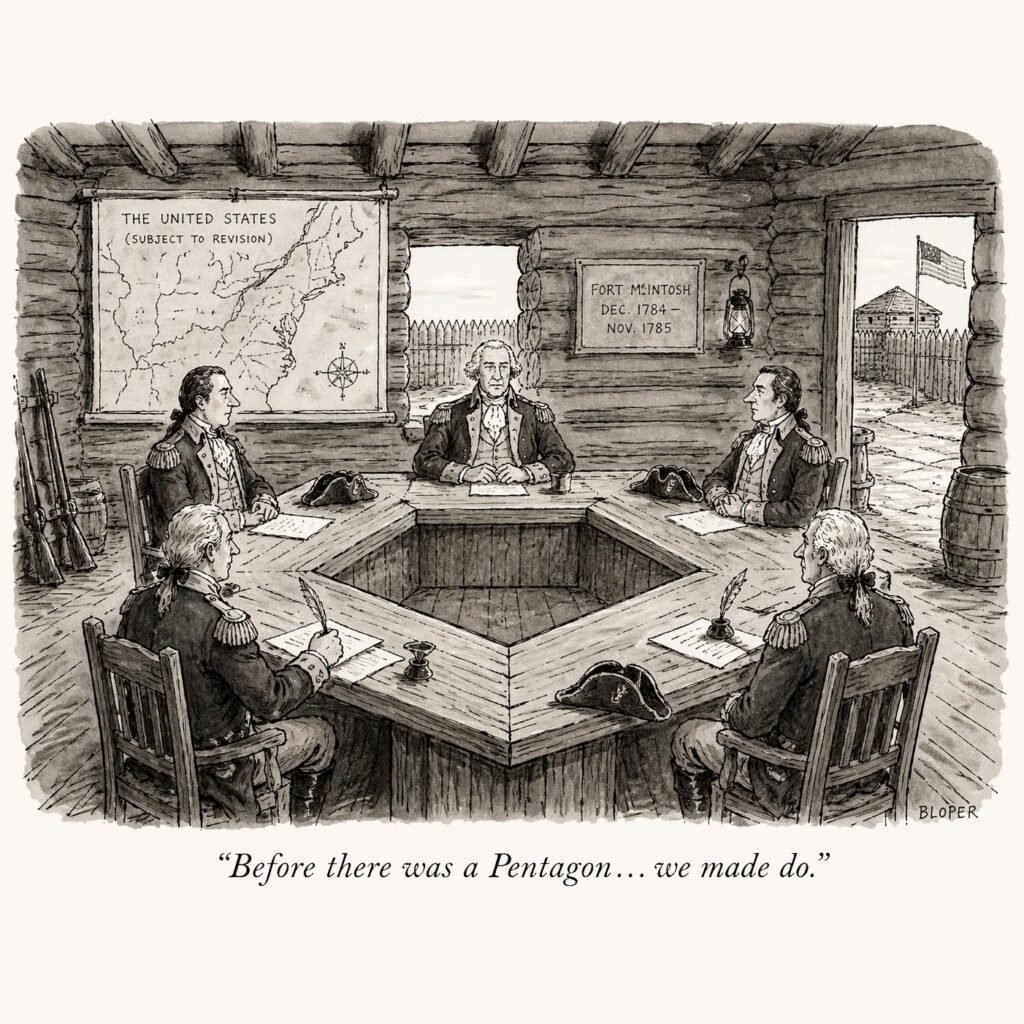
On New Year’s Day, 1785, that meant 141 enlisted men, 20 sergeants, a handful of drums and fifes, and 12 officers and staff. That was it. The whole thing. If you’d misplaced the Army that winter, the sensible place to check would’ve been Beaver.
“This was the birthplace of the first standing U.S. Army in peacetime,” Miner said, describing how Lt. Col. Josiah Harmar organized the force as the “First American Regiment”—a lineage that today leads, with a certain ceremonial dignity, to the Presidential Honor Guard.
It is not every borough that can claim to have once hosted the entire U.S. military establishment. Beaver can. It simply hasn’t made a habit of mentioning it.
The new exhibit at the Beaver Area Heritage Museum—“Fort McIntosh: Its People and Archaeology”—sets out to correct that oversight, and does so with a refreshing emphasis on the people who lived, argued, and occasionally nearly dueled there.
“What’s emerged is that the fort was important nationally,” Miner said. “Using archaeological artifacts, we’re delving into what a common soldier’s experience was like. We’re also discovering how the personalities and clashes among the leaders shaped its legacy.”
Those personalities were not, by any stretch, dull.
The fort’s namesake, Gen. Lachlan McIntosh, arrived on the frontier with a past that included killing Declaration signer Button Gwinnett in a duel—an item that would have complicated most résumés. George Washington, however, found McIntosh sufficiently impressive to send him west to command the Army’s Western Department.
From Beaver, McIntosh set about building a chain of forts intended to counter British influence in Detroit, beginning with Fort McIntosh itself, designed by French engineer Jean Louis Baptiste de Cambray-Digny. It was an ambitious plan, and like many ambitious plans, it encountered reality.
To construct the second fort in the chain, McIntosh launched an expedition into the Ohio wilderness late in the season—November, which is not widely regarded as prime campaign weather. The result was Fort Laurens, where soldiers endured starvation conditions so severe they boiled leather for sustenance. When McIntosh returned months later with relief, he found the fort abandoned.
Such episodes did little to improve his standing among colleagues. Disputes over supplies, timing, and strategy produced grievances, near-duels, and the kind of professional resentment that would be familiar to anyone who has ever attended a contentious staff meeting—albeit one with fewer muskets.
Geography added another complication. The Beaver side of the Ohio River was not, at the time, American territory but land controlled by Native nations, notably the Lenape. Fort McIntosh thus stood just beyond a boundary line that was, depending on your perspective, either strategic or provocative.
From this uneasy footing came one of the most consequential agreements of the early republic: the Treaty of Fort McIntosh. Signed by representatives of the Lenape, Wyandot, Ottawa, and Chippewa, along with American commissioners including George Rogers Clark, it cleared the way for federal land ordinances that opened the Ohio Country to survey and settlement.
It was, in other words, a starting gun for westward expansion—tidy in its language, complicated in its consequences.
The exhibit does not shy away from those complications. It explores the lives of 19 figures connected to the fort, from George Washington and Thomas Jefferson to Native leaders such as White Eyes and Captain Pipe. White Eyes, a Lenape leader who sought cooperation with the Americans, was later killed under circumstances that remain contested—an episode that lingers as a reminder that the past rarely conforms to the cleaner versions we prefer.
“I personally like that these individuals were human,” Miner said. “They exhibited some of the same personality traits as we see today.”
Which is a polite way of saying they argued, misjudged, overreached, and occasionally made a mess of things—just like the rest of us.
For all that history, much of the physical evidence has spent the last half-century sitting quietly in boxes. Artifacts uncovered in archaeological digs in the 1970s are only now being fully catalogued and interpreted, with plans underway to create a dedicated Fort McIntosh room at the museum.
There are broader ambitions as well: improving the visibility of the actual fort site, pursuing formal recognition from institutions such as the Pentagon or West Point, and—perhaps most practically—installing signage along Interstate 376 so travelers might know they are passing a place of genuine national significance.
“Where do we go from here?” Miner asked, before answering his own question with a list that sounded less like nostalgia and more like a plan.
It is, at heart, an effort to do something Beaver has long postponed: to tell its own story clearly, and perhaps even a little proudly.
After all, not every town can say it once housed the entire United States Army.
Beaver can.
It just hasn’t been in the habit of mentioning it—until now.